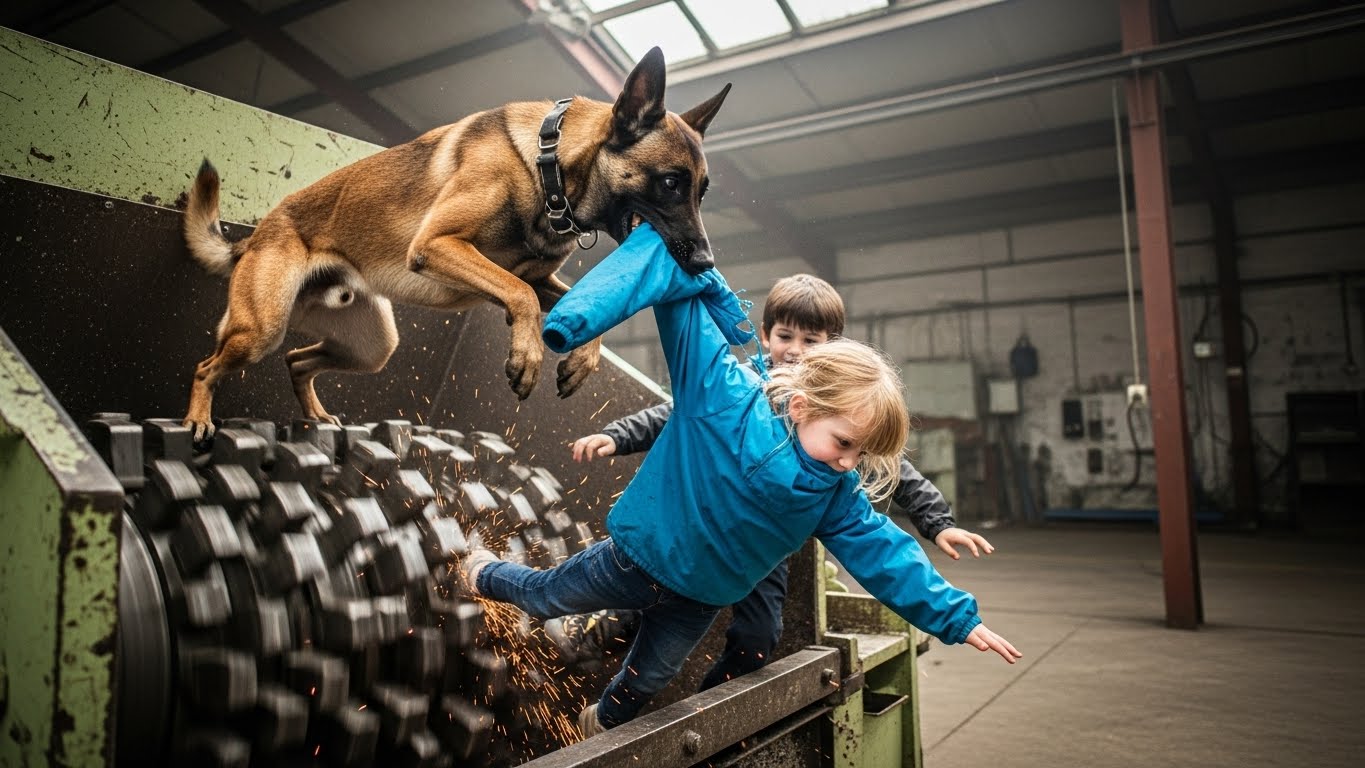
The manifest listed the crate as counterfeit ceramics to be destroyed, but my K9 partner just threw himself into the industrial crusher to stop it… And then I heard the whimpering.
The rain at the Port of Tacoma doesn’t wash things clean; it just makes the grime slicker. It was 2:00 AM on a Tuesday, the kind of graveyard shift that feels less like law enforcement and more like industrial waste management. My name is Officer Elias Thorne, and for the last six years, my partner has been a seventy-five-pound Belgian Malinois named Kaiser.
We were working the “Burn and Turn” detail. That’s slang for the destruction of seized counterfeit goods. It’s the unglamorous end of Customs and Border Protection. We catch the stuff, the legal team signs off on it, and then we watch it get fed into a massive industrial shredder or a hydraulic crusher depending on the material. Tonight, it was a mixed load: fake designer handbags, bootleg electronics, and a pallet marked “Fragile: Antique Vases – Replica/Counterfeit.”
The manifest claimed the vases were cheap plaster knockoffs of Ming dynasty pottery, seized due to lead paint regulations and copyright infringement. They were slated for the crusher.
“Come on, Thorne, let’s move it,” yelled Henderson, the yard foreman. He was sitting in the elevated cab of the claw crane, a cigar unlit in his mouth. “I got a union break coming up in twenty minutes and three pallets to clear.”
“Hold your horses, Henderson,” I muttered, tugging my collar up against the freezing drizzle. Kaiser was at my heel, but he was acting off. Usually, around the machinery, he’s distinctively calm—a statue of disciplined muscle. But tonight, he was pacing. His ears were swiveling like radar dishes, and a low, vibrating whine was emanating from his throat.
“What is it, boy?” I whispered, resting a hand on his wet fur. He didn’t look at me. His amber eyes were locked on the conveyor belt.
The belt was a loud, rattling beast of rubber and steel that fed objects into the ‘Maw’—a hydraulic crushing chamber designed to pulverize rock, let alone plaster vases. The noise was deafening: the groan of hydraulics, the screech of metal, and the relentless hum of the generator.
Henderson dropped the pallet of “vases” onto the loading ramp. The crate was wood, roughly four feet by four feet, stamped with red Chinese characters and the English words FRAGILE and CERAMICS.
Kaiser went rigid. The hair along his spine stood up in a jagged ridge.
“Scan complete,” I called out, half-heartedly waving the wand over the box. The density scanner had cleared it earlier that week, but protocol demanded a visual check. I walked toward it to cut the straps.
“Clear!” Henderson shouted, his hand hovering over the ‘engage’ button for the belt.
I reached for the crate. Suddenly, Kaiser broke his “Heel” command. He didn’t just break it; he exploded.
He lunged forward, snapping the leash taut so hard it burned my glove, nearly dislocating my shoulder. He wasn’t attacking me; he was trying to get to the box. He slammed his front paws against the wood, barking—not his alert bark, but his distress bark. High-pitched, frantic, piercing.
“Kaiser! Aus! Down!” I shouted, trying to regain control.
He ignored me. That never happens. He began tearing at the wood with his teeth, splinters flying.
“Get your dog under control, Thorne!” Henderson yelled over the comms. “I’m starting the belt!”
“Wait! Henderson, hold on!” I waved my arms.
But Henderson was already looking down at his clipboard, and the belt lurched forward. The crate, with Kaiser still scratching at it, began to move toward the crusher. The Maw was ten feet away, its steel teeth rotating slowly, hungry for the load.
Kaiser didn’t retreat. He jumped onto the moving belt.
Panic, cold and sharp, spiked in my chest. “NO! KAISER, OFF!”
The dog stood his ground between the crusher and the crate, bracing his legs against the rubber belt, pushing his chest against the heavy wooden box as if he could physically stop the tons of torque driving it forward. He looked back at me, his eyes wide with a terror I had never seen in an animal before.
I didn’t think. I sprinted.
I vaulted the safety rail, landing hard on the slick concrete, and scrambled toward the emergency shut-off panel on the side of the machine. The belt was moving fast. The crate was five feet from the teeth. Kaiser was slipping, his claws scrabbling on the wet rubber.
I slammed my fist into the red mushroom button.
CLUNK.
The hydraulics hissed. The belt groaned and shuddered to a halt. The silence that followed was heavy, broken only by the rain and my own ragged breathing. The crate was teetering on the lip of the crusher. Kaiser was panting, licking the side of the box.
“Are you crazy?” Henderson screamed, climbing down from his cab. “You can’t just kill the line like that! Do you know the paperwork involved in an emergency stop?”
I ignored him. I climbed up onto the belt, my boots slipping. “Kaiser, here. Now.”
The dog wouldn’t move. He nudged the box with his nose, then looked at me and whined again.
I pulled out my serrated knife. “If there are drugs in here, Henderson, you’re going to wish you kept your mouth shut,” I said, my voice trembling with adrenaline.
I jammed the knife under the lid of the crate. The wood groaned. I pried it up. One nail popped. Then another. I ripped the top plank off.
Inside, there were no vases. There were no drugs.
Packed tight in Styrofoam peanuts and dirty straw, there was a small cage. And inside the cage, huddled together, were three creatures.
At first, my brain couldn’t process what I was seeing. They looked like small, furless monkeys. But as the rain hit them, one of them turned its head. It wasn’t a monkey.
It was a child.
A human child.
I dropped the knife. It clattered onto the metal belt.
The sound that came out of the box wasn’t the sound of ceramics breaking. It was a terrifying, low moan of a child too weak to cry. There were three of them, curled into a ball for warmth, malnourished, their skin grey in the harsh floodlights. They couldn’t have been more than five years old.
“Oh my god,” Henderson whispered. He had climbed up behind me. The cigar fell from his mouth.
I ripped the rest of the wood away, my hands shaking so bad I could barely grip the planks. Kaiser was right there, licking the face of the child closest to the edge. The child didn’t recoil; he leaned into the dog’s warmth.
“Radio dispatch,” I choked out, tears mixing with the rain on my face. “Get EMS. Get the port commander. Get everyone.”
We got them out. They were severely dehydrated, drugged to stay quiet, and suffering from hypothermia, but they were alive. The manifest had been swapped. The ‘Vases’ were a cover for a high-end trafficking ring moving ‘product’ through the waste disposal channels to avoid the standard exit checks. They assumed no one checked the garbage.
They didn’t account for Kaiser.
Later that night, after the ambulances had left and the crime scene tape was fluttering in the wind, I sat in the back of the ambulance with a thermal blanket around my shoulders. Kaiser was sitting at my feet, chewing on a treat the EMTs had given him.
The Port Commander walked over, looking pale. “Thorne,” he said. “The density scanner… the logs show it was tampered with. It was looped. If you hadn’t stopped that belt…”
He didn’t finish the sentence. He didn’t have to.
I looked down at Kaiser. He wasn’t just a dog. He was the only thing standing between three innocent souls and the machinery of death. He rested his head on my knee and let out a long, contented sigh.
The manifest said ‘Antique Vases.’ I will never trust a piece of paper again. But I will trust this dog with my life, and the lives of anyone else, until the day I die.