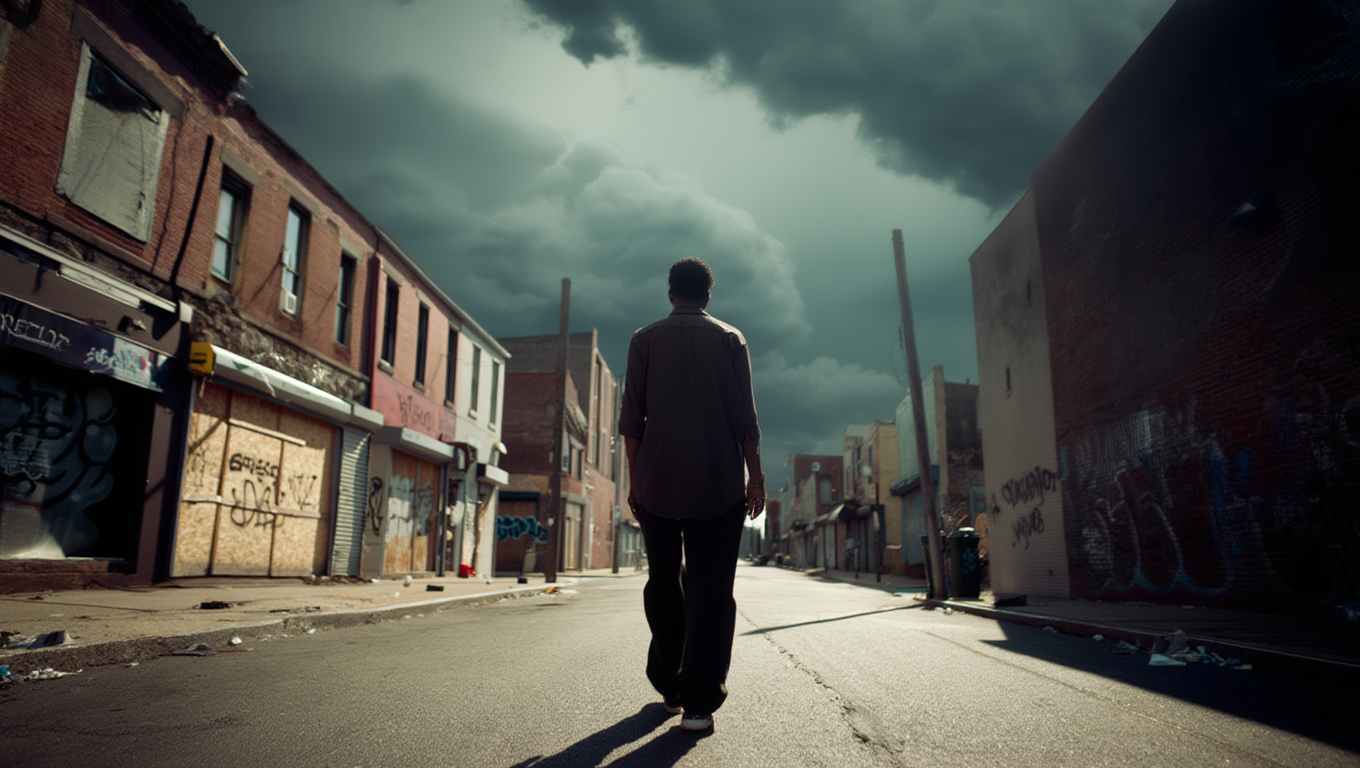
I walked through Kensington’s most dangerous street at noon… What I witnessed made me question everything I thought I knew about America.
The El train rumbled overhead as I stepped onto the cracked sidewalk of Kensington Avenue, and immediately, I knew I’d entered a different world. This wasn’t the Philadelphia you see in tourism brochures or Revolutionary War documentaries. This was the Philadelphia that America tries to forget exists.
The sunlight cut through the elevated tracks above, creating prison-bar shadows across the concrete. But it wasn’t the shadows that stopped me in my tracks—it was the people. Dozens of them, scattered along the sidewalk like discarded mannequins, frozen in what locals call the “Kensington lean.” Bodies bent at angles that seemed to defy physics, suspended between standing and falling, trapped in a moment that could last seconds or hours.
I’d come here as a documentary photographer, armed with my camera and what I thought was an understanding of addiction. I’d read the articles, seen the statistics, watched the news reports about the opioid crisis ravaging American cities. But statistics don’t prepare you for the smell—a mixture of urine, exhaust fumes, and something sweeter, more chemical. Numbers don’t capture the sound of someone’s forehead hitting a metal pole as they nod off mid-stride.
A woman in her twenties, maybe thirties—it was impossible to tell—stood frozen near a rusted pillar. Her body tilted at a forty-five-degree angle, one arm extended as if reaching for something only she could see. Her hair hung down like a curtain, shielding her face from the world. I wondered who she’d been before this. A student? A mother? Someone’s daughter, certainly. Someone who’d had dreams that didn’t include leaning against a pole on Kensington Avenue while strangers walked past without looking.
The ground beneath the tracks was a museum of modern despair. Bright orange syringe caps scattered like fallen petals. Empty miniature Ziploc bags—the kind that once held drugs now coursing through veins up and down this street. A single pink sneaker, no larger than a child’s size, lay abandoned near a pile of soaked blankets. I tried not to think about that sneaker too hard.
An older man shuffled past me, his shopping cart piled high with recyclables and what looked like someone’s entire life packed into plastic bags. He didn’t acknowledge the people frozen in their pharmaceutical stupor. This was Tuesday for him. Just Tuesday in Kensington.
I raised my camera, then lowered it. Then raised it again. The journalist in me knew these images could tell a story that needed telling. The human in me felt like a voyeur, capitalizing on suffering. But if people didn’t see this, would anything change? If we kept looking away, would these streets ever heal?
A police cruiser rolled slowly down the avenue, the officers inside barely glancing at the scene. They’d seen it all before—hundreds, maybe thousands of times. What could they do? Arrest everyone? Where would they put them? The jails were full. The rehab centers had waiting lists months long. So the cruiser kept rolling, and the people kept leaning, and the city kept pretending this wasn’t happening in the shadow of Independence Hall.
I moved deeper into the corridor under the El tracks. The architectural bones of the neighborhood were still visible beneath the decay—beautiful old brick buildings with ornate cornerstones, now covered in graffiti and rust stains. Storefront windows were either boarded up or protected by metal grates covered in peeling paint and old concert posters. A faded sign for a barbershop. A closed bodega. A check-cashing place with bulletproof glass.
Between two buildings, I saw a makeshift camp—blue tarps strung between shopping carts, creating a shelter barely big enough for two people to lie down. Someone had tried to make it homey: a battery-operated lantern hung from a piece of wire, and a folded blanket served as a doorway. This was someone’s home. In America. In 2024.
The sound of the El train passing overhead was deafening, a metallic screech that made conversation impossible for thirty seconds at a time. I watched as two people tried to complete a transaction during the noise—one handing over crumpled bills, the other passing a small package in return. They moved with the efficiency of repetition, a dance they’d performed countless times before.
A young man approached me—surprisingly alert, surprisingly coherent. “You a reporter?” he asked, his voice hoarse but clear.
I nodded. “Photographer.”
“Good,” he said. “Take pictures. Show people. They think we’re not human anymore, but we are. We’re still here. Still human.”
His words hit harder than any image I’d captured. Still human. As if that needed to be stated, needed to be defended.
He told me his story in fragments. Construction worker. Back injury. Prescribed OxyContin. Lost the prescription. Found something cheaper on the street. Lost his job. Lost his apartment. Lost his family. The American Dream in reverse, a ladder descended rung by rung until there were no more rungs and only the ground beneath the El tracks remained.
“I got a daughter,” he said, pulling out a phone with a cracked screen. He showed me a photo of a little girl, maybe eight years old, smiling gap-toothed at the camera. “She don’t live with me no more. But I’m gonna get clean. Gonna get her back.”
I’d heard variations of this promise in every documentary I’d ever watched about addiction. But standing there, looking at this man’s eyes—still bright despite everything—I wanted to believe him. I needed to believe that recovery was possible, that this street wasn’t a life sentence.
He walked away, and I continued shooting. The afternoon light was changing, casting longer shadows, painting everything in shades of amber and rust. More people had appeared, emerging from doorways and alleys like nocturnal creatures who couldn’t wait for actual nightfall. The street was waking up to its evening routine.
A woman screamed suddenly—not in pain, but in anger. She was arguing with someone invisible, gesticulating wildly at the air. Two men barely conscious nearby didn’t even flinch. The scream was just more background noise, like the train overhead or the distant sirens that seemed to play on a constant loop in this neighborhood.
I documented a makeshift memorial on a corner—flowers, stuffed animals, and candles clustered around a telephone pole. A laminated photo showed a young man in a graduation cap, bright future shining in his eyes. The dates below the photo: 1997-2023. Twenty-six years old. The flowers were fresh. Someone still cared.
How many memorials like this existed throughout Kensington? How many mothers had lit candles for children who never made it past their twenties? How many families had buried their futures in potter’s fields and unmarked graves?
The city’s outreach workers were starting their evening rounds—social workers with backpacks full of Narcan, clean needles, bottles of water, and flyers for treatment programs. They moved with practiced efficiency, checking pulses, asking names, offering help that was usually refused. They were saints or fools or maybe both, trying to hold back the tide with teaspoons.
One of them, a woman named Sarah, let me shadow her for an hour. “You get used to it,” she said, which seemed impossible but was probably true. “You have to, or you couldn’t do this job. But you can’t get so used to it that you stop seeing people. That’s the balance.”
She knelt beside a man slumped against a wall, gently shaking his shoulder. “Hey, Marcus. Marcus, you okay?” He stirred slightly, mumbled something incomprehensible. She checked his breathing, his pulse. Satisfied he wasn’t overdosing, she left a bottle of water next to him and moved on.
“He’ll drink it when he comes to,” she said. “Dehydration is a big problem out here. Bigger than people think.”
I asked her the question I’d been holding back all day: “Do you think anything will actually change?”
She was quiet for a long time, navigating around a pile of soggy cardboard boxes. Finally: “I have to believe it can. Otherwise, what’s the point? But change requires resources, political will, public support. It requires people to care about populations they’ve been taught not to care about. And that’s a heavy lift.”
As evening settled over Kensington, the character of the street shifted again. The predators emerged—dealers, pimps, people looking to exploit the vulnerable. The police presence increased slightly, but it was like putting a Band-Aid on a severed artery. The problem was too big, too entrenched, too profitable for too many people.
I finally put my camera away as the sun disappeared behind the buildings. I’d captured thousands of images, but I wasn’t sure if any of them could convey what it felt like to walk this street. The weight of it. The humanity beneath the horror. The systemic failures that created this open-air drug market in one of America’s most historic cities.
On my way back to my car, I passed the young man with the daughter again. He was leaning now, gravity slowly winning its war against his consciousness. The phone with the cracked screen had fallen from his pocket onto the sidewalk. I picked it up, placed it back in his hand, and closed his fingers around it.
“Your daughter,” I said, not knowing if he could hear me. “Don’t forget your daughter.”
I drove home that night through neighborhoods that could have been different countries. Within fifteen minutes, I went from Kensington’s apocalyptic decay to tree-lined streets with renovated townhouses selling for three-quarters of a million dollars. The same city. The same tax base. Different Americas entirely.
I haven’t stopped thinking about that day. About the woman frozen in her lean, the man with his daughter’s picture, the pink sneaker, the fresh flowers at the memorial. About Sarah and the other outreach workers fighting battles they couldn’t possibly win but showing up anyway. About the El train rolling overhead, indifferent to the human suffering playing out beneath it.
The opioid crisis isn’t an abstract concept. It’s not a statistic or a policy debate or a campaign talking point. It’s real people on real streets in real time, dying in slow motion while America argues about whose fault it is instead of fixing the problem.
I published my photos. Some went viral. People expressed outrage in comment sections, shared articles, demanded action. And Kensington Avenue remained exactly the same. The El train still runs overhead. The shadows still fall in geometric patterns across the cracked concrete. People still lean at impossible angles, suspended between consciousness and oblivion.
But that man’s words stayed with me: “We’re still human.”
In all the policy debates and political rhetoric, that’s what gets lost. These aren’t statistics. They’re humans. Someone’s child, someone’s parent, someone’s former classmate or coworker or neighbor. People who had first days of school and birthday parties and dreams. People who made mistakes or got injured or were prescribed the wrong medication at the wrong time. People who are still fighting, still breathing, still hoping for a way out.
America has always been good at looking away from its uncomfortable truths. We’re experts at it. But some things refuse to stay hidden. Some streets refuse to be forgotten. And some images, once seen, can’t be unseen.
Kensington Avenue is still there, under the El tracks, in the geometric shadows. The people are still leaning. The outreach workers are still making their rounds. The memorials are still accumulating flowers.
And I’m still asking myself the same question I asked Sarah: Will anything actually change?
I want to believe it can. I have to believe it can. But belief without action is just another form of looking away. And we’ve been looking away for far too long.
The young man with the daughter—I never learned his name. I don’t know if he’s still alive. I don’t know if he ever made it to rehab, if he ever got his daughter back. I hope so. God, I hope so.
But hope alone won’t save Kensington Avenue. It’s going to take resources, compassion, systemic change, and a fundamental shift in how we view addiction and the people suffering from it. It’s going to take America deciding that these lives matter, that recovery is possible, that we’re not going to keep building memorials for twenty-six-year-olds who never got the help they needed.
Until then, the El train keeps running. The shadows keep falling. And the people keep leaning, frozen in time, waiting for someone to see them not as problems to be solved or statistics to be cited, but as what they are: human beings who deserve better than dying slowly on a Philadelphia sidewalk while the world walks past.
We’re all still human. Even on Kensington Avenue. Especially on Kensington Avenue.
That’s the story the photos can’t quite tell. That’s the truth that lives in the space between the images. That’s what I witnessed on that Tuesday afternoon that made me question everything I thought I knew about America.
We claim to be the greatest nation on Earth, yet we have streets like Kensington Avenue in nearly every major city. We spend billions on military hardware while our citizens die from preventable overdoses. We build walls to keep people out while the people inside are already trapped in their own prisons.
The woman I saw frozen in her lean that day—she’s someone’s daughter too. Maybe she had dreams of college or marriage or traveling the world. Maybe she wanted to be a teacher or a nurse or an artist. Now she’s a cautionary tale, a statistic, a ghost haunting the shadows beneath the El tracks.
But she’s still there. They’re all still there. Still human. Still hoping, in whatever small way they can, for something better.
The question is: are we still human enough to care?