A seasoned cop found what looked like roadkill in the rain at 3 AM… But when those broken legs stood up and that tail wagged, thirty years of buried emotions came flooding out.
I’ve been a cop in this city for thirty years.
You think you’ve seen it all. You think your heart has built up enough callus to stop the bleeding when you see the worst of humanity. You think you can drink enough bad coffee and smoke enough cigarettes to numb out the things that scream in the dark.
I thought I was done. I was counting the days to retirement. I was checking out.
Then came that Tuesday. 3:14 AM.
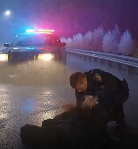
The rain was coming down in sheets, the kind of cold, miserable rain that turns the asphalt into a black mirror. My radio crackled, cutting through the rhythm of the windshield wipers.
“Unit 4-Alpha. Report of debris on Old Mill Road. Trucker says it looks like a carcass. Create a hazard. Check it out.”
“Copy,” I said, my voice gravelly from lack of sleep. “En route.”
Old Mill Road. Of course it was Old Mill Road. Nothing good ever happened on that stretch. It was where people dumped things they didn’t want anymore. Mattresses. Furniture. Sometimes worse.
I pulled up slowly, my headlights cutting through the rain. At first, I thought it was a bag of trash. Then I saw the fur. Matted. Dark with rain and something else. Blood, probably.
I grabbed my flashlight and stepped out into the downpour. The cold hit me like a slap. I approached carefully, the beam of light dancing across the wet pavement.
It was a dog.
Or what was left of one.
He was lying on his side, ribs visible through his soaked coat. His back legs were twisted at angles that made my stomach turn. One eye was swollen shut. The other—God, that other eye—it looked up at me with something I hadn’t seen in a long time.
Hope.
I knelt down in the rain, my knees hitting the asphalt hard. “Hey, buddy,” I whispered, my voice catching. “Hey, it’s okay.”
He didn’t move. Couldn’t move. But that one good eye followed me, and his tail—broken, bent, barely functional—it twitched. Just once. A single, desperate wag.
That’s when something inside me cracked wide open.
I called it in immediately. “Dispatch, I need animal control at my location. We’ve got an injured dog, severe trauma. Tell them to hurry.”
“Copy that, 4-Alpha. They’re twenty minutes out.”
Twenty minutes. I looked down at this broken thing bleeding out on the road, and I knew twenty minutes might as well be forever.
I took off my jacket and carefully, so carefully, draped it over him. His body was cold. Too cold. I could feel his ribs, every sharp edge of them, through the fabric.
“You hang on,” I told him. “You hear me? You hang on.”
His tail twitched again.
I stayed there in the rain, one hand on his side, feeling the shallow rise and fall of his breathing. I talked to him. Stupid stuff. About my daughter’s soccer games when she was little. About the burgers at Mike’s Diner. About anything to keep him conscious, to let him know he wasn’t alone.
When animal control finally arrived, Sarah—a tech I’d worked with before—took one look and her face went pale.
“Jesus, Tom,” she breathed. “What happened to him?”
“Don’t know. Found him like this.”
She knelt beside me, her hands already moving with professional efficiency. “Multiple fractures. Possible internal bleeding. Severe malnutrition. Tom, he’s… I don’t know if we can save him.”
“Try,” I said, and it came out harder than I meant it to. “Please. Just try.”
We got him on a stretcher. I followed them to the emergency vet clinic, my wet uniform sticking to the car seat, my hands still shaking.
The vet was a young guy named Dr. Patel. He had kind eyes and steady hands, and when he came out of the examination room two hours later, those eyes were tired.
“Officer… I’m going to be straight with you. This dog has two shattered hind legs, three broken ribs, a fractured pelvis, severe infections, and he’s about forty pounds underweight. He’s been living in agony for weeks, maybe months. The humane thing—”
“No.”
Dr. Patel blinked. “I understand the emotional attachment, but—”
“He wagged his tail,” I said, and my voice broke. “He’s broken and bleeding and dying, and when I knelt down next to him, he wagged his tail. That dog wants to live. So we’re going to give him that chance.”
There was a long silence. Then Dr. Patel nodded slowly. “Okay. But I need you to understand—even if we can save him, he may never walk normally again. The damage is extensive.”
“I don’t care if he never walks at all,” I said. “I just want him to stop hurting.”
The surgery took six hours. I called in sick to work for the first time in fifteen years. I sat in that waiting room, drinking terrible coffee, watching the sun come up through rain-streaked windows.
When Dr. Patel finally emerged, he looked like he’d been through a war.
“He made it,” he said simply. “He’s stable. Still critical, but stable.”
I started visiting every day. Before my shift. After my shift. Sometimes during lunch. The dog—I’d started calling him Murphy, though I don’t know why—was wrapped in bandages and hooked up to machines, but that eye would find me every time I walked in.
And he’d try to wag his tail.
It became a thing at the precinct. My partner, Rodriguez, started coming with me. Then Jenkins from narcotics. Then Captain Winters herself. We’d all stand around this broken dog, these hardened cops who’d seen bodies and crime scenes and the absolute worst of humanity, and we’d talk to him like he was a person.
“Looking good, Murphy.”
“You’re a fighter, buddy.”
“Gonna be chasing squirrels in no time.”
The staff at the clinic started calling us Murphy’s Army.
Three weeks in, Dr. Patel called me at home. “Tom, I think you need to come down here.”
My heart stopped. “Is he—”
“Just come.”
I broke every traffic law getting there. When I burst through the door, Dr. Patel was standing in the recovery room, and he was smiling.
“Watch,” he said.
He walked over to Murphy’s kennel. The dog’s eyes lit up—both of them now, the swelling finally gone. Dr. Patel opened the kennel door.
And Murphy stood up.
On two legs. His front legs, strong now from weeks of physical therapy. His hind legs were still in casts, still healing, but he’d figured out how to balance. He stood there on two legs like a person, his tail—fully healed, fully functional—wagging so hard his whole body shook.
Then he took a step. A hop, really, but a step nonetheless. Toward me.
I dropped to my knees.
Murphy hop-walked right into my arms, and he licked my face, and his whole body was wiggling with joy, and I—
I broke.
Thirty years of holding it together. Thirty years of dead kids and domestic violence and overdoses and suicides. Thirty years of pretending I was fine, I was tough, I was handling it.
I sobbed into that dog’s fur like a child.
Behind me, I heard Rodriguez’s voice crack: “Jesus Christ.”
I looked back. Rodriguez was crying. Jenkins was crying. Captain Winters, the toughest woman I’d ever met, who once stared down an armed suspect without blinking, had tears streaming down her face.
We all stood there in that veterinary clinic, the toughest cops in the precinct, crying over a dog who’d learned to stand on two legs because he wanted so badly to live.
Dr. Patel cleared his throat. “The back legs are healing well. With continued therapy, he should be able to walk on all fours again. Maybe not perfectly, but he’ll walk. He’ll run. He’ll be a dog again.”
I looked down at Murphy, still in my arms, still wagging. “He’s already a dog,” I said. “He’s the best damn dog.”
“So,” Dr. Patel said carefully. “About placement. We’ll need to find him a home—”
“He has one,” I interrupted. “He’s coming home with me.”
Rodriguez laughed through his tears. “Your wife is going to kill you.”
“She’ll understand.”
And she did. When I brought Murphy home three months later, fully healed, walking on all four legs with just the slightest limp, my wife took one look at him and said, “Well, I guess we’re dog people now.”
Murphy’s been with me for two years. He sleeps at the foot of my bed. He rides in my patrol car sometimes. He visits schools with the K-9 unit, even though he’s not trained for anything except being loved.
The kids love him because he’s goofy and friendly. The other cops love him because he reminds them why we do this job. To protect. To serve. To save the ones who can’t save themselves.
I retired last month. Thirty-two years on the force. At my retirement party, Captain Winters gave a speech. She talked about my arrests, my commendations, my years of service.
Then she said, “But the most important thing Tom ever did was stop in the rain for something everyone else drove past. He saw something broken and decided it was worth fixing. That’s what a real cop does.”
Murphy was there, of course. Dressed in a little police vest the guys bought him as a joke. When everyone clapped, he wagged his tail so hard he spun in a circle.
I found him by the side of the road at 3:14 AM on a miserable Tuesday. I was counting down to retirement, checking out, going through the motions.
He saved me just as much as I saved him.
Maybe more.
People ask me sometimes why I cried that day at the clinic. Why seeing a dog stand up broke me when years of human tragedy hadn’t.
I tell them the truth: it’s not that Murphy was more important than all those other cases. It’s that he was something I could actually fix. Something I could save. After thirty years of arriving too late, of filing reports on broken lives I couldn’t put back together, here was one broken thing I could make whole again.
And when he stood up on those two legs and wagged his tail, it wasn’t just Murphy healing.
It was all of us.
Every cop in that room had been carrying their own weight, their own ghosts, their own scars. We’d all seen too much. We’d all built those walls. We’d all convinced ourselves we were too tough to break.
Murphy showed us it was okay to break sometimes. It was okay to cry. It was okay to feel.
He taught us that being broken doesn’t mean being done.
Sometimes it just means you’re ready to heal.
I’m sitting on my porch now, retired, watching Murphy chase butterflies in the backyard. He’s got that limp, always will, but it doesn’t slow him down. He’s happy. He’s whole. He’s alive.
And every morning when I wake up and see him sleeping at the foot of my bed, I remember:
I found him on the worst night of his life. And somehow, he saved me on one of mine.
That’s the thing about broken things. Sometimes when you put them back together, they’re stronger than they ever were before.
Murphy taught me that.
And I’ll never forget it.