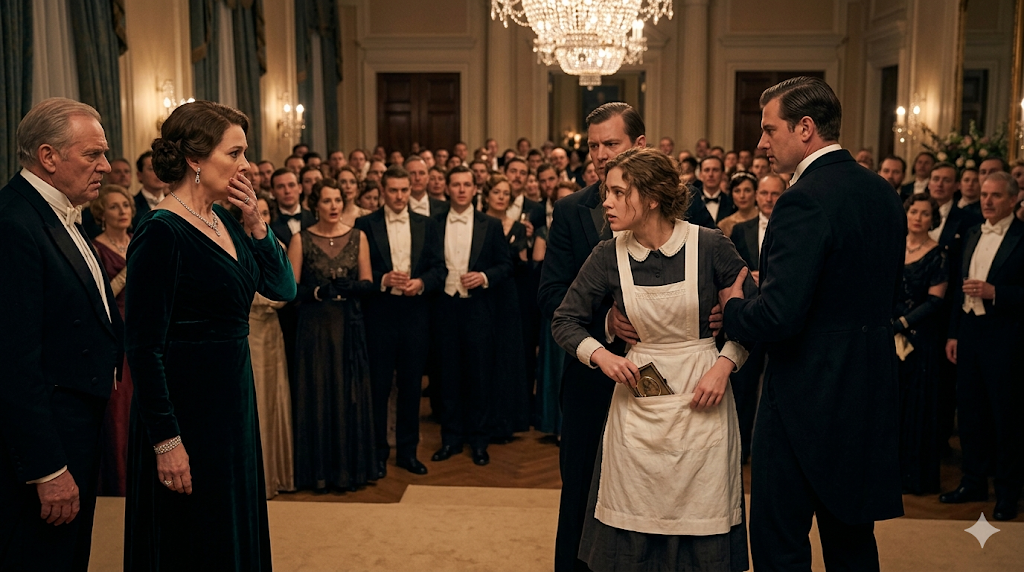

The Ashford Estate had been throwing its annual winter gala for forty-three years, and in all that time, not a single glass had been broken, not a single note from the pianist had faltered, and not a single guest had dared to raise their voice above a polite, practiced murmur. Society had rules. The Ashfords made them.
Victoria Ashford-Pembridge stood at the head of the room the way a general stands at the front of a battlefield — immaculate, untouchable, her white satin gown pooling slightly at her heels like the train of some ancient queen. She was sixty-one years old and had spent every one of those years constructing herself into something that could not be questioned. Her pearls were real. Her smile was not.
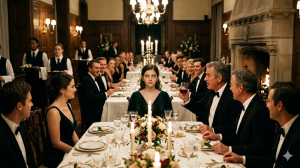
The Hartwell Ballroom glittered under three thousand crystal drops of the chandelier, a beast of light that her late husband’s grandfather had commissioned from a Viennese glassmaker in 1887. The pianist — a quiet man named Edmund, who had played every Ashford gala since 1991 — was midway through a Chopin nocturne when the theft was reported.
It was a brooch. Small, seed-pearl, shaped like a crescent moon. It had belonged to Victoria’s mother and was, she announced loudly enough for the nearest forty guests to hear, missing from the silver tray in the cloak room.
The girl had been seen near the cloak room.
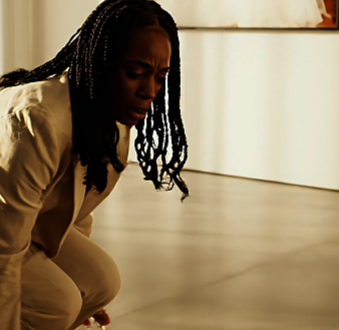
Her name was Clara Doss. She was twenty-two. She had been hired through the domestic agency six weeks earlier and had, by all accounts, been quiet and diligent and invisible in the precise way servants were supposed to be invisible. She was currently carrying a tray of champagne flutes toward the east wing when Victoria’s hand closed around her forearm like a trap.
The tray hit the marble floor. Six crystal flutes shattered. In forty-three years, the first glass had finally broken.
“You,” Victoria said. Her voice was soft. That was somehow worse than shouting.
Clara looked at the ruined champagne pooling between the shards and felt something inside her go still — not calm, but the particular stillness that comes just before an earthquake. “Ma’am—”
“Don’t.” Victoria tightened her grip. The guests nearest them had gone motionless, a tableaux of expensive clothes and open mouths. Edmund’s piano continued for three more bars before his hands stilled on the keys. In the new silence, Victoria’s voice carried the full length of the ballroom. “The brooch from the cloak room. Where is it?”
“I don’t know what you’re talking about.” Clara kept her voice level. She had spent her entire life keeping her voice level.
“You were seen.” Victoria turned to the room with the practiced ease of a woman who had always used audience as weapon. “Mrs. Hartwell saw her.”
An elderly woman near the fireplace nodded vigorously. She had the absolute confidence of someone who had never once doubted her own perceptions.
Clara did not look at Mrs. Hartwell. She was looking at Victoria Ashford-Pembridge. Looking at her the way you look at something you have been looking for for a very long time.
“Search her,” someone said from the back. A man’s voice, helpful in the way that cruelty is often helpful.
“That won’t be necessary,” Clara said.
“I’ll decide what’s necessary in my own home.” Victoria’s eyes were flat, gray, certain. The eyes of a woman who had never in her life been told she was wrong about something that mattered. “You came here with nothing and you’ll leave with nothing. And you’ll be lucky if I don’t have you—”
“My name,” Clara said, “is Clara Doss.”
“I know your name.”
“Do you know my mother’s name?”
Victoria blinked. It was the smallest fracture — a single blink where her composure slipped one millimeter — but Clara had been waiting for it.
“Her name was Maren.” Clara reached into the pocket of her apron. Her hand was steady. She had rehearsed this moment in a dozen different ways over the past six weeks, imagined it unfolding with dignity, with drama, with quiet devastation. What she had not imagined was how cold her fingers would feel, or how the chandelier light would make everything look like a painting, or how the pianist would be watching her with an expression she could only describe as recognition. “Maren Voss. She worked in this house for seven years. She left in the spring of 1972.”
Victoria said nothing. But her hand had released Clara’s arm.
Clara drew out two things. The first was a photograph, small and sepia-toned, its edges soft with handling. Two women stood in front of the Hartwell estate gate — one in a kitchen maid’s uniform, young and dark-haired, laughing at something outside the frame. The other was recognizable even at twenty years old: the same gray eyes, the same particular angle of the chin, the same air of authority not yet hardened into cruelty.
The second thing was a scrap of fabric. Ivory silk, embroidered with a small pattern of leaves along one edge — the same pattern that ran along the hem of the gown Victoria was wearing tonight. A piece of a dress that had been made in 1971 for Victoria Ashford’s debut season. A dress that had been given — according to the letter Clara’s mother had kept her entire life, in a tin box, beneath a loose floorboard — to Maren Voss on the night she was told she had to leave.
“She kept the dress,” Clara said. Her voice was no longer level. She had not planned for her voice to break, but it broke anyway, just slightly, at the edge of the words. “She kept it her whole life. She wore it on her wedding day. She’s buried in it.” She held the photograph out toward Victoria. “She never told me who my father was. But she told me whose house she worked in. She told me your name.”
The room was so quiet that when Mrs. Hartwell knocked her wine glass against the mantelpiece, everyone flinched.
Victoria Ashford-Pembridge looked at the photograph for a long time. Then she looked at the scrap of silk. Then she looked at Clara — really looked at her, in a way she had not permitted herself to look at her in the six weeks since the girl had arrived — and something moved across her face that was not a social expression. It was something older and rawer and far more human than anything the room had seen from her in forty-three years of galas.
“Where did you get that photograph,” she said. Not a question. A reckoning.
“My grandmother kept it. She worked here too. Before my mother.” Clara lowered her hand slowly. “I’m not here for money. I’m not here for acknowledgment. I came because my mother died three months ago and she spent her whole life carrying something she couldn’t put down, and I wanted to see the place she talked about. I wanted to see—” She stopped. Steadied herself. “I wanted to see you.”
Someone in the back of the room began to cry. Clara couldn’t tell who. She kept her eyes on Victoria.
Victoria Ashford-Pembridge had built herself into something impenetrable over six decades. She had survived her husband’s death and her son’s scandal and the judgment of every woman in this room and she had done it by never, not once, letting anyone see the architecture of her doubt. She was a woman made of certainty.
But certainty, Clara had learned, is just fear with better posture.
“The brooch,” Victoria said finally. Her voice had lost its carrying quality. It was a private voice now, the kind that hadn’t been heard in this house for a very long time. “Mrs. Hartwell found it this afternoon. It had slipped behind the tray.” She turned to the room without looking at any individual face. “There was a misunderstanding.”
The guests began to breathe again. Edmund laid his hands on the keys. Someone laughed, too loudly, to fill the space.
Victoria did not move. She was still looking at the photograph in Clara’s hand — at the laughing young woman by the gate, at her own twenty-year-old face caught in the permanent happiness of a moment before everything went wrong.
“Come,” she said quietly. “Not here. Come.”
She walked toward the east corridor without looking back. After a moment, Clara followed.
Behind them, the chandelier continued its indifferent glitter. The champagne continued to pool between the shards of crystal on the marble floor. Edmund played the Chopin nocturne from the beginning, and this time he played it all the way through.
No one spoke about what they had seen that night. Not because they didn’t want to — they desperately wanted to — but because they all understood, in the way people understand things they witness at the edge of privacy, that what had just happened in the Hartwell Ballroom was not a scandal.
It was a reckoning. And reckonings, unlike scandals, belong to the people inside them.
In the east corridor, a woman who had spent her life being certain stood beside a girl who had spent her life being uncertain, and they looked at a small photograph together, and for the first time in a very long time, the Ashford house held something it had not held in forty-three years of galas and performance and careful, practiced silence.
Something true.
Clara did not know what would happen next. She had not planned past this moment — past the look on Victoria’s face, past the snap of recognition. She had no script for the corridor, for the quiet, for the way Victoria’s hand hovered near the photograph without quite touching it.
But she had her mother’s voice in her memory, steady and warm, telling her the name of this house like it was a word from another language she had spent her life trying to learn. She had the dress — the ruined, beautiful, beloved dress — folded in a box in her small rented room across the city. She had the tin box. She had the letters.
She had enough.
“She loved this house,” Clara said softly. “Even after. She always said — she said it wasn’t the house she was angry at.”
Victoria looked at her for a long moment. Her eyes, Clara realized, were not flat after all. They were defended. There was a difference.
“She would have been fifty-three,” Victoria said. It wasn’t a question.
“Fifty-four. April.”
Victoria nodded once, very slightly, the way you nod at something you have always known and never let yourself know you knew.
“Stay,” she said. “Until morning. We’ll — there are things to discuss.” She said it the way she said everything: with authority. But underneath the authority, Clara heard something she recognized from her mother’s voice at the end — the particular cadence of someone trying not to ask for something they don’t know how to ask for.
“All right,” Clara said.
They stood in the corridor for a moment longer, two women separated by decades and class and a secret that had outlived the person who kept it. The chandelier light reached them dimly from the ballroom, enough to see by, not enough to see everything.
That was all right too.
Some truths don’t need the full light. They just need enough.