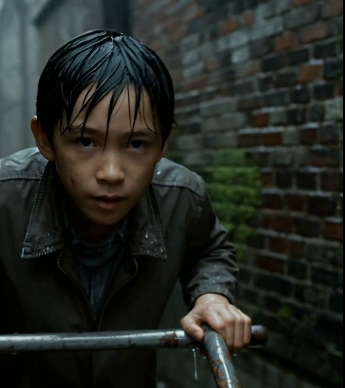

The city of Cleveland had a way of swallowing people whole.
It didn’t do it violently — not always. More often, it did it slowly, quietly, the way a tide pulls sand from a beach. A job disappears. A mother relapses. A landlord changes the locks. And then a child is standing on a corner in the rain, wondering how the world managed to forget he existed.
Ethan Miller had been forgotten for approximately four hundred and twelve days.
He knew the number because he counted. Not out of self-pity — he’d burned through that emotion somewhere around day sixty — but because counting gave him something to hold onto. A record. Proof that the days were passing. That time still moved even when nothing else did.
He was twelve years old. He slept under the Lorain-Carnegie Bridge on a flattened refrigerator box he’d dragged three blocks from a dumpster behind a Best Buy. He kept two changes of clothes in a waterproof bag he’d found at Goodwill — left behind, unclaimed, like him. He ate at St. Agnes soup kitchen on Tuesdays and Thursdays, at the Methodist church on Mondays and Fridays, and scrounged gas station dumpsters on the days in between.
He had a system. Systems kept you alive.
He didn’t think about his mother anymore. Or rather, he tried not to. She was somewhere in the city — he was almost certain of that — but the city was large and her addiction was larger and the last time he’d gone looking he’d found things he couldn’t unsee. So he stopped looking. It was safer that way.
Safer, not better.
He was learning those were different things.
The storm came on a Wednesday.
It built through the afternoon, the sky going from gray to the color of a bruise, thunder rolling in from Lake Erie like something large and angry clearing its throat. By six o’clock, the streets were rivers. Storm drains overflowed, parking lots flooded, and the underpass at West 25th became a dim cave where the sound of rain on concrete was so loud it was almost peaceful.
Ethan had found his spot two hours before the storm hit. Corner of the overpass, concrete pillar to his back, box between him and the ground. He’d watched the water rise, watched cars slow and splash, watched the city carry on the way cities do — with tremendous indifference to any single person’s suffering.
He was eating a gas station granola bar — slightly stale, chocolate chip, technically expired three days ago but still fine — when he saw her.
She appeared in the headlights the way things appear in nightmares: suddenly, completely, wrong in a way that takes a moment to process.
A woman. Sitting in the middle of the flooded street.
She was visibly pregnant — heavily so, close to her due date from the size of her — and she was soaked through, her coat dark and heavy with water, her hair plastered to her face. One shoe was on. One shoe was gone. She had her phone in her hand but the screen was dark, probably drowned.
Every thirty seconds or so, a wave of pain would move through her and she would try to stand, get halfway up, and then collapse back down with a gasp that Ethan could hear even over the rain.
Cars slowed.
He watched them.
A silver sedan slowed almost to a stop, windshield wiper going frantically, and then continued forward.
A pickup truck didn’t even slow.
A woman in a white SUV looked directly at the pregnant woman, and Ethan saw her face through the windshield — he could see the calculation happening, the risk assessment, the conclusion — and then the SUV moved on.
Ethan finished his granola bar.
He told himself it wasn’t his problem. He was twelve. He was homeless. He had no phone, no car, no resources. He was the last person in Cleveland who should be trying to help anyone.
Then the woman looked up.
Her eyes scanned the darkness under the overpass — not really seeing anything, just searching, the way people search when they’re desperate enough to hope for anything — and somehow, across thirty feet of rain and shadow and rushing water, she found him.
Their eyes met.
Ethan had been looked through his entire life. Adults looked past him, around him, over him. He’d become skilled at reading the exact moment when someone’s gaze slid off him like water off glass.
This was not that.
She saw him.
“Help…” she said. The rain nearly swallowed the word but he caught it, the shape of it, the raw need in it.
His heart slammed against his ribs so hard he felt it in his throat.
Don’t. said the part of him that had learned to survive. You’re twelve. You’re nobody. Stay down. Stay invisible. That’s how you make it through.
He stood up.
“Ma’am?” His voice came out smaller than he intended. He stepped to the edge of the overpass, rain immediately hitting him like a cold hand. “Can you hear me?”
She stared at him. Even from here he could see the disbelief moving across her face — not relief, not yet, just the pure confusing reality of who had answered her call.
A kid. A skinny kid in an oversized jacket.
“I can’t stand,” she said, louder now, her voice fraying at the edges. “I keep trying. I can’t — it hurts too much to —” Another wave of pain cut her off. She bent forward, both hands on the flooded asphalt, breathing through it.
Ethan’s mind was already moving.
He scanned the underpass. He’d catalogued it weeks ago, the way he catalogued every space he occupied. There was the box. The pillar. A shopping cart with a broken wheel. A pile of old lumber. And — half-hidden behind the pillar, where someone had left it — a metal wheelbarrow.
He crossed to it, grabbed the handles.
It was heavier than it looked. The metal was ice-cold, slick with rain, and rust had seized one of the joints so that it listed slightly to the right. He wrestled it toward the street, his arms burning immediately.
“There’s a hospital,” he called to her. “About four blocks. I can push you.”
She stared at him.
“I’m twelve,” he said, because she was clearly thinking it. “But I’m strong.”
This was a partial lie. He was not strong, exactly. He was wiry and desperate and had nothing to lose, which in his experience was a reasonable substitute.
“You can’t —” she started.
“I’ll be fine,” he said. “You won’t.”
He waded into the flooded street. The water came up past his ankles, ice cold, soaking immediately into his shoes and socks. A car horn blared somewhere behind him. He ignored it.
Getting her into the wheelbarrow was the hardest physical thing he had ever done.
She couldn’t stand on her own, which meant she had to get herself into a half-crouch while he held the wheelbarrow steady. Every movement caused her pain. She apologized for it — I’m sorry, I’m sorry — and he kept saying it was okay, it’s fine, you’re doing great, even though his arms were shaking and his back was screaming and the current in the flooded street kept trying to push him sideways.
Finally, she was in. Awkward, cramped, her knees pulled up because the wheelbarrow wasn’t designed for this.
“Okay,” Ethan said. He repositioned his hands on the handles. His fingers were already numb. “Okay. I’ve got you.”
“You don’t have to do this,” she said. Her voice was steadier now, though she was still crying. He could tell because her face was wet in a different way than the rain made it wet.
“I know,” he said.
He pushed.
The first step nearly knocked him over. The wheelbarrow was heavier with her in it, and the water created resistance, and the slight lean to the right made steering a constant negotiation. A car passed and the driver honked and someone shouted something out the window that Ethan decided not to hear.
He focused on the pavement in front of him.
One step. One more. One more.
“You’re okay,” he said softly, partly to her, partly to himself. “I got you. I won’t let you fall.”
She reached back and put one hand over one of his, briefly. She didn’t say anything. He didn’t need her to.
He walked.
His arms were burning by the end of the first block. By the second block, the burning had turned into a deep, continuous ache. By the third block, he couldn’t really feel his hands at all, which was almost a relief. He navigated around a car that had stalled in the intersection, around a river of debris, around a section of sidewalk where a drain had backed up into a miniature lake.
The woman made small sounds when the pain came. He talked her through them.
“Almost there. You’re doing so good. Just keep breathing. I’ve got you.”
He didn’t know where those words came from. Nobody had ever said them to him.
He meant every one of them.
Red lights cut through the rain first — then the sound, the urgent warble of a siren. A paramedic unit splashed to a stop twenty feet ahead of them.
Ethan stopped walking. His legs nearly gave out when he did.
Two paramedics were out of the vehicle before it fully stopped, crossing toward them with fast, purposeful movements, voices calm and professional. They lifted the woman from the wheelbarrow with practiced efficiency, transferring her to a stretcher that materialized from the back of the ambulance.
One of them turned to Ethan.
He was a big man, forties, gray at the temples. He looked at Ethan the way people didn’t usually look at him — directly, steadily, like he was seeing all of him and wasn’t surprised or troubled by what he found.
“Did you bring her here?”
Ethan nodded.
“In that?” The paramedic looked at the wheelbarrow, then back at Ethan.
Another nod.
The man was quiet for a moment. Then he said, with a certainty that Ethan felt land somewhere in his chest: “You did the right thing, son. You probably saved two lives tonight.”
Ethan opened his mouth.
He didn’t know what he was going to say. Maybe thank you. Maybe is she going to be okay. Maybe nothing — maybe he just needed a second to let those words settle, to feel the weight of them, because nobody had called him son in a very long time and nobody had ever told him that something he’d done had mattered in quite that specific, irreversible way.
But then a second paramedic appeared at his elbow.
“Kid, you need to come with us too, you’re soaked through and it’s forty degrees —”
And something in Ethan seized up.
The ambulance was warm and bright. The paramedics were kind. The woman was safe.
None of that changed what happened when adults got involved with kids like him.
He took one step back.
“I’m fine,” he said.
Another step.
“Kid —”
He turned and walked into the rain.
Three days later, the storm was a memory.
The streets had dried. The sun had returned with the particular cheerfulness of midwestern spring, indifferent to what the storm had left behind — the debris, the damage, the things that had been quietly ruined while no one was watching.
Ethan sat on the pavement outside St. Agnes soup kitchen, working his way through a piece of bread that had gone stale somewhere around six that morning. His body still ached. His arms especially, a deep muscle soreness that reminded him, every time he reached for something, of the wheelbarrow handles.
He hadn’t told anyone what he’d done.
There was no one to tell.
He was thinking about nothing — or rather, thinking about everything at once, which amounted to the same thing — when he heard it.
A car.
Not just any car. A car that moved differently from other cars: slowly, deliberately, with the particular purposefulness of a vehicle that was looking for something rather than going somewhere.
A black SUV.
It pulled up to the curb in front of the soup kitchen. Ethan watched it the way he watched everything on the street — quietly, from his peripheral vision, ready to become invisible if he needed to be.
The door opened.
A woman stepped out.
She was wearing clothes that didn’t belong on this block — not in a condescending way, just in the way that quality has a texture that’s hard to disguise. Her coat was dry-clean only. Her boots were real leather. She moved carefully, because she was enormously pregnant and had a slight limp, favoring her left leg.
Ethan’s bread stopped halfway to his mouth.
She was scanning the people on the sidewalk with that same desperate, searching look he’d seen through rain and headlights three nights ago.
Her eyes found him.
He stood up. He didn’t mean to. His body just did it.
For a long moment, neither of them moved.
Then she crossed the distance between them, which wasn’t far and also wasn’t close enough, and when she reached him she stopped and looked at him — really looked at him, the way the paramedic had, the way that cost something — and her face did something complicated.
“I’ve been looking for you,” she said. “For three days. They couldn’t tell me who you were. The paramedics. The hospital. No one knew. I’ve been calling soup kitchens all over the city.” She paused. “You’re twelve.”
“Yes, ma’am.”
“You’re living on the street.”
It wasn’t a question. He nodded anyway.
She pressed her lips together. Her eyes were doing something he recognized: fighting a feeling hard enough that the feeling was winning.
“My name is Margaret Okafor,” she said. “My husband’s name is Daniel. He’s in that car because he didn’t trust himself to get through this without — he’s very —” She stopped. Restarted. “Our daughter was born two days ago. They almost lost her. They almost lost us both.”
Ethan didn’t say anything.
“The doctor said another twenty minutes in that water and the shock alone would have —” She stopped again. Her hand moved to her stomach, a reflex, before she remembered the baby wasn’t there anymore. “She’s healthy. She’s perfect. We named her Clara.”
The name landed on him softly.
Clara.
“That’s a good name,” he said.
Margaret Okafor laughed, and it was the kind of laugh that lives right next to tears. “Yes,” she said. “It is.”
She looked at him for another long moment. A car passed on the street. The soup kitchen door opened and closed behind them, letting out a brief ribbon of warm air.
“I’m a lawyer,” she said. “My husband is an architect. We have a house in Shaker Heights with a guest room we’ve been using as a home office, and a backyard with a garden that mostly doesn’t work, and a dog named Patterson who is enormous and useless and very good at being comforting.” She paused. “We’ve been talking about fostering. Before — before the pregnancy, we’d started the paperwork. Then we got busy and we—” Another pause. “I’m not trying to make you a project. I want to be very clear about that. I’m trying to say that I have been thinking about nothing for three days except finding you and—”
Her voice broke, finally.
“I want to help you,” she said. “Whatever that means to you. Whatever you’ll let it mean.”
Ethan Miller had learned, over four hundred and fifteen days, not to trust things that sounded too good. He’d learned that adults said things they didn’t mean, made promises the world helped them break, offered hands that eventually withdrew.
He looked at Margaret Okafor.
He looked at the black SUV, where he could see the silhouette of a man in the passenger seat who was very still in the way people are still when they’re holding themselves together through sheer effort.
He looked at his own hands — chapped, scarred at the knuckles, stained faintly with rust from the wheelbarrow handles.
“I’m not easy,” he said. This felt important to establish. “I have — I don’t sleep good. And I don’t trust people fast. And sometimes I get angry and I don’t always know why.” He was watching her face. “I’m telling you this because you should know.”
“I know,” she said.
“You don’t, yet.”
“No,” she agreed. “But I’d like to.”
He looked down at the piece of stale bread in his hand.
He thought about systems. How systems kept you alive but not safe. How safe and better were different things.
He thought about a woman in the rain, and the way fear recognizes fear, and how he’d stepped out from under the bridge anyway.
He looked up.
“Okay,” he said. “Yeah. Okay.”
What happened next was not simple or easy or clean.
Because Ethan was right: he wasn’t easy. He had nightmares that woke him at three in the morning. He flinched at unexpected sounds. He hoarded food in his room — not because he was hungry but because his body hadn’t gotten the message yet that hunger was no longer the plan. He tested the Okafors in a hundred small ways, pushed against their patience, waited for the moment when their goodwill would run out and they’d look at each other over his head and calculate the cost.
The moment didn’t come.
Daniel Okafor, the architect, had a workshop in the basement and he started bringing Ethan down there on weekends, not to teach him anything specific, just to have company while he worked. They didn’t talk much. They didn’t need to. Ethan learned the names of tools, learned how to measure twice and cut once, learned the particular satisfaction of making something with your hands that hadn’t existed before.
Margaret Okafor, the lawyer, helped him re-enter school. This was its own kind of obstacle course — bureaucracy, records, catch-up, the social architecture of seventh grade which was hostile terrain even under ideal circumstances. She showed up to every meeting with the school district. She sat across from administrators who looked at Ethan’s file and made calculations, and she made different calculations back at them, louder and with more documentation.
Clara, who could not yet walk or talk or do anything except exist with staggering completeness, became the thing Ethan hadn’t known he needed: something to be gentle toward. He held her sometimes while she slept. He’d never held a baby before. It terrified him. He did it anyway.
Patterson the dog, enormous and useless, slept at the foot of his bed.
On the four hundred and sixty-second day — a Saturday in June, the kind of bright, indifferent day that Cleveland produces like an apology for the winters — Ethan sat in the backyard that mostly didn’t work. He was reading a book his teacher had assigned. The garden was a disaster. Margaret was inside with Clara. Daniel was in the workshop. Patterson was asleep six inches from his feet, twitching through some dog dream.
Ethan looked up from his book.
Just looked at the afternoon.
At the light in the leaves.
At the ordinary, extraordinary fact of where he was.
He’d done one thing, on one night, in the rain. He’d stepped forward when every instinct said stay back. He hadn’t done it because he was brave. He didn’t know if he was brave. He’d done it because fear recognizes fear and he’d looked into the eyes of someone who was terrified and he’d been unable to look away.
He hadn’t been expecting a reward.
He hadn’t been expecting anything.
He was beginning to understand, slowly, in the way that twelve-year-olds understand things — not all at once but in layers — that sometimes the world paid attention after all. Not always. Not reliably. Not in time. But sometimes a single choice in a flooded street could become a door, and doors, unlike windows, you could walk through.
He was on the other side of it now.
That was enough.
For now, that was more than enough.