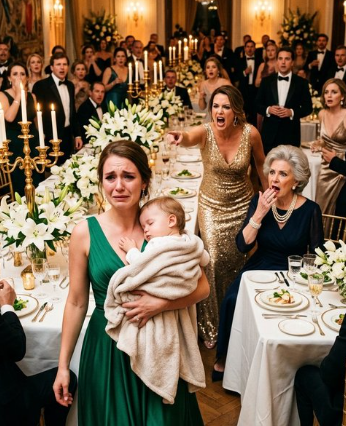

The magnolias were blooming along Peachtree Road the morning everything changed. It was Easter Sunday in Atlanta, and the city wore its spring beauty like a mask — all blossom and perfume over a city that never slowed down long enough to breathe. I drove through Buckhead with the windows down, Lily asleep in her car seat with a stuffed rabbit tucked under her chin, her church dress already wrinkled from the drive. I had worked until two in the morning closing a commercial acquisition in Savannah, and I had been running on black coffee and the vague hope that this year would be different.
I should have known better. The Sterlings were never different. They were perfectly, precisely, permanently the same.
My name is Claire Vance. I am thirty-seven years old. I am the founder and managing partner of Vance & Associates, a real estate investment and property management firm with a portfolio spanning two hundred and eighteen properties across Georgia, South Carolina, Tennessee, and Florida. I manage roughly three hundred million dollars in assets. I have rebuilt a business twice — once after my ex-husband drained our joint accounts, and once after the 2020 market correction nearly swallowed three of my biggest commercial contracts whole. I am the kind of woman who reads lease agreements like novels and can calculate cap rates in her head while ordering coffee.
My family believed I worked “some office job in the city.”
They believed this because I let them believe it. Not out of stupidity, and not out of insecurity. I let them believe it because the truth would have shattered the story my mother had told herself for forty years — that it was Vanessa, not me, who carried the Sterling name forward. That it was Vanessa, with her manicured social media feed and her partnerships with luxury brands, who was the family’s crown jewel. If I had walked into that dining room and told them the full truth of my net worth, it would not have generated gratitude. It would have generated a new kind of contempt, the contempt people reserve for those who quietly succeeded without permission.
So I kept quiet. I paid the bills. I kept the lights on.
I parked my sedan — a deliberately modest vehicle, a choice I made the same way I made every choice: strategically — at the edge of the circular driveway and looked up at the house. The Sterling Estate sat on nearly two acres in Buckhead’s most exclusive residential corridor, a Georgian Colonial with white columns and a wraparound porch that I had pressure-washed the previous spring through a property maintenance firm I happened to own. The azaleas were in full pink riot. The wrought-iron gates, which I had paid to automate the previous fall, stood open in welcome.
I was not, as it turned out, welcome.
I lifted Lily from her car seat and she stirred, pressing her face into my shoulder. She smelled like strawberry shampoo and sleepy child, and I held her for a moment longer than necessary in the cool April air. She was seven. Her eyes were my eyes — dark, watchful, too aware for her age. She had learned early that in this house, it was safer to be invisible. I hated that she had learned that. I hated that I had taught it to her by example.
“We’re here, baby,” I murmured. “Two hours. We eat, we smile, we leave.”
“Promise?” she asked.
I pressed a kiss to her temple. “Promise.”
I should have driven away right then. I should have taken my daughter to brunch somewhere with sunlight and mimosas and strangers who smiled because they meant it. Instead, I straightened my dress — a silk sheath in ivory that Vanessa would later describe as coming from “some outlet store,” a dress I had purchased at a boutique in Midtown for four hundred dollars, a detail I kept to myself because correcting Vanessa required energy I had stopped spending years ago — and I walked up the stone steps and into the house that had my name on the deed.
The entrance hall smelled of Easter lilies and candle wax. A vase of white blooms sat on the antique sideboard — a sideboard I had sourced from an estate sale in Savannah and shipped to Atlanta at my own expense. The chandelier overhead, French crystal, threw prismatic light across the marble floors. I had approved the design specifications on that chandelier via email one Friday evening while simultaneously reviewing a zoning variance in Chattanooga. I remembered the invoice: ten thousand, four hundred and twenty dollars.
I heard Vanessa before I saw her. That particular laugh — high, bright, performing itself for an invisible audience — carried through the house like a recorded track. I found them already at the table in the dining room, my mother and my sister, an island of carefully constructed elegance. Vanessa in a wide-leg silk jumpsuit the color of champagne, her collar bones decorated with a diamond necklace that caught the light every time she moved, which was often because she moved in ways designed to be noticed. Our mother, Margaret, in her signature navy, her silver hair set into the kind of deliberate softness that costs three hundred dollars at the salon she attended every two weeks — the salon whose bills ran through a corporate account I had quietly maintained for four years.
The table was spectacular. Honey-glazed ham on a silver platter ringed with fresh herbs. A spring salad with edible flowers. Crystal goblets filled with water and with wine. A centerpiece of white Easter lilies and trailing ivy in a crystal vase that I recognized immediately, because I had purchased it at a boutique auction in Ansley Park three years prior to replace the one my mother had quietly sold during the years when the family money — the inheritance our father left, which had actually run out a decade before anyone admitted it — was nearly gone.
I had replaced many things in this house. The truth was one of the things I had replaced most carefully.
“Claire.” Margaret greeted me with the kind of smile that stopped just below her eyes. “You’re late. And Lily’s dress is wrinkled.”
“We drove from Midtown,” I said pleasantly. “Traffic on Peachtree.”
“There’s no traffic on Peachtree on Easter Sunday,” Vanessa said, glancing up from her phone with the bored precision of someone conducting an appraisal they’ve already decided the conclusion of. Her eyes moved from my face to my dress to Lily, and something registered, some faint recalibration of disdain, and she returned to her phone. “You look tired, Claire. Really tired. Like a woman who’s given up.”
“Vanessa,” I said mildly, settling Lily into the chair beside me. “Happy Easter.”
“Is it?” Vanessa said, setting her phone face-down with the deliberateness of someone making a statement. “I was just telling Mom that I’m taking the Porsche up to the Hamptons for the long weekend in July. You should come, Mom. We’ll stay at the Topping Rose.” She paused to let the name land. “It’ll be so good for the content.”
“The content,” Margaret repeated, her face moving into the expression she reserved for Vanessa: something approaching reverence, soft and warm, a look I had spent thirty-seven years never receiving. “Of course, sweetheart. You’ve been working so hard on your — what do they call it? Your brand?”
“Influencer marketing and lifestyle curation,” Vanessa corrected, gently but with the practiced patience of someone who has explained this many times and found the repetition charming rather than exhausting because it is always, always about her. Then she looked at me. “Eat something, Claire. You have that martyred look again. Like you want us to ask what’s wrong so you can say ‘nothing.'”
Lily’s small hand found mine under the tablecloth. I felt her fingers wrap around two of mine, a private signal we had developed over years of these dinners. It meant: I’m here. It meant: I’m okay. It meant: how soon can we go?
“I’m fine,” I said. “Lily, would you like more ham?”
“She’s perfectly capable of serving herself,” Margaret said, not unkindly, but with the tone that had always made me feel that the things I did for my daughter were, somehow, symptoms of a failure on my part. “You hover, Claire. You’ve always hovered. It creates anxiety in children. I read an article.”
“Did you,” I said.
“In a parenting magazine,” Vanessa confirmed, without looking up from the phone she had retrieved. “You’re raising a nervous child. Look at her.”
I looked at my daughter, who was quietly and meticulously cutting her ham into careful, even squares. She was not nervous. She was strategic. She had learned to make herself small enough to escape notice in this house, and she did it with a precision that broke my heart every single time because she was seven years old and no child should have to be that precise.
“She’s doing beautifully,” I said.
“She’s doing what she has to do to survive your parenting,” Vanessa said, and laughed, and reached for her wine glass. “I’m kidding. Lighten up. God, Claire, you are such a — “
“A what?” I asked.
The question hung in the air with more weight than I intended. Vanessa blinked at me, momentarily recalibrating. My mother looked at her wine. A beat of genuine silence passed around the Easter table with its perfect flowers and its borrowed elegance, and then Vanessa set her glass down and decided to be generous.
“Nothing,” she said. “A dark cloud. You always have been. Even as a kid. Remember, Mom? Claire would walk into a room and the whole energy would just — shift.”
“She was a sensitive child,” Margaret said, which was her way of agreeing without committing to the cruelty of it.
“Sensitive,” Vanessa repeated, tasting the word. “Sure. We’ll call it that.”
My phone buzzed in my pocket. I glanced at it under the table, angling the screen away from the table: a notification from the private banking application that managed the Sterling Family Trust accounts. A transfer request from Vanessa’s linked subsidiary account. Twenty thousand dollars. The memo field read: “Hamptons advance — urgent.”
She had submitted the request while sitting across the table from me, while I was pouring water into Lily’s glass.
I looked at my sister’s profile — the clean line of her jaw, the diamond catching the light at her throat — and I felt something in the architecture of my patience quietly crack. Not collapse. Crack. Like a stress fracture in a load-bearing wall. Invisible from the outside. Significant to those who know what to look for.
I did not approve the transfer.
I returned my phone to my pocket and I helped my daughter to a roll from the breadbasket and I looked out the window at the azaleas, which were blooming their hearts out in the April sunshine with no knowledge and no care for the thing that was quietly breaking in the room behind them.
The breaking came, as breakings so often do, from an entirely unexpected direction.
Vanessa wanted a photo for her Easter content. She wanted Lily in it — “the child angle always drives engagement,” she announced to no one in particular — and she reached across the table with her phone, angling for a candid of Lily looking cherubic in the holiday light. The movement was abrupt and wide, the silk of her jumpsuit sleeve catching the air, and the displacement was enough. Lily’s elbow moved in reflex. The crystal vase — the one I had sourced from the Ansley Park boutique auction, two hundred and sixty dollars plus delivery, replacing the original that Margaret had quietly sold in the lean years before I took over the finances — tilted once, caught for a moment in that terrible suspended second where physics considers its options, and then fell.
The sound of crystal shattering against marble is a unique kind of violence. It doesn’t shatter so much as explode, sending fragments in a perfect radius of silence and then sound.
Lily froze.
Her face went white, then red, then the specific crumpled shape of a child preparing to cry while also desperately trying not to cry because she had learned, here, in this house, that crying made things worse.
“You clumsy little brat!”
Vanessa’s voice was a different register than anything I had heard from her. Not the performative sharpness she deployed at dinner tables or the cool social slicing she used in conversation. This was something rawer — the voice a person uses when their performance drops and the actual person underneath emerges. She was on her feet before the last fragment stopped moving, her chair scraping back against the hardwood with a sound like a gunshot.
“That was a family heirloom! Do you have any idea — Lily, do you have any idea what that cost? That vase was passed down from Great-Aunt Martha! It is irreplaceable! It is worth more than your mother makes in a year!”
“Vanessa.” My voice was very quiet.
“I’m sorry,” Lily was saying, her voice barely there, a thread of sound. “I’m sorry, Auntie Vanessa, I’m so sorry, I didn’t mean — “
“Sorry doesn’t put it back together!”
“Vanessa,” I said again.
“I’m done.” Vanessa rounded on me. “I am done, Claire. Every single time you bring that child into this house, something gets broken. Something gets ruined. You’re sloppy, she’s sloppy, and you’ve passed every one of your unfortunate qualities directly to her. Do you know what it’s like to have you here? Do you have any idea what you do to the energy of a room?”
“That will do.” I was very still. The stillness I was known for in boardrooms — the stillness that my director of acquisitions once described as “the calm of a woman who has already decided and is simply waiting for the room to catch up.”
But Margaret was standing now, too, and the look on her face — cold, and old, and carrying the weight of decades of resentment I had never understood and never been able to earn my way past — cut through my stillness with surgical efficiency.
“It’s enough, Claire,” my mother said. “It has been enough for years. I am exhausted by the weight of you. You have always been the difficult one — heavy, graceless, full of problems. You bring nothing to this family but sadness and burden. Vanessa is building something. She is creating a legacy. And you are here, dragging your disappointments to my table every holiday and expecting what? What is it exactly that you expect from us?”
“Nothing,” I said. “I expect nothing from you.”
“That’s good,” Vanessa said, her voice crystalline and final. “Because you’re getting nothing. You know what, Claire? We’re done. You don’t contribute to this family. You take up space and you depress the room and you raise your child to break things, and I am finished pretending that having you here is something I enjoy. So don’t come back for Christmas. Don’t come back at all. We’re pruning, Claire. We’re cutting away the dead weight. You’re out.”
“Out of the family,” I repeated.
“Out of the family,” Vanessa confirmed. She had picked up her phone again. She was photographing the broken crystal on the marble floor, I realized, in real time, for content.
I looked at my daughter. Lily was sitting very still with her hands in her lap and her eyes on the table, and she was not crying, and the not-crying was somehow worse than the crying would have been, because it meant she had already learned how to hold this particular kind of pain quietly inside herself, and she was seven years old, and I had let this go on for seven years because I thought I was protecting something, and I looked at that small contained face and understood with perfect clarity that there was nothing left to protect here and nothing left to lose.
I stood up.
I picked up Lily’s cardigan from the back of her chair. I folded it over my arm. I looked at my mother, who did not meet my eyes, and I looked at my sister, who was still adjusting the angle of her phone over the broken crystal, and I felt something lift — not painlessly, because the lifting of something long-carried is never painless — but cleanly.
“If I’m the dead branch,” I said, “you won’t mind me taking my nutrients with me.”
“What does that even mean?” Vanessa didn’t look up.
“It means,” I said, “that the tree falls with the roots.”
I walked out through the dining room and through the entrance hall and through the heavy oak front door, which closed behind me with the specific finality of a door that knows it is closing for the last time. I stood on the stone porch in the April air for a moment, Lily’s hand in mine, and I looked at the azaleas and the iron gates standing open and the modest sedan at the edge of the driveway, and I took one breath.
Then I opened my phone.
The application was encrypted and required a biometric scan before it would open. It managed access to all twelve of the subsidiary accounts connected to the Sterling Trust umbrella — a financial architecture I had built carefully over five years, routing my firm’s funds through holding structures that allowed me to maintain the illusion of inherited wealth while keeping every asset under my own ultimate authority. It was not complex, legally. It was simply thorough.
My thumb moved across the screen with the practiced ease of someone executing a transaction she had rehearsed a thousand times in preparation for the day she hoped would never come.
She had hoped wrong.
TERMINATE ALL SUBSIDIARY ACCESS: STERLING ACCOUNTS.
Confirm? YES.
The executing wheel spun for three seconds.
I took Lily’s hand and we walked to the car.
Lily buckled herself in — she had been doing it herself since she was six, with the focused pride of a small person who collects competencies the way other children collect toys. I sat in the driver’s seat and put the key in the ignition but did not turn it, and I watched the front windows of the house and I waited.
“Mommy,” Lily said.
“Yes, baby.”
“Are we okay?”
I turned around to look at her. She was straight-backed in her car seat, the stuffed rabbit from this morning’s Easter basket on her lap, her eyes on me with that specific quality of attention that she deployed when she needed to know the truth and not the comfortable version of it.
“We’re better than okay,” I said. “We’re finally free.”
She considered this with the gravity of a person who knows what it cost. “Okay,” she said. And then: “Can we get ice cream on the way home?”
“We can get ice cream on the way home,” I confirmed.
Through the dining room window, I saw the lights flicker.
The Sterling Estate’s “smart home” infrastructure — the integrated climate control, the automated lighting, the high-speed fiber-optic internet I had installed through a corporate tech-testing account for my own remote-work access — ran on a management server that I had registered under a Vance & Associates subsidiary license. When the termination command executed, the server’s authorization token was revoked. The system did not crash dramatically. It simply — stopped accepting instructions from the inside. The heating system began cycling down to its default dormant setting. The lights shifted as the smart controls dropped offline and the house reverted to its last manual configuration.
The internet died instantly.
Through the window, I watched Vanessa’s silhouette move — fast, erratic, a person who has just realized that the environment she inhabits has changed in ways she does not yet understand. Her phone held high. Moving from room to room. Looking for a signal.
A black SUV turned into the driveway.
It bore the logo of a firm I had retained three weeks prior: Meridian Asset Recovery & Logistics, one of Atlanta’s most professional repossession and asset-retrieval services. Their representative — a man in a charcoal suit with a clipboard and the neutral, apologetic affect of someone who has learned to deliver bad news with complete emotional detachment — stepped out and consulted his documentation and looked at the silver Porsche 911 in the driveway. He made a note. He walked toward it.
He was, I noted, four minutes early.
I had arranged for all necessary documentation to be transmitted the moment the termination command executed. The Porsche was a corporate lease under a Vance & Associates account, funded through a “consulting retainer” Vanessa received monthly for services she had never actually provided — a financial structure I had maintained for two years because it was easier than explaining to my mother why her favorite daughter’s lifestyle was unsustainable on its own terms. The Mercedes in the garage was similarly leased. The documentation was airtight. The process would be brief.
The front door of the house opened.
Vanessa came out first, moving the way she moved when she was genuinely afraid — with her beauty still intact but her control cracking at the edges, her phone clutched in both hands, her voice already at a register that cut through the April air with the sharpness of something that had been clipped. She came down the porch steps in her champagne silk and her diamonds and she came toward my car with her hands out, and for the first time in my life I watched my sister be genuinely at a loss.
“Claire!” She stopped ten feet from my car. “What did you — my cards are dead. All of them. The internet is gone, the house is freezing, the — what is happening? What did you do?”
I rolled down my window halfway.
“I did what you asked,” I said. My voice was level. The leveling of it was not performance; it was simply what happened when the last reserves of wanting-to-be-loved were finally, completely depleted. “I left.”
“You — ” She blinked. “Claire, this is — “
Margaret came through the front door then, and the sight of her stopped something in my chest — not with love, because that particular love had been a complicated and battered thing for longer than I could honestly remember, but with a kind of grief that had nothing to do with the events of the afternoon. She looked smaller on the porch than she looked at the dinner table. The dining room’s chandelier, which I had paid for, had been kind to her. The natural April light was not.
“Claire!” Her voice was sharp but with an edge of something beneath it that I had almost never heard before. “Call the utility company immediately. The security system is going haywire and I cannot get the gates to move. This is an absolute embarrassment — the neighbors will see — “
“The gates are in security mode,” I said, through the window. “They’re locked.”
“Then unlock them!”
“I could,” I agreed. “But since I’m a dead branch, I don’t think I will.”
A silence settled over the driveway that was different from the silences at dinner — not social, not strategic, but the silence of people confronting a reality they had declined to consider. Vanessa was staring at me. Margaret was staring at me. The man from Meridian Asset Recovery was working his way patiently around the Porsche, documenting the vehicle’s condition with the quiet thoroughness of someone who has done this many times and harbors no personal feelings about any of it.
“Excuse me,” he said, approaching the two women. “Are you Vanessa Sterling?”
She turned on him with the particular fury of a person who redirects at whatever is nearest. “Yes, what do you want?”
“I’m here on behalf of Meridian Asset Recovery, engaged by Vance & Associates.” He held out a repossession order. “I’m here to retrieve the Porsche 911, VIN ending in 4022, and the Mercedes GLE in the garage. The lease agreements were flagged for termination by the primary account holder at — ” he consulted his watch “— approximately fourteen minutes ago. I’ll need the keys to both vehicles.”
The color left Vanessa’s face.
“That’s my car,” she said.
“It’s a corporate lease, ma’am,” he replied, with the same calm. “I have the paperwork. I understand this may feel sudden. I’m sorry for the inconvenience.”
“That is MY CAR!” she screamed. It was a sound I had never heard from her before — raw and real and stripped of every curated quality she usually deployed, a sound from the actual interior of her, and it was the most honest thing I had ever heard Vanessa say.
Margaret sank to her knees.
Not dramatically. Not with theater. The way a person sinks when their legs simply stop cooperating with the version of events they have been maintaining. She went down onto the manicured gravel of the driveway, in her navy dress, with her three-hundred-dollar salon hair, and she looked at my window with the face of someone who finally, genuinely, did not know what to say.
“Claire.” Her voice was very small. “Please. We didn’t — it was Easter, it was stress, you know how Vanessa gets, you know how it is. We didn’t mean — just undo the internet, please. Just the internet. How are we supposed to eat? How are we supposed to function?”
“You have a pantry full of Easter ham,” I said. “And fresh lilies. The lilies were very nice.”
“Claire — “
“And you have forty-eight hours to vacate before the county sheriff arrives to execute the trespass order,” I said. “Since I am a dead branch with no relation to this family, I’ve filed for enforcement of the property rights on the Buckhead address. The deed is in my name. It has always been in my name. I’m sorry I let the misunderstanding go on as long as it did.”
Vanessa had gone very still beside her mother. “You own this house,” she said. Not a question. The tone of someone running a calculation they did not want the result of.
“I bought it in a foreclosure auction five years ago,” I said. “I let you live here because I wanted Lily to have a grandmother. I paid the property taxes. The insurance. The HOA. The maintenance. The vase Lily knocked over — I bought that at auction in Ansley Park in 2022. The chandelier you dined under cost ten thousand, four hundred and twenty dollars. I signed off on it on a Friday night while reviewing a zoning variance in Chattanooga. The ham was ordered through a corporate catering account I maintain. The wine you were drinking came from a case I had delivered last month.”
I watched both of them as I said it. Watched my mother’s face move through stages of comprehension that were almost geological in their slowness, layer by layer, past the story she had been telling herself for forty years. Vanessa was very still. The man from Meridian Asset Recovery was completing his paperwork at the hood of the Porsche.
My phone rang.
It was the non-emergency line for the Buckhead precinct. I had called ahead three days ago, when I had begun to suspect that this day was coming and had made the necessary arrangements, because I am the kind of woman who makes arrangements.
“Ms. Vance,” the officer said. “This is Precinct Seven. We have a report of unauthorized individuals declining to vacate a property you hold title to on Vance Road. We can proceed with formal removal at your request. What would you like us to do?”
I looked at my mother kneeling on the gravel. I looked at my sister standing beside her, beautiful and stripped and real for the first time I could remember. I looked at the azaleas still rioting in the afternoon sun, indifferent and gorgeous, caring nothing for any of it.
“Give them forty-eight hours,” I said. “I’ll call back if necessary.”
I rolled up my window.
I put the car in reverse.
Six weeks later.
The firm expanded into Nashville. We had been in due diligence on two commercial properties in Germantown for eight months, and the timing aligned with a market window I had been watching for two years. The closing dinner at a restaurant in East Nashville was the kind of small, quiet celebration I preferred — seven people, good bourbon, a view of the Cumberland River going dark in the early June evening. My partner Marcus gave a toast that referenced “keeping the main thing the main thing,” which was his way of complimenting me, and I accepted it.
I did not think about Easter in the way that people expect heartbreak to manifest — with the 2 a.m. hour and the sudden awareness of absence. The grief was different. It came sideways, in practical moments: filling out Lily’s school emergency contact form and leaving the grandmother field blank. Driving through Buckhead on a site visit and passing the turn for Vance Road without taking it. These were clean griefs. They had an ending built into them.
The Buckhead property sold in eleven days for considerably more than I had paid for it. I had it staged and listed with a colleague and did not attend any of the showings. The proceeds went into the Nashville acquisition fund.
Lily started second grade at a school in Midtown with a music program she loved and a teacher who told me in our first conference that my daughter was “exceptionally self-possessed for her age and also very funny.” I went to the car after that meeting and sat for a moment and felt something in my chest that I did not have a word for but that was not grief.
My mother called once. She left a message. I listened to it twice and then I put my phone in my desk drawer and I went back to my meeting.
I have not called back. Not because I am punishing her. Because there is nothing, at this moment, that I need from that call. There may be a version of the future where that changes. I leave it open. I close very few doors entirely.
Vanessa posted once about the Easter “chaos” and the “betrayal” of a family member she did not name, a cryptic post accompanied by a photo of white lily petals on a marble floor — the broken vase, staged — that received significant engagement. People in the comments speculated. I was not among them. I had muted her account in February, months before Easter, when I finally admitted to myself that watching it was a form of self-harm I had been practicing for years while calling it staying informed.
Lily asked me once, in July, sitting at the kitchen table eating cereal, if we were going to see Grandma Margaret for Christmas.
I thought about it.
“Not this year,” I said.
She nodded and returned to her cereal. Then: “That’s okay. Can we go somewhere instead?”
“Where do you want to go?”
She considered it with the seriousness she brought to important decisions. “Somewhere with snow,” she said. “Real snow. Not the fake kind.”
“Real snow,” I agreed. “I’ll look into it.”
I booked the Vermont trip the following week. A farmhouse with a fireplace and a sledding hill within walking distance. Lily wore every sweater she owned in layered combination and came inside at the end of each day with red cheeks and the specific exhaustion of a child who has spent herself completely on pure physical joy. I sat by the fire each evening with a glass of wine and a report I was supposed to be reading and mostly stared into the flames.
At the end of the year, my accountant presented the firm’s annual summary. We had grown thirty-one percent. The Nashville portfolio was performing above projection. A new office in Charleston was scheduled to open in February. The number at the bottom of the final page was a number I had dreamed about reaching when I started, a number that would have seemed absurd to the woman I was the day my ex-husband emptied our joint accounts and I sat in an empty apartment in Marietta with ten thousand dollars of inheritance and a seven-month-old daughter and decided to build something.
My accountant, a dry and brilliant man named Harrison, looked at the number and looked at me over his glasses.
“Successful year,” he said.
“Yes,” I agreed.
“Any plans for the next one?”
I thought about the farmhouse fire. I thought about Lily in seven sweaters, her arms out for balance as she tried a hill that was slightly too steep for her and wiped out at the bottom in a tremendous spray of snow and came up laughing. I thought about the way she had looked at me across the kitchen table in July with her cereal and her clear eyes and asked where we were going to go instead, because she had already, at seven, understood that the answer to a closed door is not to mourn the room behind it but to look for the next door, and that this is not something you explain to a child but something a child, if she is lucky, simply already knows.
“Yes,” I said. “Lots of them.”
I signed the report.
The azaleas would be back in April.
This year, I planned to be somewhere else entirely.