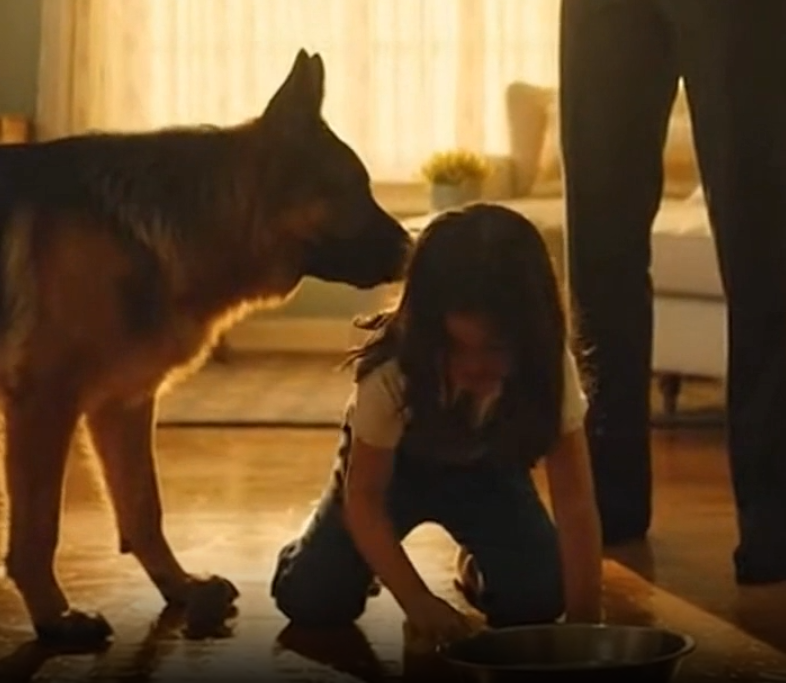
I came home early to surprise my wife. Instead, I found my 6-year-old daughter on her knees, scrubbing the floor while crying… and my wife standing over her like a drill sergeant.
There is a specific kind of silence that hangs over a crime scene. It’s heavy, thick with unspoken horrors and violence already committed. I’ve walked into that silence a thousand times in my career as a police officer. I know the taste of it. I know the weight of it.
But I never expected to feel it in my own hallway.
It was a Thursday afternoon, late October. The Virginia sun filtered through the maple trees, casting long shadows across our manicured lawn. I had clocked out early—a double homicide case finally closed, suspect in custody. My sergeant looked at the dark circles under my eyes and told me to go home.
“Go be a human being for a few hours, Harper,” he’d said.
I drove home with a lightness in my chest I hadn’t felt in weeks. I stopped at a bakery and picked up chocolate eclairs for Sarah and a glazed donut with sprinkles for Emily. I pictured the scene: Sarah looking up from her book with that soft smile, Emily barreling down the hallway screaming “Daddy!” before tackling my legs.
That was the dream. That was the life I thought I had built after my first wife passed away.
I pulled into the driveway and killed the engine. The house looked perfect—brick and mortar packaging of the American Dream. I didn’t use the garage opener. I wanted to surprise them.
I slid my key into the lock and turned it gently. The mechanism clicked open without a sound—habit. When you spend half your life executing search warrants, you learn how to open a door silently.
I stepped into the foyer.
The house was too quiet.
“Sarah?” I called out softly, playfully.
No answer.
Then I heard it. Not a scream. Not a shout. A sound so small and broken it barely registered as human—the wet, gasping hitch of a child desperately trying to swallow a sob.
My stomach dropped. The pastry box suddenly felt like lead.
I moved. I didn’t walk; I stalked. My tactical boots made no noise on the hardwood. I moved past the dining room, past our wedding photos where Sarah looked like an angel in white lace, toward the living room.
Afternoon sun poured through sheer curtains, turning dust motes into dancing gold. It should have been beautiful.
But in the center of the room, my six-year-old daughter Emily was on her knees.
She looked tiny. Too tiny. She wore her favorite astronaut pajamas, but they seemed too big now. Her usually shiny hair was a tangled mess falling over her face.
She was holding a damp gray rag in both hands, knuckles white, scrubbing the rug with frantic, terrified intensity that no child should ever possess.
“Please,” she whispered, the word cracking in the middle. “I’m trying. I’m trying.”
Standing over her was Sarah.
My wife.
Sarah Harper prided herself on presentation. Always put together—sleek ponytail, subtle makeup, tailored clothes. She once told me chaos was a sign of a weak mind.
Right now, she looked like a statue of ice, arms crossed, hip cocked, watching a six-year-old cry over a rug.
“Scrub harder,” Sarah said.
Her voice wasn’t loud. It was cold—a flat, razor-sharp tone that cut through the air like a whip. “I told you what happens when you make a mess in my house.”
“I… I didn’t mean to,” Emily choked out, tears dripping onto the spot she was cleaning.
“Stop crying,” Sarah snapped. “Tears are for babies. Are you a baby, Emily? Is that what you are?”
“No,” Emily whimpered.
“Then fix it.”
I stood frozen in the archway. My brain was trying to reconcile the woman I knew—the woman who rubbed my back when I had nightmares, who organized charity bake sales—with this tyrant in my living room.
Then it got worse.
From behind the sofa, Max came scrambling out.
Max was our German Shepherd puppy. I’d brought him home four months ago, hoping he’d be a guardian for Emily. He was all paws and ears, clumsy but with a heart the size of a lion.
He saw Emily crying. He saw the tension in Sarah’s body.
He didn’t run away. He ran to her.
Max skidded across the floor and wedged himself between Emily and Sarah. He let out a high-pitched, brave little bark—a puppy trying to sound like a wolf. Protecting her.
Sarah didn’t even blink.
“Shut up,” she hissed.
She pulled her leg back and kicked him.
It wasn’t a nudge. It wasn’t a gentle push. It was a solid, vicious kick with her designer flat, right into the puppy’s ribs.
Max yelped—a sharp, piercing sound of pain—and slid across the polished floor, crashing into the coffee table leg. He scrambled to get up, legs shaking, whining in confusion and fear. But even then, he didn’t run. He tried to crawl back toward Emily.
That was the moment the husband died, and the cop took over.
The red haze of rage behind my eyes was blinding, but I locked it down. I locked it in the iron box where I keep the things I see on the street. If I lost control now, if I laid a hand on her, I would lose everything. I needed to be smart. I needed to be dangerous.
I took a step forward. My boot heel struck the floor with a deliberate, heavy thud.
Sarah spun around.
For a split second, I saw it. The face beneath the mask. Eyes wide with feral panic, lips pulled back in a snarl.
Then, in a blink, it vanished.
Her shoulders dropped. Hands unclenched. Face smoothed into pleasant surprise. It was terrifying how fast she did it. Like watching a reptilian eyelid slide back.
“Daniel!” she exclaimed, voice light and breathless. “Oh my god, you scared me! You’re home early.”
She stepped toward me, reaching for a hug.
I didn’t move. I didn’t smile. I let the silence stretch between us, tight as piano wire.
My eyes went to Emily. She hadn’t moved. Still on her knees, frozen like a prey animal hoping the predator wouldn’t notice. She was looking at me, but she didn’t run to me.
Why didn’t she run to me?
“What is happening here?” I asked. My voice sounded strange—low, gravelly, vibrating with restrained violence.
Sarah stopped halfway to me. She sensed the shift. She laughed, a nervous, tinkling sound that grated on my nerves.
“Oh, nothing, honey,” she said, waving a hand dismissively. “Just a little discipline. Emily spilled juice on the new rug. Again. I was teaching her to clean up after herself. You know how important responsibility is.”
“Responsibility,” I repeated.
I looked at Max. The puppy was cowering by the coffee table, favoring his left side.
“And kicking the dog?” I asked. “Is that part of the lesson?”
Sarah’s smile faltered for a fraction of a second. “He… he was biting at my ankles, Daniel. He’s getting aggressive. I just nudged him away. You know how dramatic puppies can be.”
She was lying. Standing in our home, looking me in the eye and lying with the ease of a sociopath.
I looked at Emily again. “Em?” I said gently.
She flinched.
That flinch hit harder than a bullet. My daughter, who used to think I hung the moon, just flinched at the sound of my voice.
She looked at Sarah. A quick, terrified dart of her eyes. Sarah gave the slightest nod—so small that if I hadn’t been trained to watch for tells during interrogations, I would have missed it.
“I made a mess, Daddy,” Emily whispered, reciting a script. “I’m sorry. I’m cleaning it.”
I felt sick. Physically sick. This wasn’t just a bad afternoon. This was a system. This was established fear.
I walked over to Emily and knelt down, ignoring Sarah completely. I put my hand on my daughter’s shoulder. She was trembling so hard it felt like she was vibrating.
“Leave it,” I said softly.
“But Mommy said—”
“I said leave it.”
I stood up and turned to Sarah. I was close now. Close enough to smell her expensive perfume, close enough to see the tiny pulse jumping in her neck.
“She’s six years old, Sarah,” I said. “She’s not a recruit. She’s a child.”
Sarah crossed her arms, defensive. The mask was slipping again. “You baby her, Daniel. That’s the problem. She’s weak because you make her weak. I’m trying to help her grow up.”
“By making her scrub floors and kicking her dog?”
“By teaching her consequences!” Sarah snapped, voice rising. “God, you’re so dramatic. You deal with criminals all day and then come home and treat me like one just because I’m trying to run a household?”
She was gaslighting me. Trying to twist the narrative, make me feel guilty for protecting my child. Classic manipulation.
“Go to your room, Emily,” Sarah said, looking over my shoulder. “Take the mutt with you.”
Emily scrambled up, scooped Max into her arms—struggling with his weight—and bolted for the hallway. She didn’t look back. She just wanted to escape.
I watched her go, then looked back at my wife.
“I’m going to take a shower,” I said.
Sarah blinked, surprised by my sudden retreat. She had expected a fight, prepared for an argument she could win with words and tears. She wasn’t ready for silence.
“Oh,” she said, posture relaxing. “Okay. I’ll… I’ll start dinner. We can talk about this later when you’re calmer.”
“Yeah,” I said. “We’ll talk later.”
I walked past her, down the hall, into our bedroom. I closed the door and locked it.
I didn’t take a shower.
I sat on the edge of the bed and put my head in my hands. My hands were shaking—not from fear, but from the adrenaline of a man who realizes he’s been sleeping next to a viper.
I thought about the last few months. Emily becoming quieter. Max barking every time Sarah walked into a room. The bruises Emily said were from “playing.” My frequent business trips. Sarah’s insistence that she could “handle things” while I was gone.
It all clicked into place. The picture was ugly and clear.
I reached into my pocket and pulled out my phone. I stared at the black screen.
I could confront her now. Scream. Kick her out. But then it would be my word against hers. She was charming. Manipulative. She would tell the courts I was an aggressive cop with PTSD who intimidated his wife. She would fight for custody just to spite me.
No.
I needed more than my word. I needed proof.
I stood and walked to the closet. On the top shelf, hidden behind my old uniforms, was a duffel bag I used for surveillance ops. Inside were three high-definition, motion-activated micro-cameras.
I unzipped the bag. The equipment stared back at me, cold and efficient.
“You want to talk about responsibility, Sarah?” I whispered to the empty room. “Let’s see how responsible you are when you think no one is watching.”
I wasn’t just a husband anymore. I was an investigator.
And the investigation into Sarah Harper had just begun.
Over the next week, I became a ghost in my own home. I installed the cameras in three locations: one in the living room behind a picture frame, one in the kitchen inside a decorative clock, and one in Emily’s bedroom disguised as a nightlight. Motion-activated, cloud-uploaded, invisible.
I kept my distance from Sarah. I worked late shifts, picked up extra hours, made myself scarce. I played the part of the defeated husband, the one who didn’t want confrontation. Sarah bought it. She relaxed. She stopped watching her back.
The footage started rolling in on day two.
I watched it in my patrol car during breaks, my service weapon heavy on my hip, my coffee growing cold in the cup holder. Each video was a knife to the gut.
Day two, 2:47 PM: Sarah made Emily stand in the corner for an hour because she laughed too loudly during a cartoon. When Emily’s legs started shaking and she asked to sit down, Sarah said, “Soldiers don’t sit. Are you weak, Emily? Are you a disappointment?”
Day three, 11:23 AM: Max knocked over a plant while playing. Sarah grabbed him by the scruff of his neck and locked him in the basement for six hours. I could hear him whimpering through the floorboards on the recording.
Day four, 4:15 PM: Emily drew a picture at school—a happy family with stick figures holding hands. She brought it home proudly. Sarah took one look at it, crumpled it up, and threw it in the trash. “This is garbage,” she said. “Just like your effort. Do it again. Do it perfectly.”
Day five, 6:33 PM: Emily spilled water at dinner. Just water. Sarah made her eat dinner on the floor, with no utensils, like an animal. “This is where messy children eat,” she said. Emily cried silently, tears running down her cheeks as she picked at her food with her fingers.
Day six was when I hit my breaking point.
I was watching the footage from Emily’s bedroom camera. It was 8:47 PM. Emily was in bed, Max curled up at her feet. Sarah walked in for “bedtime check.”
Emily was already under the covers, eyes closed, pretending to sleep.
Sarah stood over her for a long moment. Then she said, softly, almost tenderly, “I know you’re awake, Emily.”
Emily’s eyes opened. She looked terrified.
“You told your teacher that you were sad today,” Sarah said. “Mrs. Patterson called me. She said you seemed withdrawn.”
Emily’s lower lip trembled. “I’m sorry.”
“What did I tell you about airing our business to strangers?”
“Not to.”
“That’s right. What happens in this house stays in this house. Do you understand me?”
“Yes, Mommy.”
Sarah leaned down, her face inches from Emily’s. “If you ever embarrass me like that again, if you ever make me look like a bad mother, I will send Max away. Do you understand? I will take him to the pound and you will never see him again.”
Emily started crying. “No, please. I’ll be good. I promise.”
“Then prove it. Stop being weak. Stop crying. Stop making me look bad.”
Sarah straightened up, turned off the light, and walked out.
Emily pulled Max close and sobbed into his fur, muffling the sound so Sarah wouldn’t hear.
I watched that video three times. Then I closed my laptop, walked into the station bathroom, and threw up.
When I came out, my captain was waiting for me.
“Harper, you look like hell,” he said. “What’s going on?”
I stared at him. Captain Rodriguez was a good man. Tough, fair, a father of three. I trusted him.
“I need to talk to you,” I said. “Off the record.”
We went into his office. I closed the door. I showed him the videos.
He watched in silence, his jaw tightening with every frame. When the last video finished, he sat back in his chair and rubbed his face with both hands.
“Jesus Christ, Danny,” he said quietly. “That’s your wife?”
“Was,” I said. “That was my wife.”
He looked at me. “What do you want to do?”
“I want to protect my daughter. I want full custody. I want Sarah out of our lives. But I need to do this right. I can’t have her claim I’m the aggressor. I can’t have her twist this.”
Rodriguez nodded slowly. “You need a lawyer. A good one. Family court is a different beast than criminal court. And you need to document everything. Keep those videos safe. Make copies. Cloud storage, external drives, everything.”
“Already done.”
“Good.” He paused. “And Danny? When this goes down, it’s going to get ugly. She’s going to fight. She’s going to lie. She’s going to make you out to be the villain. Are you ready for that?”
I thought about Emily’s face. Her flinch. Her tears. Her fear.
“I’ve been ready since the moment I walked through that door,” I said.
The next morning, I called a family lawyer named Patricia Moreno. She had a reputation for being ruthless and brilliant. I sent her the videos. She called me back within an hour.
“Mr. Harper,” she said, “I’m taking your case. And I’m going to make sure your daughter never has to live in fear again.”
The legal process moved faster than I expected. Patricia filed for an emergency custody hearing, citing documented evidence of child abuse and animal cruelty. The videos were submitted under seal. A child psychologist was appointed to evaluate Emily.
Sarah didn’t see it coming.
I served her the papers on a Monday morning. I had already moved Emily and Max to my brother’s house for safety. When Sarah opened the envelope and read the contents, her face went white.
“What is this?” she hissed.
“It’s over, Sarah,” I said calmly. “I know what you’ve been doing. I have proof. You’re going to pack your things and leave. Today.”
Her mask shattered. The rage underneath was volcanic.
“You bastard!” she screamed. “You think you can take my daughter away from me? I’m her mother! I gave birth to her! You’re just some cop with a savior complex who thinks he knows everything!”
“I’m her father,” I said. “And I’m the one who’s going to keep her safe.”
“Safe? You’re never here! You’re always at work! I’m the one who raised her! I’m the one who sacrificed everything!”
“You sacrificed nothing. You terrorized a child because you’re a control freak who gets off on power.”
She lunged at me, nails out, screaming. I sidestepped easily, caught her wrist, and restrained her without hurting her. Years of training.
“Don’t touch me!” she shrieked.
“Then don’t attack me,” I said coldly. “Pack your things and get out. If you resist, I’ll call the police. And trust me, Sarah—they’ll believe me.”
She jerked away from me, breathing hard. For a moment, I thought she might actually try to hurt me. But she was too smart for that. She knew the game was over.
“You’re going to regret this,” she spat. “I’ll take you for everything. I’ll make sure you never see Emily again.”
“Good luck with that,” I said. “Your performance is already on record.”
She stared at me, and in that moment, I saw her clearly for the first time. She wasn’t a wife. She wasn’t a partner. She was a predator who had worn a human mask so convincingly that I had married her, brought her into my home, and trusted her with my child.
Never again.
She packed two suitcases and left within the hour. She didn’t say goodbye to Emily. She didn’t ask about her. She just walked out the door and slammed it behind her.
The custody hearing was three weeks later.
Patricia was a force of nature. She presented the videos, the psychologist’s report, testimony from Emily’s teacher, and even a statement from our veterinarian about Max’s injuries.
Sarah’s lawyer tried to paint me as a controlling, paranoid cop who had set up his wife. But the evidence was overwhelming. The judge, a stern woman in her sixties, watched the videos with an expression that could have curdled milk.
When the last video finished, she removed her glasses and looked directly at Sarah.
“Mrs. Harper,” she said, “in my thirty years on the bench, I have seen many forms of abuse. What I have witnessed today is systematic psychological torture of a child. It is unconscionable. It is unforgivable.”
Sarah tried to speak. “Your Honor, I—”
“I am not finished,” the judge cut her off. “You will have supervised visitation only, pending a full psychological evaluation. Custody is awarded to the father, effective immediately. This court also recommends that the district attorney review this case for possible criminal charges of child endangerment and animal cruelty.”
The gavel came down.
Sarah’s face went from white to red. She stood up, shaking. “This isn’t over!” she shouted. “He poisoned you all against me! He’s lying! He’s—”
“Mrs. Harper, sit down or you will be held in contempt,” the judge said coldly.
Sarah sat. But the look she gave me was pure venom.
I didn’t care. I had won.
That evening, I picked up Emily from my brother’s house. She was sitting on the porch steps with Max, reading a book. When she saw my car pull up, she looked up, hesitant.
I got out and walked over to her. I knelt down so we were eye to eye.
“Em,” I said gently. “You’re coming home with me. Just you, me, and Max. And you’re never going to have to be afraid again.”
Her eyes filled with tears. “Promise?”
“I promise.”
She threw her arms around my neck and sobbed. I held her tight, feeling her little body shake with relief.
Max barked once, happily, and wagged his tail.
We drove home as the sun set over the Virginia hills. Emily fell asleep in the backseat, Max’s head in her lap. I looked at them in the rearview mirror and felt something I hadn’t felt in months.
Peace.
The house was different now. I repainted Emily’s room in her favorite color—lavender. I threw out the furniture Sarah had chosen and let Emily pick out new things. I put up her drawings on the fridge. I let Max sleep on the couch.
And slowly, day by day, Emily started to heal.
She laughed more. She played more. She stopped flinching when I walked into a room. The light came back into her eyes.
One night, about six months later, I was tucking her into bed. She looked up at me with those big, solemn eyes and said, “Daddy?”
“Yeah, sweetheart?”
“Thank you for saving me.”
I felt my throat tighten. “You don’t have to thank me, Em. That’s what dads do.”
“But you did it anyway,” she said. “Even when it was hard.”
I kissed her forehead. “Always, baby. Always.”
As I walked out of her room, I thought about the man I used to be. The man who thought he had it all figured out. The man who believed in the facade.
That man was gone.
In his place was someone harder, wiser, and infinitely more protective.
I had learned the most important lesson of my life: never assume the people closest to you are who they say they are.
Always watch. Always listen. Always protect.
Because sometimes, the monster isn’t in the dark alley or the crime scene.
Sometimes, the monster is at the dinner table, wearing a smile.