My police dog went ballistic at a stranger’s house in the pouring rain. Inside, a woman watched two freezing children through the glass, holding a wooden stick… and smiling.
The rain in the suburbs doesn’t wash things clean; it just makes the secrets harder to see.
It was a Thursday, late afternoon, the kind of gray, miserable day where the sky feels heavy enough to crush the rooftops. I was patrolling Sector 4, a quiet grid of manicured lawns and two-car garages where the biggest crimes were usually noise complaints or teenagers smoking weed behind the community center.
My name is Officer Daniel Reed. I’ve been on the force for fifteen years, K-9 unit for the last six. People say I’m “by the book.” They say it like it’s an insult, like I lack imagination. They don’t understand.
Years ago, an IED in a desert halfway across the world scrambled my brain. The doctors called it a Traumatic Brain Injury. I called it a reset button. When I came back, the world was too loud, too chaotic. I lost the ability to trust my gut. Intuition became a foreign language. So, I replaced it with procedure. Rules. Protocols. The book doesn’t lie. The book doesn’t hallucinate. The book keeps you alive.
But Atlas… Atlas doesn’t read books.
Atlas is a five-year-old German Shepherd, eighty pounds of muscle and instinct wrapped in black and tan fur. He sat in the back of the cruiser, his breathing usually a rhythmic white noise that helped me think. But today, the rhythm broke.
We were cruising at fifteen miles per hour past a row of identical houses when Atlas hit the window.
It wasn’t a bark. A bark is a challenge. This was a thud—his shoulder slamming against the reinforced glass—followed by a sound I rarely heard from him. A low, vibrating whine that started in his chest and ended in a sharp intake of breath.
I checked the mirrors. Nothing. The street was empty, the sidewalks deserted in the downpour.
“Easy, Atlas,” I said, my voice flat. “Settle down.”
He didn’t settle. He escalated. He began pacing the small cage, his claws clicking frantically against the metal floor. He let out a sharp yip, staring out the side window, his nose working overtime, decoding the wet air.
I stopped the car.
Procedure says you don’t stop without probable cause or a dispatch call. But the first rule of K-9 handling overrides the manual: Trust your dog. If Atlas said something was wrong, the universe was out of alignment.
I looked where he was looking.
It was a beige house, unremarkable in every way. The lawn was cut, the hedges trimmed. But there was something on the porch.
At first, I thought it was a pile of trash bags left out for pickup. Then the “trash bags” moved.
I squinted through the rain-slicked windshield. It was a person. Small. Sitting on the concrete step, huddled under the overhang of the roof, but the wind was blowing the rain sideways, soaking them anyway.
“Dispatch, this is K-9 One,” I radioed, my thumb brushing the mic automatically. “I’m initiating a welfare check at 420 Oak Creek. Suspicious activity.”
“Copy, K-9 One. Proceed with caution.”
I cracked the door open. The smell of wet asphalt and ozone hit me. I clipped the leash onto Atlas’s collar. He didn’t pull, which was strange. Usually, when he’s amped up, he’s a tow truck. Today, he was glued to my leg, his body rigid, his amber eyes locked on that porch.
We walked up the driveway. The sound of the rain was deafening, masking the crunch of my boots.
As we got closer, the shape resolved into a boy.
He couldn’t have been more than six years old. He was white, pale as a sheet of paper, with wet brown hair plastered to his skull. He was wearing a thin windbreaker that looked like it belonged to a smaller child, the sleeves riding up his forearms.
But he wasn’t hugging himself. He was hugging a bundle.
I stopped ten feet away. The boy looked up.
I have seen fear in my life. I’ve seen the fear of soldiers under fire, the fear of criminals caught in the act. But the look in this kid’s eyes was different. It was the hollow, ancient fear of someone who expects pain the way other people expect the sun to rise.
He didn’t speak. He didn’t ask for help. He just curled tighter around the bundle in his lap.
“Hey there,” I said, pitching my voice low, the way I do with skittish victims. “I’m Officer Reed. This is Atlas. You’re getting soaked out here, son.”
The boy didn’t blink. His gaze flicked from me to the house behind him, then back to me.
I took a step forward. Atlas whined again, pressing his wet nose against the back of my hand.
That’s when I saw the bundle move. A tiny, jerky motion.
It wasn’t a doll. It was a baby.
My stomach dropped. A newborn, wrapped in a flannel blannel that was rapidly soaking through. The baby’s face was visible—grayish-blue lips, eyes squeezed shut against the cold dampness.
“Jesus,” I whispered. Procedure went out the window. This was immediate danger to life.
“We need to get you inside,” I said, moving faster now, closing the gap. “Is this your house? Is your mom home?”
The boy flinched when I said mom. He shook his head violently, a frantic no that seemed to rattle his whole small body.
“Okay, okay,” I soothed. “But we can’t stay out here. Look at your brother. He’s cold.”
The boy looked down at the infant. The mention of the baby’s distress seemed to break his paralysis. He looked up at me, his lip trembling, and whispered a single word.
“Locked.”
I looked at the front door. It was a standard storm door with a heavy glass panel. Behind the glass, the inner wooden door was wide open.
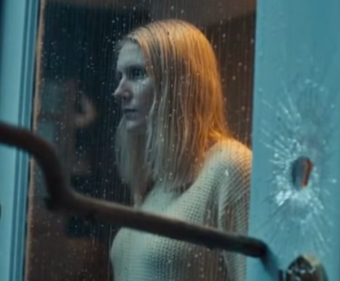
And standing there, framed like a portrait of malice, was a woman.
She was tall, thin, with severe dark blonde hair pulled back so tight it pulled the skin of her face taut. She was wearing a crisp blouse and slacks, dry and warm. She wasn’t on the phone calling for help. She wasn’t frantically looking for keys.
She was just watching.
Her arms were crossed, but in her right hand, resting casually against her hip, was a thick wooden dowel. It looked like a closet rod, cut down to about two feet. The end was worn smooth.
Our eyes met through the rain and the glass. Her eyes were colorless, flat. There was no surprise in them. No panic. She looked at me with the annoyance of someone whose dinner plans had been interrupted by a solicitor.
She raised the stick an inch, pointing it at the boy, then tapped it against the glass. Tap. Tap.
The boy heard it. He curled into a ball, trying to make himself disappear, shielding the baby with his own spine.
I felt a heat rise up the back of my neck that had nothing to do with the weather. It was a primitive, roaring anger that my therapist had told me to suppress years ago.
“Ma’am!” I shouted, my hand instinctively dropping to my belt, though not to my weapon. “Open this door! Now!”
She didn’t move. She mouthed something. I couldn’t hear it over the rain, but I can read lips.
Go away.
Atlas let out a sound I had never heard before. It was a roar, deep and guttural, a vibration that traveled up the leash and into my arm. He stepped in front of me, placing himself between the woman and the boy.
I looked at the boy’s arms. The wet jacket had ridden up further.
That’s when I saw the map of his life.
Bruises. Yellow ones, fading green ones, and fresh, angry purple ones. They weren’t the scraped knees of a kid playing soccer. They were patterned. Straight lines. About the width of a wooden dowel.
The world narrowed down to a tunnel. The rain disappeared. The protocol manual in my head burned to ash.
“Dispatch,” I said into the radio, my voice terrifyingly calm. “I need an ambulance at 420 Oak Creek. Pediatric exposure, possible hypothermia. And send backup. I have a suspect refusing entry. I am making entry.”
I didn’t wait for the confirmation. I knelt down in the mud, right in front of the boy. Atlas stood guard, staring at the woman, daring her to move.
“What’s your name, son?” I asked, unzipping my heavy tactical rain jacket.
He hesitated, his eyes darting to the stick behind the glass.
“Noah,” he whispered.
“Okay, Noah. I’m going to put this jacket over you and the baby. It’s going to be warm. And then,” I looked up at the woman, who was finally starting to look uncertain as she saw the look on my face, “we are going to have a talk with the lady inside.”
“She said…” Noah’s voice cracked. “She said there’s no room.”
I took the jacket off, feeling the icy rain hit my uniform shirt. I wrapped it around him and the baby—Eli, I would learn later—engulfing them in the warmth of my body heat.
“She’s wrong,” I said, standing up and turning to face the door. Atlas moved with me, a loaded weapon on four legs.
I walked up the steps. I didn’t knock. I didn’t ask.
I gripped the handle of the storm door. Locked.
The woman smirked. It was a small, tight movement of her lips. She thought the lock protected her. She thought the badge meant I had to play nice.
She didn’t know about the reset button. She didn’t know that when I looked at Noah, I didn’t just see a victim. I saw a reflection of a pain I had buried six years ago. A pain that was about to claw its way out of the grave.
I pulled my baton, shattered the glass in one strike, and reached inside to unlock the door.
The sound of shattering glass was the loudest thing in the world.
The woman stumbled backward, her smirk replaced by something close to shock. The wooden dowel clattered to the floor as she raised her hands defensively.
“You can’t—” she started.
“Exigent circumstances,” I cut her off, my voice like gravel. “Immediate danger to minors. Step back.”
Atlas was already inside, positioning himself between her and the door, his teeth bared in a silent promise.
I turned back to Noah and Eli. The ambulance sirens were wailing in the distance, growing louder. I scooped both boys up, feeling how light Noah was, how fragile Eli felt against my chest.
“It’s over,” I told Noah, and for the first time since I’d seen him, his eyes showed something other than fear. It was hope, tentative and trembling, but real.
The paramedics arrived within minutes. Backup came right behind them. As they loaded the boys into the ambulance, wrapping them in heated blankets and checking vitals, I gave my statement to Sergeant Martinez.
The woman—whose name I learned was Rebecca Foster, the boys’ foster mother—was taken into custody. The investigation would reveal a house of horrors: a locked bedroom with a mattress on the floor, food withheld as punishment, and that wooden dowel, which had become an instrument of daily terror.
But there were also miracles in the wreckage.
Noah and Eli were placed in emergency care that night. Within a week, they were with a new family—the Harrisons, a couple who had been through the foster system themselves and understood the long road to healing.
I visited them twice in those early days. The second time, Noah was sitting on a couch with actual cushions, holding Eli, who was pink and healthy and crying the way babies should cry—loud and demanding and alive.
Noah looked up at me and said, “Thank you.”
I wanted to tell him it was my job. I wanted to cite procedure, to make it clinical and professional. But the words wouldn’t come.
Instead, I knelt down, and Atlas padded over to rest his head on Noah’s knee.
“You protected your brother,” I said. “You’re the hero here.”
He shook his head, his small hand buried in Atlas’s fur. “Atlas knew. He saved us.”
I looked at my partner, at those amber eyes that had seen what I couldn’t, that had trusted instinct when I had lost mine.
“Yeah,” I said softly. “He did.”
Six months later, I got a letter. It was written in crayon, the letters uneven but determined:
“Dear Officer Reed and Atlas, We got adopted! The Harrisons are nice. Eli walks now. I told him about you. Thank you for breaking the door. Love, Noah.”
I kept that letter in my patrol car, tucked into the visor. On the hard days, when the world felt too heavy and the protocol manual felt too thin, I would read it.
And I would remember that sometimes, the book is wrong.
Sometimes, you have to trust the dog.
Sometimes, you have to break the glass.
And sometimes, when you do, you don’t just save a life. You save a future.
Atlas still patrols with me. He’s older now, a little gray around the muzzle, but his nose is as sharp as ever. And every time we pass 420 Oak Creek—now occupied by a retired teacher who waves from her garden—he looks at me with those knowing eyes.
He doesn’t need to bark. We both know what we found there.
We both know what we saved.
And we both know that in the silence between the raindrops, in the space between procedure and instinct, there lives a truth more powerful than any manual:
Love, even the love of a stranger, can shatter the glass that traps the innocent.
And sometimes, a dog knows better than we do when it’s time to act.