
The Westbrook High School library had a smell that Maya Chen had memorized over three years — old paper, lemon wood polish, and the faint ghost of someone’s forgotten coffee. It was her favorite place in a building she otherwise found suffocating. Between the shelves and the long reading tables, she was invisible in the best possible way. Nobody bothered the girl with her nose in a chemistry textbook. Nobody wanted anything from her here.
That Tuesday afternoon in November, she arrived twenty minutes early to claim Table 4 — the one near the tall east-facing windows where the winter light fell flat and clean, perfect for reading without squinting. She spread out her things methodically: textbook, yellow highlighter, spiral notebook, the green travel mug her brother Eli had bought her for her sixteenth birthday. She pulled out her earbuds, decided against music, and let the library hush settle around her like a held breath.
Three tables back, almost hidden behind a shelf displaying this month’s staff picks, her older brother Eli Chen had already been sitting for forty minutes. He was a freshman at Westbrook Community College now, but the high school library still had the best Wi-Fi within walking distance of his apartment, and the librarian, Mrs. Patel, had never had the heart to turn him away. He had his laptop open, headphones resting around his neck, a half-finished problem set for his Calculus II course in front of him. He was the kind of person who went entirely unnoticed in libraries. He liked it that way too.
He noticed Maya come in. Gave her a small wave she didn’t see. Smiled to himself and went back to derivatives.
He did not notice Derek Hoffman until Derek was already standing over Maya’s table.
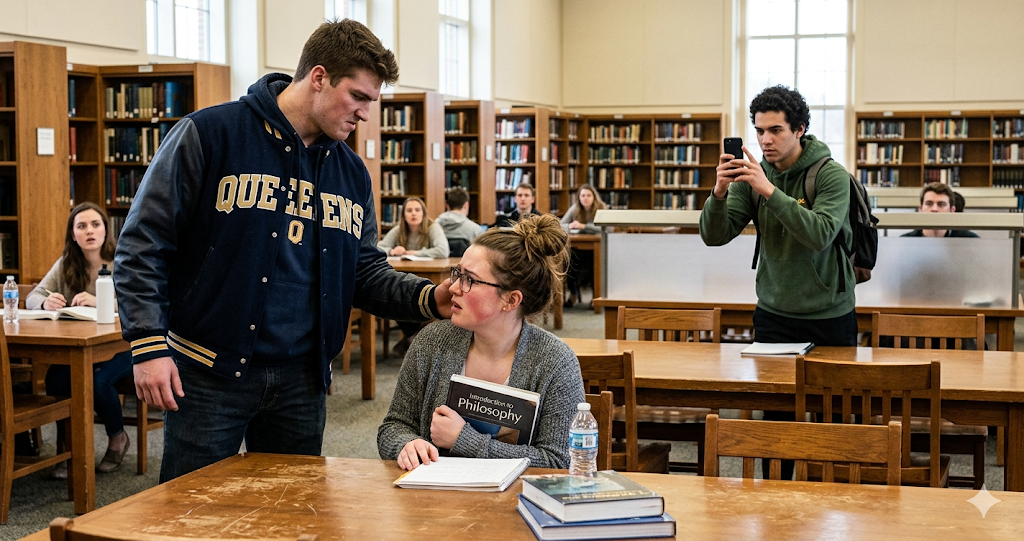
Derek was hard to miss in hallways — six-foot-two, broad-shouldered, wearing his varsity jacket like a second skin — but in the library he’d somehow materialized silently, the way predators do when they’ve stopped caring whether you hear them coming. His girlfriend Jessica Hale trailed two steps behind him, phone already raised, scanning the room the way influencers scan for lighting.
“Move.”
Maya looked up slowly, the way people do when they’re deep in thought and a sound reaches them from far away. Eli, three tables back, registered the word but not yet the weight of it. He looked up from his laptop.
“I’m sorry?” Maya said.
“I said move. My girlfriend wants this table.” Derek jerked his chin toward Jessica, who tilted her head and offered a performance of a smile. “It has the best lighting for her stories.”
Eli set down his pencil.
He’d known Derek Hoffman by reputation for two years — back when Eli was still a senior here and Derek was a sophomore just beginning to understand what the varsity jacket meant in the social architecture of this school. He’d seen the type. He’d never had a direct problem with him. But something in Derek’s posture — the absolute certainty, the laziness of the entitlement — made the hair on the back of Eli’s neck rise. Quietly, without thinking too hard about why, he picked up his phone and opened the camera.
He would tell people later that he didn’t know. That it was instinct. That something in the air told him to press record.
“There are plenty of other tables,” Maya said. Her voice was calm. She glanced around the near-empty library — maybe a dozen students scattered across twenty tables, plenty of window-adjacent spots still open. “Any of those would work just as well for—”
The sound hit before Eli’s brain could process what his eyes were seeing.
A sharp, flat crack. Like a book dropped spine-first on a hard floor. Except it wasn’t a book.
Maya’s head snapped sideways. Her chemistry textbook slid off the table and hit the linoleum with a heavy thud. Her green travel mug rocked but didn’t fall. She sat perfectly still for one second, two seconds — the stillness of someone whose nervous system hasn’t finished receiving the information — and then her hand came up slowly to her cheek.
The library went silent in a way it had not been silent before. The silence before had been comfortable, chosen. This silence was the silence of forty people freezing mid-breath.
Phones rose. Students who had been staring at textbooks were now staring at the space between Derek Hoffman and the girl at Table 4.
Eli’s phone was already recording.
His hand had gone completely steady — the steadiness that comes not from calm but from a cold, crystalline focus. He didn’t move from his seat. He didn’t make a sound. He made himself small behind the staff picks shelf and kept the lens centered on Derek’s face.
“When I tell you to move,” Derek said, his voice dropping into something uglier, more private, “you move. This isn’t complicated. Nobody wants to look at your pathetic—”
A chair scraped against the floor.
Not Eli’s chair. Someone else’s. A junior named Marcus Webb, who played trumpet in the school band and had never once been in a fight, stood up three tables to the left. He didn’t say anything. He just stood. Then another student stood — a girl named Priya Okafor who Maya barely knew, a sophomore who spent her lunch breaks reading graphic novels in the biography section. Then a senior named Connor Walsh, who was Derek’s teammate on the football team and who had looked the other way at things before and was apparently done doing that.
Derek looked around. For the first time, something flickered across his face that wasn’t certainty.
Mrs. Patel had emerged from behind the reference desk. She was sixty-one years old, five foot three, and had the particular authority of a woman who has maintained order over ten thousand teenagers and is no longer impressed by any of them. “Derek Hoffman,” she said, with the tone of someone reading a name into a permanent record. “Step away from that table. Now.”
Derek stepped back. Once. He looked at Maya — still sitting, still pressing her hand to her cheek, watching him with an expression he couldn’t read because he’d never bothered to learn what quiet dignity looked like — and he said, “It’s not a big deal,” with the desperation of a person who knows it is.
Jessica had already put her phone down.
Eli stopped recording. He had fifty-three seconds of video. He looked at the thumbnail — Derek’s face in profile, hand extended, the full arc of the motion, Maya’s head turning, the thud of the book — and he sat with it for a long moment before he texted his sister.
You okay?
On the other side of the room, he watched Maya’s phone buzz. Watched her look at it. Watched something cross her face — confusion first, then she turned slowly and scanned the library, and her eyes found him three tables back, phone in hand.
He gave her a small nod.
Her eyes went wide.
He mouthed: I got it. All of it.
The next hour moved quickly and then slowly. Principal Torres arrived in the library within six minutes of Mrs. Patel’s call. Derek’s parents were called. Maya’s parents were called. Eli was asked to come to the office, and he walked there with his phone in his pocket and his jaw set and the recording backed up to three different places because he was an engineering student and he was not taking chances.
He sat across the desk from Principal Torres and played the video. Fifty-three seconds. No ambiguity. No angle problem. The sound of the slap was so clear in the recording that Torres visibly flinched.
“I wasn’t trying to film anything,” Eli said quietly. “I just had a feeling.”
Derek was suspended immediately — three days pending a full disciplinary review. The review, which took place the following week with parents and the school district’s legal liaison present, resulted in a ten-day suspension and removal from the football team for the remainder of the season. There was discussion about whether the matter would be referred to local law enforcement; Maya’s parents, after consulting with their own lawyer, decided to reserve that option.
The video did not stay in that principal’s office. Eli had not posted it. He hadn’t sent it to anyone except the school administration. But seventeen students had filmed pieces of the incident on their own phones, and by Wednesday morning a composite clip assembled from four different angles had twenty thousand views on TikTok. By Thursday it had a quarter million. By Friday it had passed a million, and local news was outside Westbrook High, and Derek Hoffman’s name was in headlines, and people who had never heard of the school were leaving comments in the thousands.
Maya did not watch the videos. She’d seen enough.
What she did watch — once, sitting in the kitchen of the apartment she shared with her parents and her brother, late on Thursday night when the house was quiet — was Eli’s original fifty-three-second recording. He sat next to her at the kitchen table and they watched it together without speaking, the way you watch something you survived.
“You were already recording when it happened,” she said.
“Yeah.”
“How did you know?”
Eli was quiet for a moment. He thought about how to explain it — the posture, the certainty, the lazy cruelty of people who’ve never had to justify themselves — and decided he couldn’t explain it any better than the feeling itself.
“You’re my sister,” he said finally. “I just knew.”
Maya looked at the frozen final frame of the video — Derek stepping back, Mrs. Patel in the background, herself sitting at the table with her hand to her cheek and her book on the floor — and she thought about the way the library had felt in those seconds after the slap. The held breath. The phones rising. Marcus standing up. Priya standing up. Connor, who had looked the other way before and chose differently this time.
“A lot of people stood up,” she said.
“Yeah,” Eli said. “They did.”
She closed the video. Outside the kitchen window, the November dark was total, no moon, just streetlights making halos in the cold. She thought about Table 4, and the flat winter light, and how she’d go back there on Monday and it would be hers again — not because anyone gave it to her, but because it had always been hers, in the way that any space belongs to the person willing to simply sit in it and be.
She thought about the sound the slap had made. How she’d heard it before she’d felt it. How the library had echoed it back like a confession.
She picked up her green travel mug — the one that hadn’t fallen — and finished the last of her cold tea.
“Thanks for being there,” she said.
Eli picked up his own mug. “I’m always three tables back,” he said.
She laughed. It was a small laugh, but it was real, and it filled the kitchen, and it was the best sound either of them had heard all week.