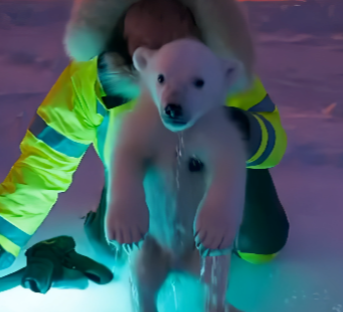
A polar bear cub was moments away from a frozen grave beneath the Arctic sea ice… But a desperate team of researchers heard a sound that shouldn’t have been there.
The Arctic is a world of monochromatic silence, a place where the wind doesn’t just blow—it carves. Dr. Elias Thorne had spent twenty years studying the shifting dynamics of the Beaufort Sea, but he had never seen the ice behave quite like this. It was early spring, yet the “blue-ice” shelves were fracturing in unpredictable patterns, creating deadly traps for the creatures that called this frozen desert home.
It started as a routine survey mission. Elias and his three-person team were mapping ice density near a known migratory path. The sun hung low on the horizon, a pale, heatless disc that cast long, skeletal shadows across the ridged landscape. They were packing their gear when Sarah, the team’s youngest biologist, held up a hand.
“Stop,” she whispered. “Do you hear that?”
The team went still. At first, there was only the low hum of the wind and the distant, rhythmic groaning of the shifting plates. Then, a dull, rhythmic thud echoed from beneath their boots. It was faint—a scratching, a desperate muffled beat against the underside of the frozen shelf.
They scrambled toward a patch of translucent, frost-covered ice. As Sarah wiped away the surface snow, her breath hitched. Beneath five inches of solid, crystalline ice, a small, white shape was thrashing. It was a polar bear cub. Somehow, during a localized shelf collapse, the cub had been swept into a pocket of air beneath the surface ice as it refroze. It was trapped in a watery tomb, its oxygen running out, its small paws scraping fruitlessly against the impenetrable ceiling.
“Get the chisel! Now!” Elias shouted.
The team didn’t move; they flew. In the Arctic, every second is a thief. The cub’s movements were slowing. Its eyes, visible through the distorted lens of the ice, were wide with a primal, suffocating terror. It was a sight that tore through the professional detachment of the researchers.
Elias gripped the heavy steel chisel, his knuckles white against the cold metal. He knew the risk. If he struck too hard, the vibration could cause the surrounding shelf to shatter, dropping them all into the sub-zero depths. If he struck too softly, the cub would drown before he made a dent.
Clang. Clang. Clang.
The sound echoed across the tundra like a funeral bell. Shards of ice sprayed Elias’s face, cutting his skin, but he didn’t blink. With every strike, the cub’s strength seemed to ebb. Its head began to loll back into the dark water.
“Come on, little one! Stay with me!” Sarah cried out, kneeling on the ice, her gloved hands pressed against the surface as if trying to transfer her own warmth to the dying animal below.
Finally, the chisel broke through. A geyser of freezing seawater erupted from the puncture. Elias didn’t wait to widen the hole properly. He dropped the tool and plunged his bare arm into the slush, the cold biting into his bone like a million needles. He felt the coarse, sodden fur of the cub’s neck.
With a roar of effort, Elias hauled the waterlogged cub through the jagged opening. The animal was limp, a heavy weight of wet fur and fading life. They immediately wrapped it in a high-tech thermal blanket, Sarah beginning a frantic massage to stimulate circulation.
For three minutes, the only sound was the wind and the sobbing breaths of the team. Then, a cough. A tiny, shivering sneeze.
The cub’s eyes flickered open. It let out a high-pitched, warbling cry—a call for its mother.
“Look,” Sarah pointed toward the horizon.
About five hundred yards away, a massive silhouette was moving fast across the snow. The mother bear had heard the call. She was a mountain of white fur and muscle, her desperation evident in her gait. The team knew they had to move. A grateful mother bear is still a mother bear, and they were standing over her cub.
They backed away slowly, retreating to the safety of their heavy-duty snowcat. From the observation deck, they watched through binoculars as the mother reached the site. She didn’t attack. She didn’t growl. She nudged the shivering cub, licking the salt and ice from its fur, before gently picking it up by the scruff of its neck.
As the two figures disappeared into the white haze of the approaching storm, Elias looked at his trembling, frost-nipped hand. In a landscape defined by the cruelty of nature, they had just witnessed a miracle carved out of steel and hope.