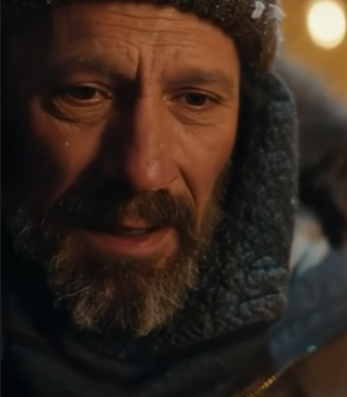
The police destroyed his only shelter in the middle of a freezing blizzard… But when he returned to the alley, he found a miracle waiting in the snow.
The wind in the city didn’t just blow; it bit. It was a “Silver Fang” winter, the kind that got inside your bones and refused to leave. Elias sat on a damp milk crate, his fingers tucked deep into the matted fur of Barnaby, a golden retriever mix whose age was beginning to show in the grey dusting around his muzzle. They were tucked into a narrow gap between a brick warehouse and a dumpster—a place Elias called “The Pocket.”
For three months, The Pocket had been home. It was reinforced with discarded plywood, a heavy tarp, and a collection of wool blankets found in various states of ruin. It wasn’t much, but it kept the wind off Barnaby’s joints. To Elias, that was all that mattered.
Then came the flash of blue and red.
It wasn’t a crime scene. It was a “sweep.” Officer Miller, a man Elias knew by name and who usually offered a nod of pity, stood by as two city workers began tossing the plywood into the back of a garbage truck.
“I’m sorry, Elias,” Miller said, his voice muffled by a heavy scarf. “Complaints from the new lofts across the street. We’ve got orders. You can’t stay here tonight. There’s a shelter on 4th.”
“The shelter doesn’t take dogs, Miller,” Elias said, his voice raspy from the cold. He stood up, his legs shaking. Barnaby let out a low, confused whine as his bed—a pile of old sweaters—was pitched into the crushing maw of the truck.
“I can’t help you with that, Elias. You know the rules. Move on, or we have to take you in.”
Elias didn’t fight. He didn’t have the strength. He whistled low, and Barnaby followed him out into the swirling white void of the city. They walked for hours. Every doorway was blocked by metal spikes; every park bench had an armrest in the middle to prevent lying down. The city was a fortress designed to keep him standing until he collapsed.
Unbeknownst to Elias, a pair of eyes had been watching the sweep from a warm SUV parked at the light. Maya, an eight-year-old girl with a heart too big for her chest, watched the man and his dog walk away. She saw the way the man shielded the dog from the wind with his own thin coat.
“Dad,” she whispered. “They’re going to freeze.”
Her father, Thomas, looked at the rearview mirror. He saw the despair in the man’s slumped shoulders. “I know, peanut. I know.”
That evening, while Elias and Barnaby huddle under a bridge, shivering uncontrollably, Thomas and Maya went to work. They enlisted Sarah, Thomas’s wife, and loaded their truck. They didn’t go to the shelters; they went back to the outskirts of the warehouse district, to a small, hidden alcove behind an abandoned community center that Thomas knew from his days as a contractor. It was out of sight of the street, protected by an overhanging concrete roof.
Elias eventually circled back to his old neighborhood, driven by a primal need for the familiar. He was exhausted, his toes numb, and Barnaby was limping. He turned the corner toward the community center, hoping to find a dry patch of concrete.
He stopped dead.
In the shadows of the alcove, a soft, golden light was flickering. It wasn’t a fire; it was a string of battery-operated fairy lights draped over a brand-new, heavy-duty insulated tent.
Elias rubbed his eyes, certain the hypothermia was finally causing hallucinations. But the smell hit him next—the rich, savory scent of beef stew.
He approached slowly. Outside the tent sat a large, elevated dog bed lined with a self-heating thermal pad. Next to it were two bowls: one filled with fresh water, the other with high-quality kibble topped with chunks of steak.
Barnaby didn’t wait for permission. He let out a joyful yip and dove into the food.
Elias reached for the tent flap. Inside, he found a thick sleeping bag rated for sub-zero temperatures, a crate of non-perishable food, a thermos still steaming with hot tea, and a small pile of hand warmers. There was also a note, written in the shaky, earnest handwriting of a child:
To our neighbor. We wanted you to know that you are seen. Merry Christmas. — M, T, & S.
Elias sank to his knees. The cold was still there, but the ice that had formed around his heart over years of being ignored by the world began to crack. He pulled the thermal blanket around his shoulders and wept—not for the hardship he had endured, but for the sudden, overwhelming weight of being human again.
Through the fabric of the tent, he heard the sound of a car door closing in the distance. He didn’t see the family watching from the street, but for the first time in a decade, he knew he wasn’t alone.