A homeless veteran sat alone in a diner, staring at an empty plate he couldn’t afford to fill… Then a 7-year-old girl did something that made every adult in the room freeze.
Marcus hadn’t been inside a real restaurant in three years. The fluorescent lights of the downtown diner felt harsh against his weathered skin as he sat in the corner booth, trying to make himself invisible. His hands, calloused and scarred from two tours in Afghanistan, trembled slightly as he held the laminated menu he couldn’t afford to order from.
He’d walked past this place a hundred times, always peering through the windows at families laughing over pancakes and coffee, couples sharing desserts, lone diners reading newspapers over eggs and toast. Today, something had pulled him inside. Maybe it was the cold. Maybe it was the exhaustion. Maybe it was just the desperate human need to feel normal again, even if just for a moment.
The waitress, Karen—her name tag said so—had approached with the practiced smile of someone who’d worked the morning shift for too many years. “What can I get you, hon?”
Marcus had frozen. His mouth opened, but no words came out. In his pocket, he had $3.47. Not enough for the cheapest item on the menu. He’d known that before he walked in, but some foolish part of him had hoped otherwise.
“Just… just water, please,” he’d managed, his voice rough from disuse.
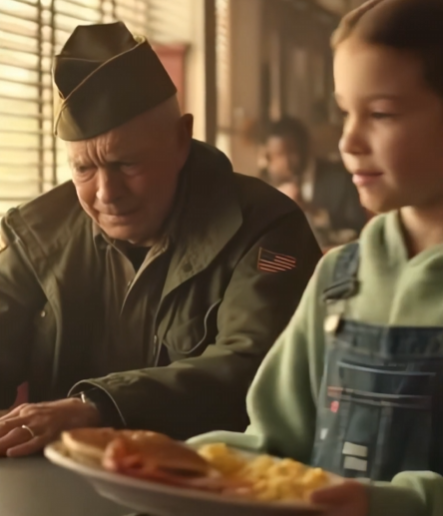
Karen’s smile had faltered, her eyes taking in his torn military jacket with the faded insignia, the dirt under his fingernails, the hollow look in his eyes. She’d nodded slowly and walked away, returning with a glass of water that Marcus held like it was fine wine.
That’s when little Emma noticed him.
She was seven years old, sitting three booths away with her mother and older brother. While her family was absorbed in their phones and conversation, Emma had been watching the man in the corner. Her young mind couldn’t understand all the complexities of homelessness or economic hardship, but she understood something more fundamental: he looked sad. And he looked hungry.
Her mother, Sarah, had ordered Emma the child’s breakfast special—chocolate chip pancakes, scrambled eggs, and bacon. It had arrived on a colorful plate shaped like a cartoon character, and Emma had immediately started eating, but her eyes kept drifting back to the man with no food.
“Mommy,” she whispered, tugging on her mother’s sleeve. “That man doesn’t have any food.”
Sarah glanced over, saw Marcus, and felt a pang of sympathy mixed with the urban dweller’s practiced caution. “Sweetie, maybe he’s waiting for someone. Eat your breakfast.”
But Emma couldn’t let it go. She looked at her pancakes, then at Marcus, then back at her pancakes. In her young heart, the math was simple: she had food, he didn’t. She could share.
Before her mother could stop her, Emma slid out of the booth, carefully picked up her entire plate, and walked across the diner floor. Her small sneakers squeaked against the linoleum. The diner wasn’t crowded—maybe a dozen people scattered across booths—but as Emma made her way toward Marcus, conversations began to falter. Heads turned. People watched.
Marcus didn’t notice her approach at first. He was staring out the window, lost in memories of better times—the home he’d had before the injuries, before the PTSD, before everything fell apart. Then a small voice broke through his reverie.
“Excuse me, mister.”
He looked down to find a little girl with brown pigtails and a gap-toothed smile, holding up a plate of pancakes like an offering.
“You can have some of my breakfast,” Emma said simply. “You look hungry.”
For a moment, Marcus couldn’t speak. His throat tightened. This child—this innocent, pure-hearted child—was offering him her meal when every other adult in this place had looked away. When he’d been invisible to the world for so long, she’d seen him. Really seen him.
“Sweetheart, I can’t—” he started, his voice cracking.
“It’s okay,” Emma insisted, climbing up onto the booth across from him and pushing the plate toward him. “Mommy says sharing is important. And these pancakes are really good. Try them!”
By now, Sarah had rushed over, embarrassed and worried. “Emma! You can’t just—” She stopped when she saw Marcus’s face. Tears were streaming down his weathered cheeks, falling onto his faded jacket. This wasn’t a man who meant her daughter harm. This was a man who’d forgotten what kindness felt like.
“I’m so sorry,” Sarah said softly to Marcus. “She just—”
“Don’t apologize,” Marcus whispered, wiping his eyes with the back of his hand. “Please don’t apologize for raising a child with a heart like this.”
Emma beamed, completely unaware of the profound impact her simple gesture had created. “See, Mommy? He IS hungry. We should share.”
Sarah felt her own eyes stinging. She looked at this man—really looked at him—and saw the military insignia on his jacket, the exhaustion in his posture, the quiet dignity he maintained even in his circumstances. She slid into the booth next to her daughter.
“Karen!” she called to the waitress. “Can we get another breakfast special over here? Actually, make it two. And coffee. Lots of coffee.”
The waitress, who’d been watching the scene unfold, nodded with a knowing smile and hurried to the kitchen.
Around the diner, something shifted. A businessman in a suit two booths over quietly asked his waitress to add Marcus’s meal to his check. An elderly couple nodded approvingly. A young woman wiped tears from her eyes and smiled.
Emma, oblivious to all of this, had already started chatting with Marcus. “Do you like dinosaurs? I love dinosaurs. My favorite is the pterodactyl even though my brother says that’s not technically a dinosaur, it’s a pterosaur, but I think it counts. What’s your favorite?”
Marcus, for the first time in longer than he could remember, laughed. A real laugh that came from somewhere deep inside, somewhere he’d thought had died long ago.
“Triceratops,” he said, his voice steadier now. “They’re tough. Survivors.”
“That’s a good one!” Emma approved, taking a bite of pancake. “See? I told you these were good.”
Over the next hour, something remarkable happened. Sarah bought Marcus breakfast—a full meal that he ate slowly, savoring every bite. They talked. Emma told him about school, about her pet hamster, about the book she was reading. Marcus told them about his service, carefully editing the stories to be appropriate for young ears. He told them about his love of cooking, a skill he’d learned from his grandmother and lost the ability to practice years ago.
Sarah learned that Marcus had been an Army medic, that he’d saved lives in combat zones, that he’d come home with injuries both visible and invisible, that he’d fallen through the cracks of a system that should have caught him. She learned that before today, he hadn’t spoken to anyone beyond transactional necessities in weeks.
When it was time to leave, Sarah did something impulsive. She wrote her phone number on a napkin and slid it across to Marcus.
“My husband and I run a small contracting business,” she said. “We’re always looking for help. If you’re interested, call this number. We can figure something out. No pressure. Just… an option.”
Marcus stared at the napkin like it was a winning lottery ticket. “I don’t know what to say.”
“Say you’ll think about it,” Sarah replied. “That’s all.”
Emma gave Marcus a hug before she left—a fierce, unselfconscious embrace that nearly broke him all over again. “Bye, Mr. Marcus! I hope you like working with my mommy and daddy!”
After they left, Marcus sat alone again in the booth, but everything felt different. The napkin with the phone number sat in front of him next to an empty plate—the first real meal he’d finished in months. Around the diner, people no longer looked away. A few nodded at him. Karen the waitress brought him more coffee without being asked and refused payment.
“That one’s on the house,” she said with a wink. “And that little girl? She’s something special.”
“They all are,” Marcus said quietly. “We just forget sometimes.”
He thought about Emma—about her unquestioning generosity, her complete lack of judgment, her simple understanding that someone was hungry and she could help. Adults complicated things with assumptions and fears and social calculations. Children just saw humans.
Marcus pulled out the napkin again, running his thumb over Sarah’s phone number. Maybe this was just a kind gesture that would lead nowhere. Maybe nothing would come of it. But maybe—just maybe—this was the moment. The turning point. The day a seven-year-old girl reminded him that he was still visible, still valuable, still worthy of kindness.
Three months later, Marcus had a small apartment, a regular job with Sarah’s contracting company, and weekly dinners with Emma’s family. He’d started attending a veterans’ support group. He’d reconnected with his sister, who he’d pushed away years ago out of shame. He was rebuilding.
But he never forgot that moment in the diner. He kept a photo that Sarah had taken that day—Emma sitting across from him, both of them smiling over half-eaten pancakes. On the back, in Emma’s careful child’s handwriting, she’d written: “Best breakfast ever!”
On his hardest days, when the PTSD crept back or the weight of everything felt too heavy, Marcus would look at that photo and remember: sometimes salvation comes in the smallest packages, delivered by the purest hearts, reminding us that dignity and compassion aren’t about age or status or circumstance.
They’re about seeing each other. Really seeing each other. And choosing kindness.
The world hadn’t changed that day in the diner. But Marcus’s world had. And all because one little girl decided that sharing pancakes was more important than anything else.
Respect, Marcus learned, wasn’t something you earned through rank or wealth or achievement. It was something you gave freely, recognizing the humanity in every person. And sometimes, children understood that better than anyone.