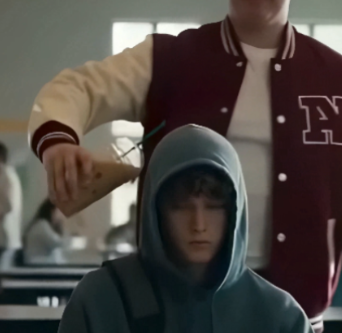
The school bully humiliated the quiet transfer student for a laugh… But he didn’t realize he just declared war on a lethal martial arts master.
Oakridge High wasn’t just a school—it was a battlefield disguised as brick walls and lockers. Everyone knew where they stood. The strong ruled. The quiet endured. And newcomers? They were called “Fresh Meat.”
That’s what they called me on my first day.
My name is Jacob Daniels. To the student body, I was just another transfer student wearing a faded grey hoodie and carrying secondhand textbooks. I kept my head down. I spoke only when spoken to. What they didn’t see were the fifteen years of Taekwondo and Hapkido training carved into my muscles, or the discipline burned into my mind by my grandfather, a Grandmaster who had served in the Korean special forces.
“True strength,” he always told me while I held a horse stance until my legs shook and sweat blinded me, “is not in how hard you can hit. It is knowing when not to strike. A sword stays in its sheath until it is the only option left to save a life.”
I carried that philosophy like a shield. But at Oakridge, shields were meant to be broken.
The hierarchy revealed itself within minutes. Martin Pike stood by the lockers like he owned the building, laughing loudly, surrounded by his crew—football players in letterman jackets who treated the hallway like a VIP lounge. Teachers looked away when he passed. Students lowered their eyes. Martin was 6’2″, built like a linebacker, and thrived on the fear he cultivated.
Near the water fountain stood Rowan—a thin kid with slumped shoulders and bruises he tried to hide with long sleeves, even in the heat. His eyes darted constantly, like prey sensing a predator. When our gazes met, I saw it instantly: years of fear, humiliation, and silence. A silent plea that said, Don’t make it worse. Don’t be noticed.
I kept walking.
That’s when Martin stepped directly into my path and slammed his shoulder into mine. It wasn’t an accident. It was a calculated check. My books scattered across the linoleum floor. Laughter exploded down the hallway, echoing off the metal lockers.
“Watch it, Fresh Meat,” he sneered, looming over me.
I knelt calmly, picking up each book with deliberate care. My breathing stayed steady. My hands didn’t shake. I analyzed his stance—off-balance, weight forward, chin exposed. In the dojo, he would have been on the mat in less than a second. But this wasn’t the dojo.
Martin expected anger. Fear. Tears. He got none.
I stood up, met his eyes for a brief second, and walked away.
Lunch brought no relief. The cafeteria was a segregated map of social status. I sat alone at a wobbly table near the exit until Rowan cautiously joined me. He looked terrified just sitting there.
“You shouldn’t have walked away,” Rowan whispered, picking at his sandwich. “He takes silence as an insult. He wants a reaction.”
“He won’t get one,” I said, opening my water bottle.
“Martin doesn’t stop,” Rowan warned, his voice trembling. “Ever. He put the last transfer kid in the hospital with a ‘accidental’ fall down the bleachers.”
I nodded slowly. I wasn’t here to fight. I was here to survive my senior year and graduate.
Then the shadow fell over our table.
Martin was there. He wasn’t alone; three of his friends flanked him, cutting off my exit. He was holding a large cup of iced coffee, condensation dripping down the plastic.
“Hey, Fresh Meat,” Martin said, his voice feigned friendliness. “I think you look a little thirsty.”
Without waiting for a response, he tipped the cup.
Cold, sticky liquid cascaded over my head. It soaked my hair, ran down my neck, and drenched my hoodie. Ice cubes hit the table with a clatter.
The cafeteria erupted. Hundreds of students laughing, pointing. Phones were out instantly, flashes going off, recording the humiliation.
I didn’t move. I sat there, the coffee dripping off my nose.
“Oops,” Martin laughed, crushing the empty cup and tossing it onto my wet tray. “My bad.”
I felt the adrenaline spike—the fight-or-flight response. My grandfather’s voice echoed in my head. Emotion is the enemy of technique. Breathe.
Slowly, I stood up. I wiped the coffee from my eyes and turned to face him. I was three inches shorter and forty pounds lighter.
“Are you done?” I asked. My voice was low, steady, devoid of the fear he craved.
The room went quiet. The laughter died down, replaced by a tense curiosity.
Martin’s smile faltered. He stepped closer, invading my personal space, his breath hot on my face. “I’m done when I say I’m done, trash. Do something about it.”
He shoved me. Hard.
I stumbled back a step but regained my balance instantly. I looked at his hands—clenched into fists. I looked at his feet—flat, unprepared.
“I don’t want to fight you, Martin,” I said.
“Too bad!” Martin swung. A wild, haymaker punch aimed right at my jaw.
Time slowed down.
To everyone else, it happened in a blur. To me, it was choreography.
I sidestepped the punch with a simple pivot, letting his momentum carry him past me. As he stumbled, I didn’t strike. I just watched him regain his balance, face turning red with rage.
“Stand still!” he screamed, charging again.
This time, he tried to tackle me. I stepped in, grabbed his wrist and his collar, and used his own forward energy against him. With a sharp twist of my hips—a classic Judo throw—I sent him flying over my shoulder.
Martin hit the cafeteria floor with a thunderous thud. The wind was knocked out of him.
Dead silence. You could hear a pin drop.
I didn’t pounce on him. I didn’t start punching. I smoothed out my wet hoodie and looked down at him.
“Stay down,” I said.
Martin scrambled up, humiliation overriding his pain. He roared, grabbing a plastic chair and swinging it like a club. This was no longer bullying; this was assault.
Threat assessment updated. Neutralization required.
I stepped inside the arc of the swinging chair, jamming my forearm into his bicep to kill the power of the swing. In one fluid motion, I swept his legs out from under him. He fell hard, but this time I followed.
I pinned him, my knee on his chest, my hand locking his wrist in a painful submission hold. I applied just enough pressure to let him know that if I wanted to, I could snap his arm like a dry twig.
“Let go!” he screamed, thrashing.
I leaned in, my face inches from his. “Listen to me closely. You are not strong. Making people afraid doesn’t make you a king; it makes you a bully. And today, your reign is over.”
I applied a fraction more pressure. “Do we have an understanding?”
“Yes! Yes! Let go!”
I released him and stood up. I offered him a hand to get up.
He looked at my hand, then at the crowd of students who were no longer laughing. They were staring at me with awe. He slapped my hand away and scrambled to his feet, cradling his arm.
“You’re dead,” he whispered, but there was no venom in it. Only fear. He ran out of the cafeteria, his friends trailing behind him, heads low.
I turned to the table where Rowan was sitting. His mouth was hanging open.
“I need some napkins,” I said calmly.
The aftermath was immediate. By the next morning, the video had a million views. “Kung Fu Kid vs. Bully” was trending locally.
In the principal’s office, Martin’s parents threatened to sue. They claimed I attacked him. But the footage—shot from twenty different angles—showed the truth. The coffee. The shove. The chair. And me, using only self-defense.
Principal Harrison suspended Martin for two weeks. He gave me a warning about “escalation,” but as I left his office, he gave me a subtle nod of respect.
When I walked into the hallway, the atmosphere had shifted. The battlefield had changed.
I went to my locker. Rowan was there, standing tall for the first time.
“Hey,” Rowan said, smiling. “Do you think… maybe you could teach me some of that?”
I looked around. Other kids—the “Fresh Meat,” the nerds, the outcasts—were watching, waiting.
“My grandfather has a garage,” I said. “Training starts at 6 AM. Don’t be late.”
Martin returned two weeks later, but the spell was broken. When he tried to shove a freshman into a locker, three other students stepped up. They didn’t fight him. They just stood there, united. And that was enough.
I didn’t strike him that day in the cafeteria to hurt him. I did it to show everyone else that monsters are only scary until you turn on the lights.
Oakridge High realized something important that year: The quiet ones aren’t always weak. And true strength isn’t about ruling others—it’s about lifting them up.
VIDEO PROMPT:
High school cafeteria, chaotic noise. Focus on Jacob (teen, hoodie) sitting quietly. Slow motion: Bully (Martin) pours iced coffee over Jacob’s head. Liquid splashes dramatically. Jacob doesn’t flinch. He stands slowly, coffee dripping from his nose. Close up on Jacob’s eyes—intense, calm, dangerous. Martin laughs, then throws a punch. Jacob dodges effortlessly and grabs Martin’s wrist in mid-air. The camera zooms on Martin’s face shifting from arrogance to pure shock.