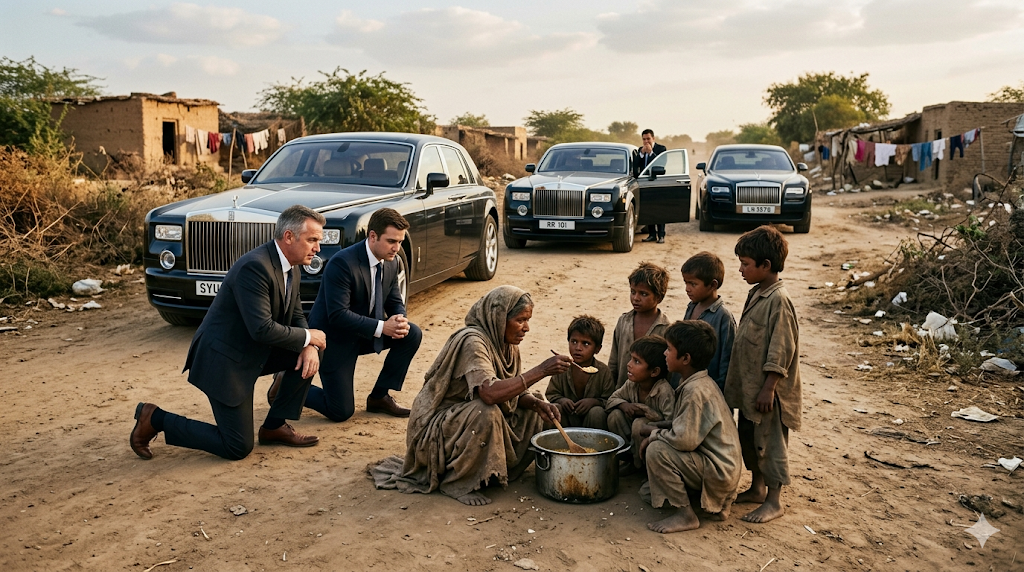

Three Rolls-Royces pulled up to a dirt road where a poor woman was feeding ragged orphan boys from a dented pot… and the men in suits dropped to their knees.
The summer of 1948 came in hot and merciless, the kind of heat that cracked the earth and emptied pockets faster than a bad harvest. Maren Calloway had known that kind of summer her whole life.
She was forty-two years old, wide-hipped and strong-shouldered, with dark hair that she pinned back each morning before dawn and a floral dress so faded the roses had gone almost white. The apron she tied around her waist was a map of every meal she’d ever cooked — grease stains and tomato, a burn mark near the hem from the summer she’d knocked the pot sideways reaching for a crying child. She never replaced it. It felt, somehow, like a record of something important.
Every afternoon at half past noon, Maren rolled her old iron stove on its cracked wheels to the edge of Depot Road and set her pot to simmering. The broth was thin — mostly vegetable ends, dried beans, whatever the grocer’s wife would give her that morning without embarrassing either of them. But she salted it well, and she ladled it generously, and she never once made a boy feel small for holding out his bowl twice.
They came from the rail yards, mostly. Boys between eight and fourteen who had fallen off something — a family, a freight car, a future that had simply stopped existing during the Depression and never quite resumed. The town had no orphanage. The county had no budget. Maren Calloway had a pot and a stove and the unshakeable conviction that a hungry child was an emergency, full stop, no exceptions.
On this particular Tuesday in July, there were seven of them seated along the curb — knees dirty, faces creased with heat, slurping from mismatched bowls she kept in a crate beneath the stove. She knew all their names. She always knew their names.
She didn’t notice the dust rising at the far end of the road until she heard the engine sounds — low, expensive, the kind of purr that didn’t belong in a town like this. She looked up from her ladle.
Two black Rolls-Royces rolled slowly through the haze, gleaming like something from a different century, a different planet. They stopped at the edge of the road, not far from her stove, and a silence fell over the boys that she had never heard from them before. It was the silence of children confronted with something so far outside their experience that they didn’t have words for it yet.
Three doors opened. Three men stepped out.
They were identical in their precision — each wearing a black three-piece suit that had clearly been cut by someone who charged more for a jacket than Maren made in six months. Their shoes caught the sun. Their posture was the particular posture of men who had learned to carry themselves carefully, as though they once hadn’t been able to and still remembered it.
They were, she realized with a slow and strange feeling, about thirty years old. All three of them.
They walked toward her. Not swaggering. Not performing. Walking the way men walk when they have rehearsed something in their hearts for a very long time and are finally, finally doing it.
The one in the middle stopped three feet from her stove.
Maren didn’t step back. She wasn’t a woman who stepped back.
“Can I help you?” she said, ladle still in hand.
The man looked at her. His jaw worked once. His eyes, she noticed, were doing something complicated — moving between her face and the stove and the boys on the curb as though he was matching a memory to a reality and finding them identical.
“Mrs. Calloway,” he said. His voice was low and careful. “You don’t remember us.”
It wasn’t a question, but she considered it like one. She looked at all three of them — the same dark eyes, the same square jaw, the same particular way of standing with their weight slightly forward, like boys who’d spent years bracing against wind.
“The Aldren brothers,” she said quietly. “Thomas. William. And you’re—”
“James,” he said. “Yes, ma’am.”
The summer of 1931. Three boys, seven years old, sitting exactly where those boys on the curb were sitting now. She remembered the smallest one — James, she now recalled — had cried into his bowl the first day and pretended he wasn’t crying.
“You moved away,” she said.
“We were taken to the city. A businessman. He needed—” James paused. “It doesn’t matter what he needed. What matters is that we had something before we got there. Something that kept us.” He looked at the pot. “You fed us. Every day for almost two years. You remembered our names. You—” He stopped again.
William, the quiet one, who had always been the quiet one, stepped forward and set a leather briefcase on the folding table beside her crate.
“We built something,” Thomas said. “A company. It took a long time. We want you to have—”
“I don’t want your money,” Maren said, reflexively, the way she’d said it to every well-meaning person who’d ever tried to press a bill into her hand on the road.
“It’s not charity,” James said. “It’s a building. On Holt Street. It’s already bought. It’s already registered.” He opened the briefcase himself, turned it to face her. “It’s an orphanage, Mrs. Calloway. Staffed and funded for thirty years. It has your name on the door.”
She looked at the papers. She looked at him.
“We didn’t know how else to say thank you,” James said, “for something that size.”
Behind her, one of the boys on the curb had stood up, bowl still in hand, watching with enormous eyes.
Maren Calloway set down her ladle. She pressed both hands to her apron — the stained, burned, faded apron — and she breathed once through her nose.
“You boys eat lunch yet?” she asked.
James Aldren — thirty-two years old, worth more than the town he was standing in — shook his head.
“Sit down, then,” she said, and reached for the ladle again.