I watched my date press his dirty hiking boot into my lunch at the military cafeteria… The entire base saw what I did next.
I’d been deployed overseas for eight months when I finally got a weekend pass. The desert heat, the constant patrols, the weight of responsibility—it all felt like a lifetime compressed into those months. Coming back stateside, even temporarily, felt surreal. Like stepping into a memory of who I used to be.
My college friend Jake messaged me the week before. We’d been close once—roommates sophomore year, study partners, the kind of friends who’d stay up until 3 AM debating everything from philosophy to the best pizza toppings. But that was before I enlisted. Before I traded term papers for tactical training. Before I learned what real exhaustion, real fear, real purpose felt like.
“Hey Sarah! Heard you’re back in town. Want to grab lunch? I’m doing a hiking trip near your base. Would love to catch up!”
It seemed innocent enough. Nostalgic, even. I missed having normal conversations with civilians, missed talking about anything other than mission briefings and equipment maintenance. So I said yes. We arranged to meet at the base cafeteria for lunch on Saturday.
That Saturday morning, I woke up in my barracks room, staring at the ceiling. My roommate, Specialist Chen, was already up, polishing her boots with the kind of methodical precision the Army drills into you. The rhythmic sound was almost meditative.
“Big plans today, Sergeant?” she asked without looking up.
“Just lunch with an old friend,” I replied, swinging my legs out of bed. “College buddy. Haven’t seen him in years.”
“Civilian?”
“Yeah.”
She paused mid-stroke, finally glancing over. “Good luck with that. They never really get it, do they?”
She was right, though I didn’t want to admit it then. There’s a gap that forms between soldiers and civilians, an invisible canyon carved by experiences that can’t be fully translated. You try to explain what it’s like to patrol a hostile village at dawn, or to hold a dying comrade’s hand, or to go weeks without a real shower, and the words just… evaporate. They nod, they say “thank you for your service,” but their eyes are already drifting to their phones, their normal problems, their comfortable lives.
Not that I resented it. I chose this path. But the distance was real.
I showered, dressed in my duty uniform—the camouflage OCP pattern that had become like a second skin—and headed to the cafeteria around noon. The base was relatively quiet for a Saturday. Most soldiers were either off-duty in town or catching up on sleep. The cafeteria had that weekend lull, maybe forty people scattered across tables meant to hold two hundred.
I grabbed a tray and went through the line. The options were the usual: overcooked chicken, mystery meat loaf, wilted salad, and—surprisingly—a decent-looking pasta primavera with roasted vegetables. I loaded up my plate, grabbed a water bottle, and found a table near the windows where natural light poured in, supplementing the harsh fluorescent overhead lighting.
Jake arrived fifteen minutes late.
I spotted him immediately: tall, blonde hair styled in that deliberately messy way that probably took twenty minutes to achieve, wearing a gray t-shirt that showed off his gym results, and cargo shorts despite the October chill. But what caught my attention were his boots—massive, expensive hiking boots caked with dried mud, grass clippings, and what looked like creek sediment.
“Sarah!” He waved enthusiastically, weaving between tables with the oblivious confidence of someone who’d never had to think about regulations or decorum.
I stood and hugged him briefly. He smelled like expensive cologne and campfire smoke.
“Jake. Good to see you. How was the hike?”
“Incredible! Did the Appalachian Trail section near here. Twelve miles, some brutal elevation. You should’ve come!” He dropped into the chair across from me with a heavy thud, his boots leaving small clumps of dirt on the clean cafeteria floor.
I noticed a few heads turn. Soldiers are trained to notice details, and muddy civilian boots in a military cafeteria definitely qualified as a detail worth noticing.
“Been a little busy,” I said, gesturing vaguely at my uniform.
“Right, right. The Army thing.” He said it like I’d taken up a quirky hobby, not dedicated my life to service. “So what’s deployment like? Is it like the movies?”
I took a bite of pasta, buying time to formulate an answer that wouldn’t sound either preachy or dismissive. “It’s… different. Less explosions, more boredom and paperwork. But when things happen, they happen fast.”
“Sounds intense! I’ve been thinking about doing one of those adventure reality shows. You know, survival stuff. Probably similar skills, right?”
I nearly choked on my water. Comparing military deployment to a reality TV show was like comparing a paper cut to a gunshot wound, but I forced a smile. “Something like that.”
He started talking about his life—his marketing job at a tech startup, his CrossFit routine, his new Tesla, his travel plans to Bali. I listened with half my attention, the other half wandering to the soldiers around us. A group of privates near the door, still baby-faced and eager. A grizzled master sergeant I recognized from the motor pool, reading a newspaper. My platoon sergeant, Staff Sergeant Williams, sitting three tables away with some NCOs from another company.
Jake was mid-sentence about Bitcoin investments when I noticed the change in his expression. That flash of mischief I remembered from college. The glint in his eyes that always preceded something stupid.
My sophomore year, he’d put plastic wrap under the toilet seat in our shared bathroom. Junior year, he’d replaced my shampoo with mayonnaise. Senior year, he’d hidden my car keys the morning of a major exam, thinking it was hilarious.
Back then, I’d laughed it off. Pranks were currency in college. Harmless fun between friends.
But I wasn’t in college anymore.
“Hey Sarah, remember when we used to mess with each other’s food?” He was grinning now, that wide, conspirator’s grin.
My stomach dropped. “Jake, don’t—”
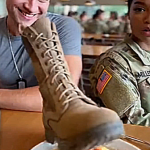
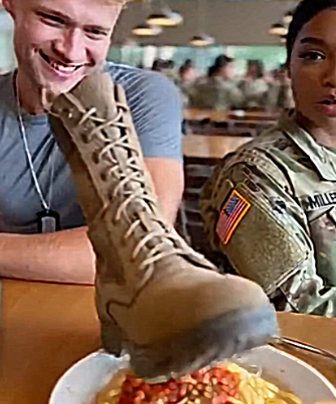
But he was already moving. In slow motion—or maybe my combat-sharpened reflexes just made it seem slow—he lifted his right leg, planted his elbow on his knee for leverage, and extended that muddy, disgusting hiking boot over my tray.
“For old times’ sake!” he announced.
I watched, frozen in disbelief, as the sole of his boot—ridged with dried mud, embedded with small rocks, streaked with substances I didn’t want to identify—descended onto my plate of pasta.
The impact was almost artistic in its destruction. Pasta noodles squished and splattered. Roasted vegetables shot across the table. Marinara sauce erupted like a tiny tomato volcano, speckling my uniform sleeve, the table, and Jake’s cargo shorts. The boot pressed down with his full weight, grinding the food into an unrecognizable mess, the cleated sole leaving a perfect imprint.
The cafeteria went silent.
Not gradually. Not a slow fade of conversation. Instant, total silence.
Every head turned. Every conversation stopped. Even the staff behind the serving line froze, ladles suspended mid-air.
I stared at the boot print in what had been my lunch. Then slowly, very slowly, I raised my eyes to Jake’s face.
He was still grinning, waiting for my reaction. Waiting for me to laugh, to retaliate with a food fight, to play along like we were still carefree twenty-year-olds in a dining hall where the worst consequence was a cleaning fee.
But his smile was already faltering. He’d finally noticed the silence. The stares. The fact that nobody—absolutely nobody—was laughing.
“Bro, it’s just a joke,” he said, his voice suddenly uncertain. “Remember freshman year when you put salt in my coffee? I’m just getting you back.”
I didn’t respond immediately. I was doing the mental math that becomes second nature in the military: assessing the situation, calculating consequences, choosing the most effective course of action.
My platoon sergeant was watching. My peers were watching. Junior enlisted soldiers who looked up to me were watching. And every single one of them was waiting to see how I’d handle this disrespect.
Because it wasn’t just about the food. In the military, everything means something. The uniform represents honor, discipline, sacrifice. The base represents security, order, American sovereignty. And respect—respect for rank, for service, for the institution—is the foundation everything else is built on.
This civilian just put his dirty boot in my food, in my cafeteria, while I was in uniform, in front of my brothers and sisters in arms.
I stood up. Slowly. Deliberately. My chair scraped against the floor with a sound that echoed in the silent room like a gunshot.
“Jake,” I said, and my voice came out cold. Not angry—anger would have been unprofessional. But cold. The voice I used with privates who screwed up on patrol. The voice that carried consequences. “You have exactly ten seconds to apologize, clean this up, and buy me a new meal. Or I’m calling base security.”
His face went through a rapid evolution of expressions: confusion, then defensiveness, then the dawning realization that he’d miscalculated badly.
“Come on, Sarah, it’s just a prank. Don’t be so uptight. It’s just food—”
“Five seconds.”
“You’re seriously going to make a big deal out of this? We used to—”
“Time’s up.”
I pulled out my phone and dialed the MP station. The Military Police. For non-military folks, they’re essentially base law enforcement, and they take their job very seriously.
“Wait, wait!” Jake’s hands shot up in a placating gesture. “Okay, I’m sorry! I’ll clean it up. Jesus, when did you become so serious?”
“When I took an oath to defend my country,” I replied, phone still to my ear. “When I learned that actions have consequences. When I grew up.”
The MP dispatcher answered. “Military Police, what’s your emergency?”
“This is Sergeant Sarah Mitchell, currently at the main base cafeteria. I need an officer to respond for a civilian causing a disturbance.”
Jake’s face went white. “Sarah, come on, you don’t need to—”
“What’s the nature of the disturbance?” the dispatcher asked.
“Civilian deliberately destroyed military property and created an unsanitary condition in the dining facility. Also created a disruption to good order and discipline.”
Technically, the food was military property. Technically, mashing it with a dirty boot violated about six different health codes. And technically, causing a scene that disrupted the professional environment of a military installation was absolutely grounds for removal.
“Roger that, Sergeant. Officers en route. ETA three minutes.”
I hung up and looked at Jake. His smug confidence had completely evaporated, replaced by genuine panic.
“You called the cops on me? For a joke?”
“Military Police,” I corrected. “And yes.”
The cafeteria was still silent, but I could feel the mood shifting. What had been shock was becoming something else. Approval. Solidarity. A few soldiers were nodding slightly. Specialist Chen, who’d apparently come in for lunch, gave me a subtle thumbs-up from across the room.
And then Staff Sergeant Williams stood up.
Williams was a legend on base. Twenty-two years of service, three combat deployments, a Silver Star, and a reputation for not tolerating any nonsense. He was six-foot-four, built like a brick wall, with a shaved head and a voice that could strip paint at fifty yards.
He walked over to our table with measured steps, his boots clicking on the linoleum. Jake shrank back in his chair.
Williams looked at the destroyed food. Then at Jake’s muddy boots. Then at Jake’s face.
The silence stretched for five long seconds.
“Son,” Williams finally said, and his voice was quiet but carried to every corner of the cafeteria, “I don’t know what kind of upbringing you had, but where we come from, you respect people’s food. You respect people in uniform. And you damn sure respect this base.”
Jake opened his mouth, closed it, opened it again. “I… it was just…”
“You just failed on all three counts.” Williams crossed his arms. “In my twenty-two years of service, I’ve seen a lot of stupid. But disrespecting a non-commissioned officer in her own cafeteria, in front of her peers, on a United States military installation? That’s a special kind of stupid.”
“I didn’t mean any disrespect, I just—”
“Your intentions don’t matter. Your actions do. And your actions just earned you a conversation with the MPs and a permanent record in our base security database.”
Right on cue, two Military Police officers entered the cafeteria. They spotted our table immediately—not hard, given that everyone was staring at us—and approached with professional efficiency.
“Sergeant Mitchell?” the senior MP, a female staff sergeant, asked.
“That’s me.”
“Can you explain the situation?”
I gave a concise report: Jake was my guest, he deliberately destroyed my food in an unsanitary manner, created a disturbance, and showed disrespect to military personnel and property. Clinical. Factual. Unemotional.
The MP took notes, then turned to Jake. “Sir, do you have a valid reason for being on this installation?”
“I’m… I’m visiting my friend.” He gestured weakly at me.
“The friend who just filed a complaint against you?”
Jake’s face went red. Then white. Then an interesting shade of green.
The MPs didn’t arrest him—they couldn’t, really, since putting a boot in someone’s pasta isn’t a criminal offense. But they could, and did, escort him off base immediately. And they could, and did, issue him a written barring order: a permanent ban from entering not just this base, but any military installation in the entire district without explicit written permission from the base commander.
Good luck getting that permission after this incident went into the official record.
“But my car is in the parking lot,” Jake protested weakly.
“You’ll be escorted to retrieve it, and then you’ll leave. Immediately. If you return without authorization, you’ll be arrested for trespassing on federal property. Do you understand?”
He nodded miserably.
As the MPs led him toward the door, he looked back at me one last time. I couldn’t read his expression—regret? Anger? Embarrassment? Maybe all three.
I felt… nothing. Not satisfaction, not anger, not even nostalgia for our lost friendship. Just a kind of tired resignation. Some people never grow up. Some people never learn that the world doesn’t revolve around their entertainment. And some bridges aren’t worth rebuilding.
The cafeteria door closed behind them.
For a moment, nothing happened. Then Staff Sergeant Williams turned to the room and called out, “Who’s got phone footage of that?”
Six hands shot up.
Williams grinned. “Send it to me. I want to use it in a training briefing about maintaining professional standards.”
Laughter rippled through the cafeteria. The tension broke. Conversations resumed. The world kept turning.
Williams looked down at me. “You hungry, Sergeant?”
“Starving, actually.”
“Come on. I’m buying. Can’t have one of my NCOs going hungry because some civilian has the manners of a feral raccoon.”
We went through the line together. Williams insisted on loading my tray with extra food—double portions of pasta, a slice of cake, fresh fruit. When I tried to pay, he waved me off.
“Consider it an apology on behalf of the entire civilian population,” he said with a wry smile.
We sat back down at my original table, now cleaned by one of the cafeteria staff. Other soldiers drifted over—Specialist Chen, a couple of privates from my platoon, a lieutenant from the S-3 shop. What had started as a humiliating incident became an impromptu lunch gathering.
“That was the most boot thing I’ve ever seen,” Private Jackson said, using military slang for clueless behavior. “Did he seriously think that was okay?”
“Civilians live in a different world,” Chen observed. “No consequences, no accountability. Just vibes and TikTok pranks.”
“Not anymore,” Williams said darkly. “That footage is gonna follow him. Disrespecting a soldier in uniform? That doesn’t play well on social media. Ask me how I know.”
He was right. By that evening, the video had spread beyond the base. Someone posted it to a military humor page with the caption “Civilian learns about consequences.” Within 24 hours, it had half a million views. Within 48 hours, Jake’s hiking club had issued a statement condemning his behavior and revoking his membership. His employer’s HR department apparently had a very serious conversation with him about “representing company values.”
The internet can be a cruel place, but it has a special disdain for people who disrespect the military without cause.
Jake sent me an email the next day. Five paragraphs of apologies, excuses, explanations. He was sorry, he didn’t realize, he was just trying to reconnect with old times, he didn’t mean any disrespect, could I please contact the base and get the ban lifted, this was affecting his life, people were recognizing him, his girlfriend broke up with him…
I read the first paragraph. Then I deleted it without finishing.
Some apologies come too late. Some actions can’t be undone. And some people need to learn that growing up isn’t optional—it’s mandatory. The world doesn’t owe you a consequence-free existence just because you meant well or thought something was funny.
Three weeks later, I was called into my company commander’s office. Captain Reynolds was a no-nonsense officer who I respected immensely. I reported as required, wondering if this was somehow related to the cafeteria incident.
“At ease, Sergeant Mitchell,” she said, gesturing to a chair. “You’re not in trouble. Actually the opposite.”
She pulled out a folder. “I received a letter from the base commander. Apparently, footage of your… cafeteria incident… has been circulating. He wanted you to know that you handled the situation with exemplary professionalism and composure.”
I blinked, surprised. “I just called the MPs, ma’am.”
“You maintained military bearing in a disrespectful situation. You used proper channels instead of retaliating. You upheld standards without escalating unnecessarily. That’s leadership, Sergeant.” She slid a paper across the desk. “He’s recommending you for an Army Commendation Medal for upholding military standards and demonstrating professional excellence.”
I stared at the recommendation letter, genuinely shocked. “For… not punching someone who put their boot in my food?”
Captain Reynolds laughed. “For being a model of military discipline when it would have been very easy not to be. Take the win, Mitchell.”
The medal ceremony happened a month later. It was small, informal—just my company during a regular formation. But when the commander pinned that ribbon on my chest and shook my hand, I felt something I hadn’t expected: pride.
Not for handling Jake. That was just common sense.
But for being part of something bigger than myself. For being held to a higher standard and meeting it. For proving that discipline and respect aren’t old-fashioned concepts—they’re foundational values that separate professionals from children.
I never heard from Jake again. Last I checked, he’d moved to a different state, changed his social media to private, and was probably still trying to live down his viral moment of stupidity.
And me? I went back to work. Back to training privates, maintaining equipment, preparing for the next deployment. Back to the life I’d chosen, with all its challenges and sacrifices and occasional moments of profound meaning.
Sometimes people ask me if I regret how I handled it. If I wish I’d just laughed it off, let it go, preserved the friendship.
I don’t.
Because some things are worth more than nostalgia. Some standards are worth upholding even when it’s uncomfortable. And some people need to learn that the real world has real consequences.
Play stupid games, win stupid prizes.
Boot print and all.