
Twenty Steps to Goodbye
The suitcase slipped from Emily Parker’s hands the moment she heard the words.
“You’re dismissed. Pack your things and be gone by sunset.”
That was all Daniel Grant gave her. No warning. No explanation. No conversation. Just four words from a man who had built his empire on precision — and who had just dismantled three years of her life in the time it takes to button a coat.
Emily stood in the marble hallway of the Grant estate, the kind of hallway where the echo of your own footsteps reminds you how small you are. The chandelier overhead sparkled like something out of a fairy tale. She had admired it once, on her very first day, when Olivia had tugged her hand and whispered, “It looks like frozen stars, doesn’t it?”
Now it just blurred through the tears she was fighting to hold back.
She moved slowly toward the wide stone terrace that wrapped around the estate’s west wing. Eyes fixed on the ground. Each step careful, deliberate — as if counting them could hold her emotions together.
Twenty steps to the iron gate.
Twenty steps to walk away from three years of her life.
The Santa Barbara sunset bathed the mansion walls in a soft golden glow. It had always been her favorite time of day — the hour when the light turned amber and warm, when everything softened just enough to feel forgiving. She had spent dozens of evenings sitting beside Olivia’s window, watching that same light spill through the curtains while they made shadow animals on the ceiling.
Birds.
Butterflies.
Stars.
Emily didn’t look back now.
She knew that if she did, she would completely fall apart.
She had already cried in the small staff bathroom while packing everything she owned. Three pairs of jeans. Five blouses. The pale blue dress she wore to Olivia’s fourth birthday party — the one where Olivia had insisted on a mermaid theme, demanded Emily arrive wearing something “ocean colored,” and then spent half the party sitting in Emily’s lap, ignoring all her little guests.
One thing Emily left behind on purpose.
A pink hairbrush — small, plastic, shaped like a flamingo — that Olivia loved using to style the hair of her favorite doll. Emily had bought it at a drugstore on a rainy afternoon when Olivia had been bored and restless. It was the silliest, most trivial thing. But leaving it felt like leaving a piece of their connection behind. A quiet message: I was here. I loved this child. Some part of me always will.
The mansion shimmered around her. Thirty-two rooms. A pool that seemed to float at the edge of the hill. A garden shaped like something from a French château. And her entire life there fit into a single rolling suitcase.
She was nearly at the gate when she heard it.
A small voice. High and certain — the voice of someone who has not yet learned that the world rewards silence.
“Daddy. You made Emily cry.”
A Decision Made in Silence
Inside the house, Daniel Grant believed everything was already resolved.
He stood in his study — tall windows, mahogany shelves, a desk that cost more than most people earned in a year — and he stared at the legal document his assistant had left for him to sign. His third acquisition this quarter. A pharmaceutical company in Oslo. Clean. Efficient. Numbers arranged in their proper order.
To a man like Daniel, life ran on systems.
He had learned early, growing up with nothing, that chaos was the enemy. That every weakness you allowed was a door left open to failure. His first company had nearly collapsed because he had trusted someone with soft eyes and a warm handshake. He had vowed never to make that mistake again.
So when his head of security had brought him the photograph — grainy, time-stamped, pulled from a camera at the estate’s south gate — he had acted immediately. The man in the photograph was leaning close to Emily. Speaking quietly. Smiling.
That man was Marcus Delvoy. Emily’s ex-boyfriend. A tabloid journalist known for selling private details about wealthy families to the highest bidder. He had exposed two other prominent families in the past three years.
To Daniel, the equation was simple: Emily had been speaking to a known threat. She had to go.
He told himself he didn’t owe her an explanation. Explanations were vulnerabilities. Questions led to conversations, and conversations led to the kind of tangled human mess he had spent his entire adult life trying to avoid.
He hadn’t considered one thing.
He couldn’t control his daughter.
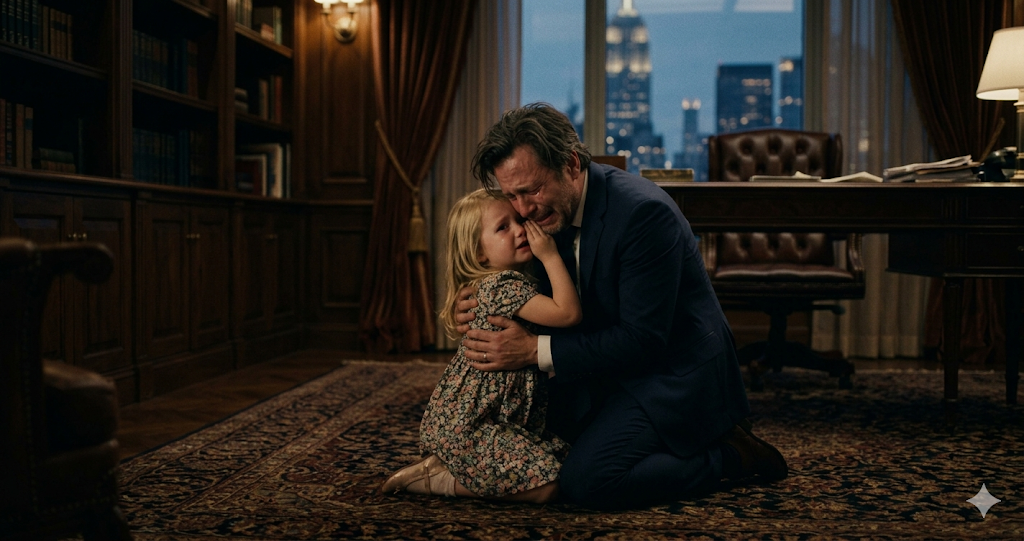
“Daddy. You made Emily cry.”
Olivia stood at the edge of his desk. She was four years and three months old. She had her mother’s dark curls and her father’s unnervingly direct gaze. She was holding her flamingo hairbrush — the pink one Emily had given her.
Daniel looked up.
“Olivia, this is grown-up business. Go find Mrs. Hale.”
“Mrs. Hale is on the phone,” Olivia said, with the breezy authority of someone unbothered by dismissal. “And Emily is at the gate. She’s leaving.”
“I know.”
“Why?”
“Because I said so.”
Olivia considered this the way only a four-year-old can — with complete, undefended honesty, measuring it against everything she understood about fairness. She set the flamingo brush on the corner of his desk. Then she leaned close to his ear.
She whispered something.
Daniel went very still.
His jaw tightened. His hand, hovering over the document he’d been about to sign, came slowly to rest flat on the desk. The pen rolled away.
He stood up.
What His Daughter Knew
Children notice everything.
Adults forget this. They believe that children are absorbed in their own worlds — in toys and cartoons and the drama of scraped knees — and that the currents moving through the adult world flow right past them unseen.
But Olivia had been watching.
She had been watching three weeks ago, when Emily came back from her afternoon off looking shaken and pale, and spent a long time in her room before coming out to read bedtime stories with her voice slightly too steady, the way grown-ups sound when they’re trying very hard not to show something.
She had been watching the next morning, when a man had come to the south gate — Olivia had seen him from the playroom window — and Emily had gone out to meet him. But Olivia had also seen Emily’s face when she returned. She wasn’t happy. She looked the way Olivia felt when someone made her do something she didn’t want to do.
She had been watching the week after, when Emily had gone to the estate’s main office and spoken to Mr. Harland, Daniel’s head of security. Olivia hadn’t heard the words, but she’d seen Emily place a folded piece of paper on his desk.
And she had been watching, two days ago, when she’d climbed into her father’s lap while he read, and he’d held his phone up briefly to take a call — and the screen had shown a photograph. A grainy one. A man at a gate. And Emily.
What Olivia whispered to her father was this:
“Emily tried to tell Mr. Harland. She left a note. She said the man at the gate was bad, and she was scared of him, and she didn’t want him to come back. She told me. She said she was keeping us safe.”
The Man at the Gate
Daniel moved faster than he had moved in years.
He crossed the estate in long strides, pulling his phone from his pocket, calling Harland before he’d even reached the hallway.
“The note,” he said, when Harland picked up. “Emily Parker left you a written report. Three weeks ago. Where is it?”
A pause. The particular kind of pause that contains a mistake being recognized.
“Mr. Grant, I — I forwarded a summary to your office. Standard procedure—”
“The original note. Did you attach it?”
Another pause. Longer this time.
“I’ll check, sir.”
Daniel pushed open the terrace doors. The sunset hit him full in the face — that same golden light that had always made this estate look, to him, like something worth protecting.
Emily was at the gate.
She had stopped. Her suitcase had tilted slightly, and she was standing very still, the way people stand when they’re bracing themselves for a final moment.
“Emily.”
She turned.
There were tear tracks on her face, dried now in the evening air. She looked at him the way people look at someone who has already done the worst thing — with a kind of exhausted resignation. Not anger. Not bitterness. Just the quiet look of someone who has accepted a wound and decided they will survive it.
He crossed the terrace to her.
“Why didn’t you tell me directly?” he asked. “About Delvoy.”
She blinked. Something shifted in her expression — not surprise exactly, but the particular confusion of someone whose private action has been found out.
“I did,” she said. “I told Mr. Harland in writing. I asked him to pass it along when he felt the moment was right.” She paused. “I didn’t want to alarm you unnecessarily. I wasn’t even sure if Marcus was there because of your family or because of me. Our breakup was — it wasn’t simple. I thought maybe he’d followed me. I was trying to handle it without making it a bigger situation than it needed to be.”
She looked at the gate behind her. Then back at him.
“I was trying to protect Olivia. That was all I was ever doing.”
The Things She Had Not Said
Daniel stood there in the amber light, and for the first time in longer than he could remember, he did not know what to do next.
He was a man of action. Of decisions. Of systems that moved cleanly forward.
But there was no system for this.
He had dismissed her to protect his daughter from a threat — and she had tried to protect his daughter from the same threat, quietly and at personal cost, without asking for credit or recognition. She had absorbed the discomfort of the situation, carried it alone, and still showed up every morning to take Olivia to the garden and make shadow animals on the ceiling and leave her pink flamingo brush behind as a quiet act of love.
“Harland never forwarded the original note,” Daniel said. “I only received a summary. It didn’t include context. I saw the photograph and I—” He stopped. He was not a man who apologized easily, but honesty, at least, he had always been able to manage. “I made a decision before I had all the information.”
“That’s what happened,” Emily said simply. Not accusatory. Just true.
He looked at her suitcase. At the iron gate. At the last thin slice of sunset still clinging to the hills.
“Come back inside,” he said.
Emily was quiet for a long moment. The kind of quiet that isn’t emptiness — it’s thought, and feeling, and the careful accounting of what something has cost.
“Olivia needs consistency,” she said finally. “Not people who leave when things get complicated. And not employers who make decisions without asking questions.”
“I know.”
“Do you?”
He held her gaze. A lesser man would have retreated to authority, to the privilege of the estate at his back, to the sheer fact of his position. Daniel Grant did not.
“I handled this wrong,” he said. “You deserved the benefit of the doubt. You deserved to be asked. I am asking now — I’m asking you to come back.”
What Olivia Said When It Was Over
Emily came back inside.
It was not simple after that. Things rarely are. There were conversations — the kind of honest, uncomfortable ones that happen when two people stop managing distance and start being real with each other. Daniel called Harland to account for what had happened. Marcus Delvoy was quietly and permanently removed from any possibility of accessing the estate.
And Olivia?
When she saw Emily walking back up the terrace with her suitcase, she made the small, decisive sound that small children make when justice has been served — a single satisfied “hm” — and went back to styling her doll’s hair with the flamingo brush.
Later, when Emily was tucking her in, Olivia looked up at her with those steady dark eyes.
“I knew Daddy would fix it,” she said.
“You did?” Emily asked.
“Yes.” A pause. “I told him what you said. About keeping us safe. Daddy always listens when it’s about keeping safe.”
Emily smoothed the blanket. The room was warm and quiet. Outside, the Santa Barbara night had gone dark and soft, and the stars were out, and if you looked at the ceiling just right, you could almost see butterflies.
“Olivia,” Emily said. “How did you know what to tell him?”
The girl considered this with tremendous seriousness.
“Because you tell me the truth,” she said. “So I told him the truth. That’s how it works.”
Emily sat there a moment longer than she needed to.
Then she turned off the light.
A Postscript on Empires
Daniel Grant had built his fortune by being the smartest person in the room.
But intelligence, he was learning — slowly, at the cost of mistakes he could not optimize away — is not the same as understanding. You can analyze every variable and still miss the one thing that matters. You can control every system and still be undone by a four-year-old with a flamingo hairbrush and the simple, devastating habit of telling the truth.
He requested that Harland institute a new protocol: any staff concern flagged in writing would come directly to Daniel’s desk, unfiltered, within twenty-four hours.
He did not explain why to anyone except himself.
He had fired someone trying to protect his daughter.
His daughter had saved her.
That was the kind of math that stayed with you.