
A sobbing woman crashed a billionaire’s wedding and exposed the groom’s darkest secret mid-vow… But nobody expected a 7-year-old in a tuxedo to become the most legendary dancer in the room.
The roses were white. Every single one of them — three thousand white roses flown in from a greenhouse in the Netherlands, arranged by a florist who charged more per hour than most people earned in a week. The Hartwell Estate had been transformed into something that looked less like a wedding venue and more like a fever dream about wealth — gilded archways dripping with crystal, chandeliers the size of small cars rotating slowly overhead, a string quartet playing Debussy somewhere near the fountain that had been imported from a demolished French château.
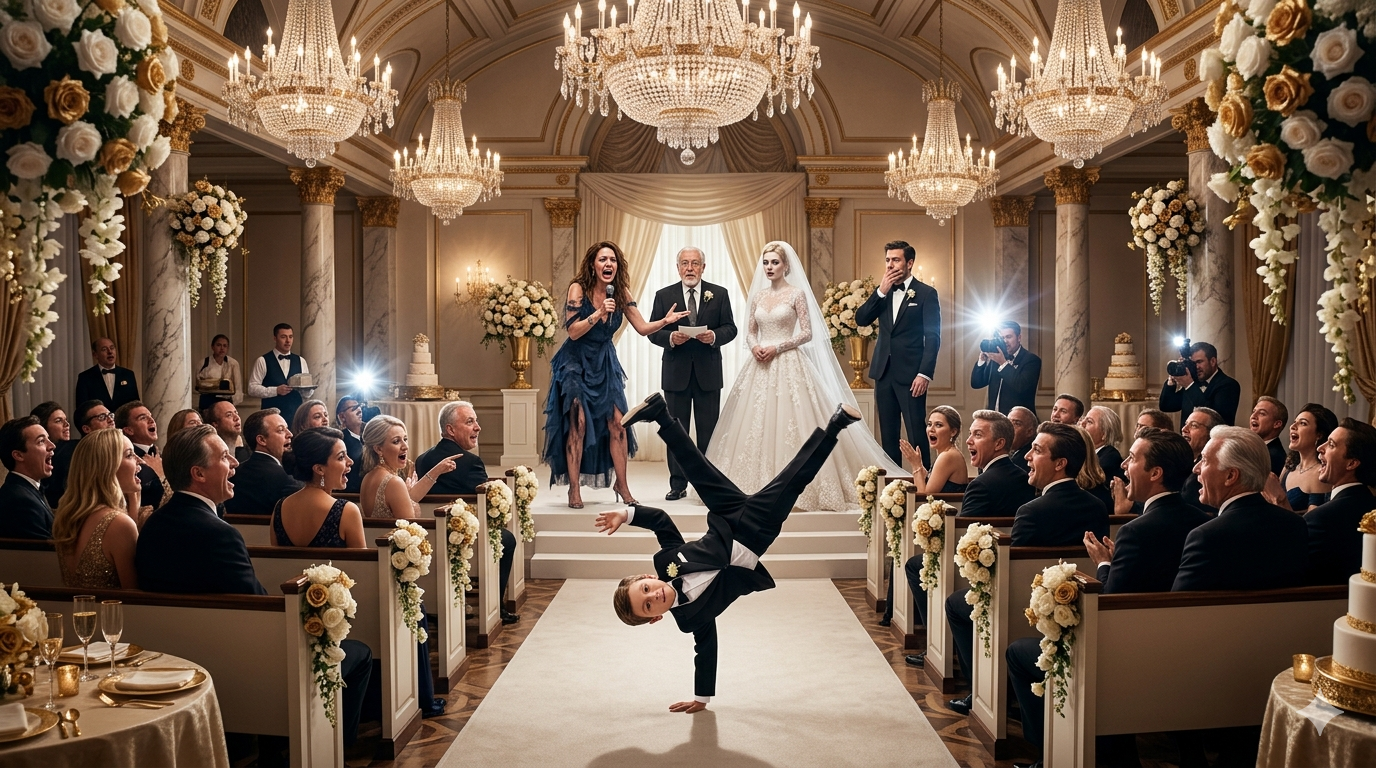
This was the wedding of Dominic Hartwell, thirty-four, hedge fund heir, to Cassandra Voss, twenty-nine, the kind of woman who made photographers nervous because she was more beautiful than their equipment could properly capture. Four hundred guests sat in white velvet chairs arranged in perfect rows across the estate’s grand ballroom. Celebrities in the back rows. Old money in the front. Politicians near the aisle, just close enough to be photographed.
Everyone had been waiting for this moment for two years.
The ceremony had started at four o’clock precisely. The officiant — a man who had also presided over two royal weddings and a senator’s third marriage — had barely finished his second paragraph when the doors at the back of the ballroom crashed open.
Not opened. Crashed.
The sound was enormous — a boom that rolled through the chandeliers and made the crystal tremble. Every head in the room turned.
She stood in the doorway.
At first, the guests nearest to the back assumed she was a catering staff member who had gotten lost, or perhaps a journalist who had somehow slipped past security. She was wearing a military-style field jacket — olive green, faded, caked with mud along the left sleeve and hem, like she’d been crawling through something wet. Her hair was half-pulled from a ponytail, strands plastered to her face. Her mascara had run so far down her cheeks it had dried there, forming dark rivers that told a story of hours, maybe days, of crying.
She looked like someone who had walked a very long distance to get here.
“DOMINIC.”
Her voice cracked the silence like a hammer on glass.
The string quartet stopped. The officiant lowered his book. Cassandra turned slowly, her veil catching the air. And Dominic — Dominic’s face did something that four hundred people simultaneously noticed and would later describe in four hundred different ways. Some said he went pale. Some said he went rigid. One woman in the third row would later tell her daughter that she had seen guilt land on a human face exactly once in her life, and it looked like what happened to Dominic Hartwell’s expression in that moment.
“You can’t do this,” the woman sobbed, stepping forward. Her boots left small dark prints on the white marble. “You can’t marry her. You need to tell her. You need to tell everyone.“
The guests were absolutely frozen.
In the front row, Margaret Hartwell — Dominic’s mother, sixty-one years old, a woman who had once made a venture capitalist cry simply by looking at him — stood up.
Margaret was wearing a silver sequined gown that caught every light source in the room and threw it back doubled. She had spent forty years building the Hartwell name into something that made people straighten their posture when they heard it, and she was not — not — going to allow some mud-caked woman to dismantle it in the middle of four hundred witnesses on the most expensive day her family had ever staged.
She moved toward the intruder with the focused energy of someone who had handled crises before and found them tedious.
“Security is on their way,” Margaret said, low and even. “I suggest you leave before—”
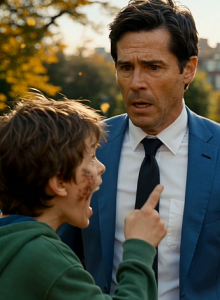
“He has a daughter,” the woman said. “He has a daughter and he’s never told anyone. She’s four years old and she’s mine and he hasn’t paid a single—”
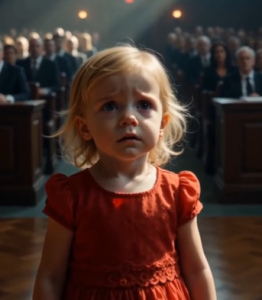
What happened next took approximately 0.6 seconds and was witnessed by four hundred people, three camera operators, and one seven-year-old boy named Oliver who was sitting in the front row in a miniature black tuxedo, holding a small velvet pillow with the rings still tied to it with white ribbon.
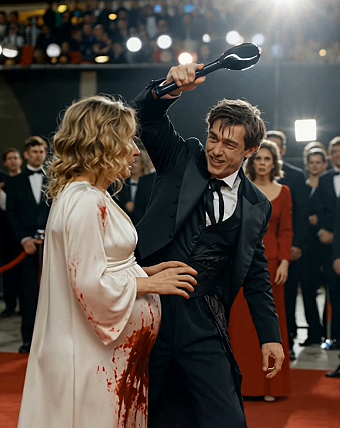
Margaret Hartwell drew back her right hand and delivered a slap.
Not a gentle, symbolic slap. Not the kind deployed in old films to signal feminine distress. This was a full-rotation, shoulder-engaged, weight-transferred strike that connected with a crack so loud that one of the camera operators later said he genuinely thought something had broken. The sound bounced off the marble floors, ricocheted off the chandeliers, and arrived at the ears of the back-row guests a fraction of a second after the visual — which created a strange, cinematic effect, like watching it in a movie where the sound sync was slightly off.
The disheveled woman staggered sideways.
And here is where things departed from any version of events that could be described as normal.
Oliver — seven years old, thirty-eight inches tall, holder of the rings — had been watching all of this from his velvet chair with the intense focus that small children apply to things they do not yet have the context to understand. When Margaret’s arm swung back with that particular force and velocity, the backswing connected with Oliver’s velvet pillow, which connected with Oliver, and the resulting physics were not — strictly speaking — physically realistic.
Oliver left his chair.
Not in a falling-sideways, toppling-over-a-chair way. In a launched way. In a way that suggested he had been briefly treated as a projectile by the universe. He cleared the armrest. He cleared the flowers lining the aisle. For a moment — genuinely, in the memory of everyone who later tried to describe it — he was horizontal, parallel to the floor, traveling through the air above the aisle at a height of approximately four feet, both arms spread slightly, velvet ring pillow still clutched in one hand, the rings still attached.
A sound went through the crowd that had no name. It was not screaming. It was not gasping. It was the sound four hundred people make when they collectively process something their brain is telling them is not possible.
Oliver landed on the dance floor.
The dance floor was at the far end of the ballroom — a thirty-foot expanse of polished white marble that had been cleared for the reception. He landed on it in a low crouch, both knees bent, one hand flat on the floor for balance, the velvet ring pillow somehow still level in his other hand. The rings had not fallen off. The white ribbon was still tied.
The ballroom was completely silent.
Oliver looked up.
He was seven years old. He had been dressed in a tuxedo since ten in the morning. He had been told four times to sit still and stop pulling at his collar. He had been bribed with the promise of cake to behave during the ceremony. He had been holding a velvet pillow for forty-five minutes without being allowed to put it down.
Something in Oliver’s expression changed.
Later, the guests would struggle to describe it. Some said it was like watching someone remember something. Some said it looked like a decision being made. His aunt — who knew him best — would say later that it looked exactly like his face when a song he liked came on in the car.
Oliver set the ring pillow down very carefully on the marble floor beside him.
He rolled his neck once, slowly, to the left.
And then Oliver Hartwell, age seven, began to breakdance.
Not tentatively. Not in the way children dance when they are performing for adults who are delighted by anything they do. He dropped into a six-step footwork sequence that covered a six-foot radius, legs moving in sharp, rhythmic arcs, the tuxedo jacket spreading behind him like wings. He transitioned into a freeze — one hand on the floor, body cantilevered sideways at an impossible angle — and held it for three full seconds.
For a moment, the four hundred guests simply could not process the transition. Their nervous systems were still calibrated for tragedy. The crying woman was still standing somewhere in the aisle, holding her face. Margaret was still standing, arm raised. Cassandra was still turned around at the altar, veil floating, expression unreadable. Dominic had not moved.
And then Oliver went into a headspin.
The headspin broke the spell.
It started in the back rows — a laugh that sounded almost involuntary, like something escaping. Then the row in front of it. A woman in a blue dress stood up without meaning to. A man near the aisle began clapping in rhythm, slowly at first, then faster as Oliver matched it. The string quartet, by some collective and unspoken decision, shifted from Debussy into something with a beat.
The applause spread the way applause spreads when it is genuine — unevenly, catching person by person, building from scattered to thunderous. Oliver came out of the headspin into a standing sequence, working the full width of the dance floor, and the crowd gave him the room, parting naturally, forming a circle the way crowds form circles when something remarkable is happening.
The crying woman was forgotten. Or not forgotten — suspended. Held in parentheses by the collective decision to deal with that later.
Margaret Hartwell sat back down. Her expression was difficult to categorize.
Dominic, at the altar, was laughing. Not the polished, appropriate laugh he deployed at fundraising dinners. A real laugh — surprised out of him, the kind that reaches the eyes. Cassandra’s hand had found his arm, and she was laughing too, and the laugh seemed to mean something between them, some relief, some pressure released.
Oliver executed a final move — a Michael Jackson-style slow lean that should not have been physically possible — and held it.
The ballroom erupted.
The ring pillow was retrieved. The rings were still attached. The officiant, a man who had thought he had seen everything, found his place in the book and cleared his throat. The crying woman was quietly escorted to a side room by two members of staff, where she was given water and the phone number of Dominic’s personal attorney, who would later — in a story that would take months to fully resolve — confirm that arrangements had been made, that the conversation should have happened differently, that Oliver’s new niece was named Lily and that she had, it would turn out, inherited some of the same gravitational immunity her uncle displayed on that afternoon.
The ceremony continued.
Dominic and Cassandra were married at 4:47 PM, in front of four hundred witnesses, three camera operators, and one seven-year-old boy in a tuxedo who sat in the front row for the remainder of the ceremony looking extremely pleased with himself.
The wedding reception, when it came, lasted until two in the morning. The dance floor was never empty. Oliver was there for most of it.
At some point, very late, he fell asleep under a table near the chocolate fountain, still wearing his tuxedo, the velvet ring pillow tucked under his head like a pillow.
The rings had been safely removed by then.
Nobody had the heart to wake him.
At the after-party, in the hotel suite that Cassandra’s family had booked on the forty-second floor, the story was already circulating — passed from phone to phone, captured from fourteen different angles by fourteen different guests who had instinctively raised their cameras at the exact right moment. The clip of Oliver’s headspin had been shared before midnight. By the time the couple’s flight landed in the Maldives two days later, it had been viewed eleven million times.
The comments were mostly the same: I have watched this forty times. I am not okay. This child has done more with his life than I ever will.
Oliver’s parents, who were not wealthy people and who had spent the entire reception in a low-grade state of panic about the cost of replacing the velvet ring pillow if anything happened to it, received three calls from talent agents the following week.
Oliver himself, when told about the video, watched it once, nodded as though confirming something he already knew, and asked if there was any cake left.
There wasn’t.
He accepted this information and went back to watching cartoons.
The question of Dominic and the daughter — of Lily, four years old, in her apartment across the city — was not resolved at the wedding. It was not the kind of thing that resolves cleanly, or quickly, or without pain distributed across multiple people who deserved better than the situation they had been placed in.
But it was no longer a secret.
And secrets, once they are out of the room, lose at least some of their power to do damage in the dark.
Lily would, eventually, meet her father. The first meeting was awkward. The second was less so. The third, which happened six months later at a park on a Sunday afternoon when the leaves were turning, went long enough that everyone missed lunch, and nobody minded.
Oliver was there for that one too. He and Lily raced each other across the grass three times. She won twice. He claimed he let her, which she did not believe, which he found hilarious.
He taught her the six-step at Christmas.
She was better at it than he expected.
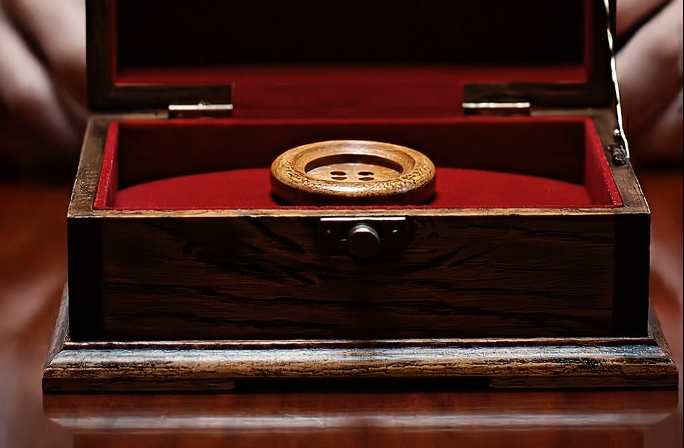
And somewhere in a drawer in the Hartwell Estate, in a room that guests rarely entered, the velvet ring pillow sat folded in a box with a small card attached.
Used for the rings. Also served as a launching pad. Do not throw away.
It was the only item from the wedding that anyone had bothered to label.
No one had thought it would need one.
No one had been right about anything that day.