The silence in our house in Portland wasn’t the peaceful kind; it was the kind that felt like a held breath. My name is Caroline, but everyone calls me Carrie. At thirty-two, I thought I had finally navigated the wreckage of my past to find a safe harbor. My first marriage had been a masterclass in emotional manipulation, leaving me with a mountain of anxiety and a beautiful, fragile daughter named Emma.
When I met Evan Brooks, he seemed like the antidote to every bitter memory I carried. He was a quiet man, an architect by trade, with eyes that seemed to see the structural integrity of people’s souls. He didn’t just love me; he stepped into the role of a father to Emma with a grace that felt almost too good to be true. He didn’t push her. He sat on the floor and played Legos in silence until she was ready to talk. He was the man who brought us cocoa when the Oregon rain turned into a week-long gloom.
But this year, when Emma turned seven, the “gloom” didn’t just stay outside. It moved into her bedroom.
Emma had always been a sensitive child, but lately, she was fading. There were dark circles under her eyes. She began wetting the bed again—something she hadn’t done since she was three. Most disturbing were the “staring spells.” I’d find her in the hallway, eyes wide and fixed on a corner of the ceiling, her body rigid as a board. When I’d touch her, she’d gasp as if she’d been underwater for minutes.
“She’s just adjusting, Carrie,” Evan would tell me, rubbing my shoulders. “The world is big and scary for a seven-year-old. We just have to be her anchor.”
I wanted to believe him. But then, the nightly disappearances started.
It began three months ago. I’d wake up at 2:00 AM, my hand reaching out for Evan’s side of the bed, only to find the sheets cold. The first time, I found him in the kitchen drinking water. The second time, he was on the couch, claiming his back was acting up. But by the fifth time, I didn’t find him in the common areas.
I found him in Emma’s room.
The sight of him lying there, a grown man huddled on a small twin-sized mattress beside my daughter, sent a jolt of primal instinct through me. He had his arm over her, his forehead pressed against the back of her head. He looked exhausted, his face pale in the orange glow of the nightlight.
“She had a nightmare,” he whispered when I confronted him. “I didn’t want to wake you. You’ve been so stressed at work.”
It was the perfect answer. It was the answer of a hero. So why did my stomach feel like it was full of lead?
Over the next two weeks, it became a ritual. Every night, around midnight, Evan would slip away. And every morning, Emma would look more haggard, more terrified. She started flinching when anyone—even me—entered her room too quickly. My mind, poisoned by the betrayals of my first husband, began to weave a tapestry of horror. I started researching the darkest possibilities. I looked at Evan and didn’t see a protector anymore; I saw a stranger who was obsessed with my daughter’s presence.
I couldn’t ask him again. If he was guilty, he’d lie. If he was innocent, the accusation would destroy the best thing that ever happened to me. So, I did the only thing a desperate mother could do. I bought a high-definition nanny cam disguised as a USB charger and plugged it into the outlet facing Emma’s bed.
I let it record for three nights. I didn’t have the courage to watch it immediately. I waited until Evan left for a site visit in Eugene, leaving me alone in the house while Emma was at school.
I sat at the kitchen table, my laptop open, my heart hammering against my ribs like a trapped bird. I bypassed the first two nights of footage—mostly static and the sound of the heater—and went straight to Tuesday night.
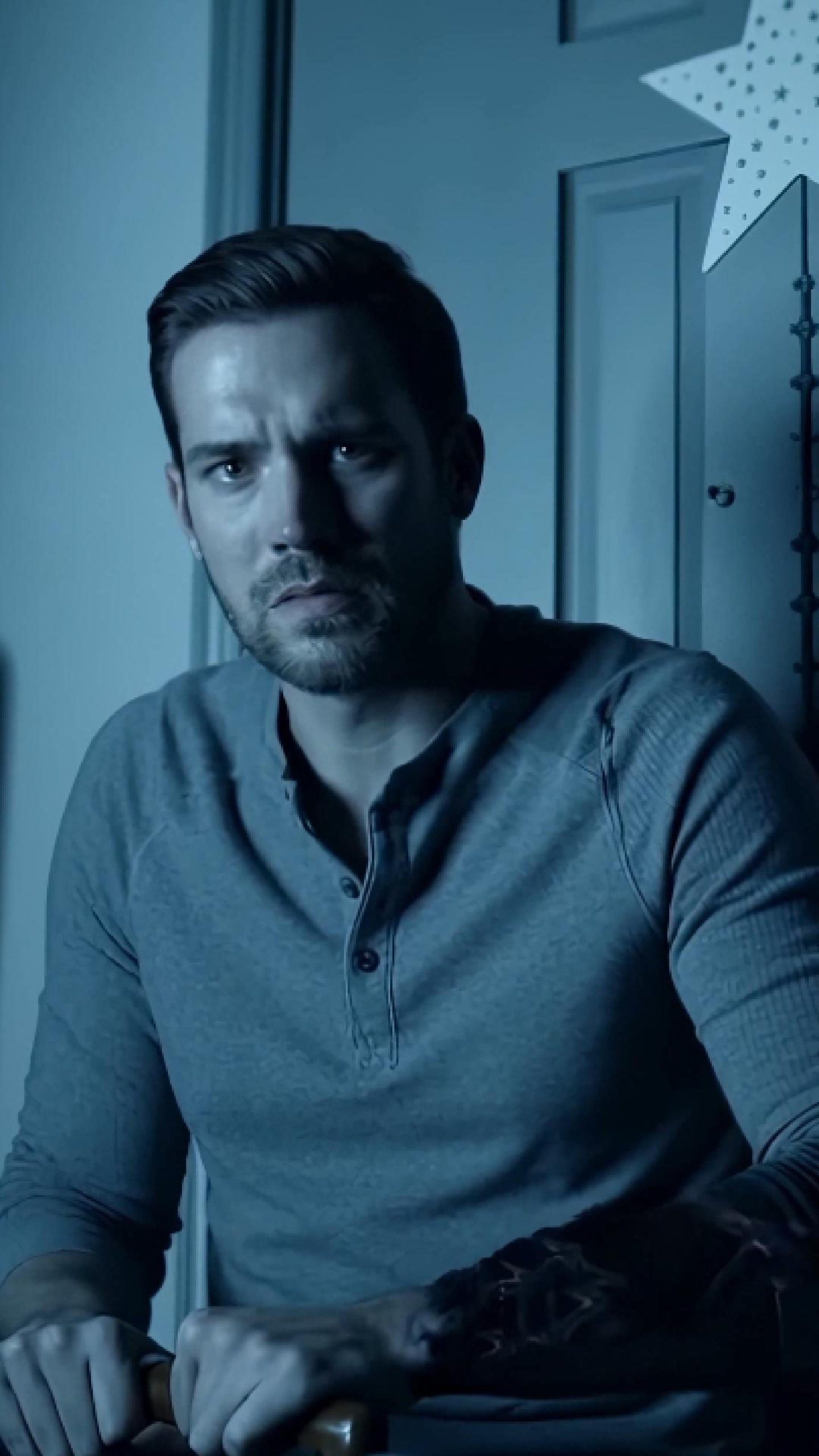
At 12:14 AM, the door to Emma’s room creaked open. Evan walked in. He wasn’t carrying a book or a glass of water. He was carrying a heavy wooden chair from the dining room. He didn’t get into bed with her. Instead, he positioned the chair directly in front of Emma’s closet door. He sat down, facing the closet, his back to the bed.
He sat there, unmoving, for an hour. I frowned. What was he doing?
Then, at 1:22 AM, the closet door—which I knew for a fact was latched—began to rattle. Not a gentle rattle, but a violent, rhythmic shaking, as if someone inside was trying to throw themselves through the wood.
My breath hitched. We didn’t have a dog. There were no pipes behind that wall.
On the screen, Evan didn’t flinch. He leaned his weight against the chair, bracing it against the door. His lips were moving. I cranked the volume on my laptop to maximum. Through the digital hiss, I heard his voice. It was a low, guttural growl I didn’t recognize.
“Not tonight,” Evan whispered. “You are not invited. This is my house. You go back to the dark.”
The rattling stopped abruptly. A cold chill swept through the room on the video; I could see Emma’s sheer curtains flutter as if a window had been opened, but the windows were shut. Emma sat up in bed, but her eyes weren’t open. She was sleepwalking. She began to climb out of bed, her movements jerky, like a marionette. She headed straight for the window.
Evan jumped from the chair, catching her just as her hand reached for the lock. He didn’t shake her. He wrapped her in a blanket, whispering “I’ve got you, Em. It’s just the shadows. I’m the light. I’m the wall. Nothing gets past me.”
He spent the rest of the night sitting on the floor, holding the door shut with one hand and holding Emma’s hand with the other.
But that wasn’t the part that made my hands tremble.
At 3:45 AM, the closet door stopped shaking. Instead, a thin, oily black shadow began to seep from the crack under the door. It wasn’t a shadow cast by light; it was like ink moving through water. It coiled around the legs of the chair, rising up toward Evan’s throat.
Evan didn’t run. He took a small object from his pocket—a crucifix, or perhaps a stone, I couldn’t tell—and pressed it against the shadow. I heard a sound on the tape that I will never forget. It was a hiss, like cold water hitting a hot engine, followed by a faint, distant scream that didn’t sound human.
The shadow retracted. Evan slumped over, his nose beginning to bleed. He looked like a man who had just gone ten rounds in a ring. He stayed there until the sun began to peek through the blinds. Only then did he wipe his face, put the chair back in the dining room, and crawl into bed beside Emma for a few minutes so I’d find him there if I woke up.
I realized then that Emma wasn’t staring at “nothing.” She was seeing something that had followed us from my past—perhaps something attached to the trauma of her biological father, or something that lived in the bones of this old Portland house.
I looked at the screen, at my husband’s exhausted, bleeding face, and I realized I had been worried about a monster in my bed, while he had been fighting a demon in the hallway.
When Evan came home that evening, he looked at me, seeing the laptop still on the table. He saw my red eyes. He knew.
“I didn’t want you to have to be afraid again,” he said softly, dropping his keys. “I thought if I could just hold it off long enough, it would tire out. It wants the fear, Carrie. I didn’t want it to have yours.”
I didn’t say a word. I just walked over and held him. Because for the first time in my life, I wasn’t just “protected.” I was guarded by a man who was willing to stand at the gates of hell every night just so I could sleep.
We didn’t stay in that house. We packed our bags that night. We didn’t care about the lease or the furniture. As we drove away, I looked at Emma in the backseat. She was sleeping—truly sleeping—for the first time in months. And beside me, Evan finally let his head lean back against the headrest, his eyes closing as the sun set behind us.
The hidden camera stayed in the trash can of that empty house, but the truth it revealed stayed with me: sometimes, the things that look the most suspicious are actually the greatest acts of love.