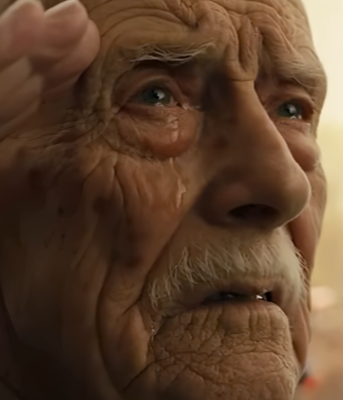
He survived the front lines of WWII and lived to see his 107th birthday… But when he finally opened a sealed envelope from 1944, the room went silent.
The air in the community center was thick with the scent of vanilla frosting and old memories. Arthur Penhaligon sat in a high-backed chair that felt more like a throne, his thin frame draped in a suit that had seen three different decades. Around him, the flashbulbs of local news cameras popped like the distant artillery he still heard in his dreams. Today, Arthur was 107 years old. He wasn’t just a man; he was a living bridge to a world that was rapidly fading into the ink of history books.
Arthur’s eyes, milky with cataracts but sharp with a lingering intelligence, scanned the room. He saw great-grandchildren who looked at him like a museum exhibit. He saw politicians shaking hands, looking for a photo op with the “Oldest Hero in the State.” But Arthur wasn’t thinking about the cake or the medals pinned to his chest. He was thinking about a muddy ditch in Belgium, the winter of 1944, and a promise he had kept for over eighty years.
Arthur had been twenty-five when he stepped onto the sands of Normandy. He wasn’t a hero in his own mind; he was a farm boy from Nebraska who knew how to fix a tractor and keep his head down. He survived the hedgerows, the liberation of Paris, and the biting, soul-crushing cold of the Ardennes. It was there, during the Battle of the Bulge, that he had met Thomas. Thomas was a kid from Brooklyn, barely nineteen, with a laugh that could cut through the sound of mortar fire.
They had huddled together in a foxhole, sharing a single bar of chocolate and a dream of what they’d do when the world stopped screaming. Thomas had handed Arthur a letter, sealed with wax and grit. “If I don’t make it,” Thomas had whispered, “don’t mail this. Just hold onto it. Take it home. Open it only when you’ve lived enough life for the both of us.”
Thomas didn’t make it. A week later, a sniper’s bullet found the boy from Brooklyn. Arthur had survived—not just the war, but the Great Depression before it, the Cold War after it, the loss of his wife, the birth of his children, and the dizzying rise of the digital age. He had carried that letter in a small, cedar box for eighty-one years. He had waited until he felt he had “lived enough life.”
As the Mayor finished a speech about “unwavering courage,” Arthur signaled to his eldest daughter, Martha. She brought over the cedar box. The room fell into an expectant hush. People expected a hidden map, a confession of wartime gold, or perhaps a final message to a long-lost love.
With hands that shook like autumn leaves, Arthur broke the seal. The paper was yellowed, brittle as parchment. He didn’t read it aloud at first. He let his eyes trace the hurried scrawl of a nineteen-year-old boy who had been dead for a lifetime.
“Artie,” the letter began. “If you’re reading this, it means you’re old. I hope you’re really, really old. I hope you’ve forgotten the smell of cordite and the sound of the screaming meemies. I hope you’ve fallen in love a dozen times and eaten a thousand steaks. Don’t spend your life being a ‘Veteran.’ Don’t let them make you a statue. Just be a man who enjoyed the sun on his face. That’s why I’m staying here—so you can go there. Drink a beer for me. Live a quiet life. That’s the greatest victory.”
Arthur looked up. A single tear tracked through the deep canyons of his wrinkles. The “hero” the crowd saw was a man of bronze and courage. But the man Arthur felt like was just a friend who had finally completed his last mission.
“He told me to live,” Arthur whispered into the microphone, his voice cracking but clear. “He didn’t ask me to be brave. He asked me to be happy.”
The crowd didn’t know how to react. They wanted tales of bayonets and glory. But as Arthur reached for a piece of cake, a genuine smile—the first one in years—spread across his face. He wasn’t a textbook. He wasn’t a survivor of an era. He was Arthur, and at 107, he was finally following orders. He sat back, ignored the cameras, and enjoyed the sun streaming through the window, finally at peace with the ghost of the boy who had given him a century.