Category Archives: Story

Millionaire Fires Wife After Cleaner Reveals What Was In The Trash


The cleaner noticed the millionaire’s mother fell ill every time she drank the daughter-in-law’s “special” tea… But the hidden ingredient she discovered in the trash exposed a secret worth killing for.


Rain hammered against the windows of the mansion on Beacon Crest Drive, demanding entry. Inside, the silence was heavy, the kind that money buys to suffocate the noise of real life. At six sharp, Lucia slipped in through the service entrance, shaking the Connecticut storm from her worn coat.

Lucia was forty-three, invisible, and efficient. To the Kessler family, she was part of the furniture—essential but unnoticed. She knew which floorboards creaked and exactly how the sunlight hit the expensive Persian rugs at noon. But mostly, she knew the people.

Trevor Kessler, the tech mogul owner, was a man who solved complex algorithms but couldn’t solve the equation of his own unhappy home. He loved his mother, Dolores, with a fierce, protective loyalty. Dolores, seventy-two and kind-hearted, had moved in six months ago. She was a woman of earth and flour, a stark contrast to the sterile luxury of the mansion. She treated Lucia like a cousin, asking about her children, Mateo and Camila, and slipping her homemade cornbread when no one was looking.

Then there was Felicity. Trevor’s wife. A woman composed of sharp angles, expensive perfume, and a smile that never quite reached her eyes. Felicity treated the air she breathed as if she owned the patent for it. She viewed Dolores not as a mother-in-law, but as an intrusion—a stain on her perfect aesthetic.

That morning, the tension in the house was palpable. Lucia found Dolores in her bedroom, pale and trembling.

“My head,” Dolores whispered, clutching Lucia’s hand. Her skin felt clammy. “It feels like stones in my stomach, Lucia.”

Lucia arranged the pillows, her heart hammering. This was the fourth time this week. The doctors were baffled, citing age, stress, or a late-onset vertigo. But Lucia had grown up in a village where you learned to read signs, not charts.

The pattern was undeniable. Dolores only got this sick after the afternoon tea. The “Special Blend” that Felicity insisted on preparing herself. “An ancient herbal remedy,” Felicity called it. “For vitality.”

Lucia left the room and headed for the kitchen. As she passed the hallway, she nearly collided with Felicity.

“How is she?” Felicity asked. Her voice was smooth, lacking any real concern.

“Worse,” Lucia said, keeping her head down. “She can barely lift her head.”

“Pity,” Felicity sighed, checking her diamond watch. “Old age is a thief. I’ll make her tea earlier today. Maybe that will help settle her.”

Lucia saw it then—a micro-expression. A flicker of satisfaction that vanished as quickly as it appeared. A chill went down Lucia’s spine that had nothing to do with the rain outside.

Lucia went to the laundry room, her mind racing. She needed proof. She couldn’t just accuse the lady of the house; she’d be fired and blacklisted before she finished the sentence.

She waited until Felicity went to her pilates session. The house was empty save for Dolores sleeping upstairs. Lucia went to the kitchen. The trash had been emptied, but not the recycling. She dug through the bin, past the sparkling water bottles and imported wine.

At the bottom, hidden inside a folded empty cereal box, was a small blister pack. It wasn’t herbs. It wasn’t vitamins. It was a prescription sheet, punched empty. Lucia squinted at the label, her English good but not medical. She pulled out her phone and snapped a picture, sending it to her niece, who was a nursing student.

What is this? she texted.

Three minutes later, the phone buzzed. That’s a heavy-duty beta-blocker, Tía. Dangerous if you don’t have heart problems. Overdose causes nausea, dizziness, heart failure… death if kept up.

Lucia’s hand flew to her mouth. Dolores had low blood pressure naturally. This wasn’t tea; it was a slow execution.

The front door slammed. Felicity was back early.

“Lucia!” Felicity’s voice rang out. “Boil the water. Trevor is coming home early for lunch, and I want Mother to join us. I’m making the tea now.”

Panic seized Lucia. If Dolores drank another cup in her weakened state, her heart might not take it.

Lucia stood in the kitchen doorway. Felicity was at the island, her back turned. She was crushing something with a mortar and pestle—blue pills turning into fine dust. She swept the powder into the teapot and covered it with loose tea leaves.

“Almost ready,” Felicity hummed.

Trevor walked in moments later, shaking a wet umbrella. “Smells good in here,” he said, kissing Felicity on the cheek. “How’s Mom?”

“Struggling,” Felicity said with a sad pout. “I made her the special tea. Why don’t you take it up to her? She loves it when you visit.”

Trevor took the tray. “You’re an angel, Felicity. Thank you for taking care of her.”

He turned to leave.

“Wait!”

The word tore out of Lucia’s throat before she could stop it. Both Trevor and Felicity froze. Lucia never spoke out of turn.

“Lucia?” Trevor frowned. “Is something wrong?”

Lucia’s hands trembled. She stepped forward, ignoring Felicity’s glare that could cut glass. “Mr. Trevor. Please. Don’t give her that.”

“Excuse me?” Felicity laughed, a sharp, brittle sound. “Lucia, go back to cleaning the floors.”

“No,” Lucia said, her voice shaking but gaining strength. She looked at Trevor. “Sir. Every time your mother drinks that tea, she almost dies. It is not herbs.”

“How dare you,” Felicity hissed, stepping between Lucia and Trevor. “Trevor, she’s clearly having a mental break. I want her out of this house. Now.”

Trevor looked between the two women. The devoted wife and the loyal cleaner. “Lucia, those are serious accusations.”

“Look in the pot,” Lucia pleaded. “Look at the powder. It is blue. Tea is not blue.”

“It’s blueberry extract!” Felicity shouted, her face flushing red. “Trevor, take the tea upstairs!”

Trevor looked at the tray. He looked at his wife’s desperate, angry face. Then he looked at Lucia, whose eyes were filled with tears of fear.

Trevor set the tray down on the counter.

“If it’s blueberry extract,” Trevor said quietly, “then it won’t hurt to taste it.”

The room went dead silent. The only sound was the rain lashing the glass.

“What?” Felicity whispered.

“Drink a cup, Felicity,” Trevor said, his voice hardening. “Show Lucia she’s wrong. Drink it, and I’ll fire her on the spot and give you a vacation in Paris.”

Felicity stared at the steaming cup. Her hands began to shake. She reached for it, but her hand recoiled as if the porcelain were red hot.

“I… I have an allergy,” she stammered.

“To blueberries?” Trevor asked. “You ate them in your yogurt this morning.”

He took a step toward her. “Drink the tea, Felicity.”

She backed away until she hit the refrigerator. The facade crumbled. She burst into tears, knocking the teapot to the floor. It shattered, splattering the blue-tinged liquid across the white marble.

“I just wanted her gone!” Felicity screamed, her face twisted and ugly. “She’s a leech, Trevor! She’s spending our inheritance, living in our house, breathing our air! She was never going to leave!”

Trevor looked at his wife as if looking at a stranger. The silence that followed was louder than the storm outside.

Two hours later, the police led Felicity away. The lab results from the tea dregs confirmed lethal amounts of prescription medication.

Lucia sat in the kitchen, trembling as the adrenaline faded. Trevor walked in. He looked ten years older than he had that morning. He sat on the stool opposite her and took her rough, work-worn hands in his.

“You saved her,” he said, his voice cracking. “You saved both of us. How can I ever repay you?”

Lucia looked up, her eyes dry now. “Just take care of your mother, Sir. She is the only gold in this house.”

Trevor kept his word. Felicity went to prison for attempted murder. Dolores recovered, slowly but surely, with Lucia by her side. And though Lucia remained the cleaner, she was no longer invisible. She was the guardian of the house, the one who saw the truth when everyone else was blinded by the shine of gold.


“The truth behind Elon Musk’s billionaire persona is more heartbreaking than anyone can imagine — a pain too profound for even him to endure in silence.”

In a world where success is often measured by wealth and power, Elon Musk, the visionary billionaire behind companies like Tesla and SpaceX, has achieved levels of success few can even imagine. Yet, despite his immense achievements and global fame, there lies a truth about the man that few truly understand—a heartbreaking pain that even his wealth and status cannot shield him from.

The Billionaire Mask

Elon Musk has long been portrayed as a genius billionaire—a larger-than-life figure who is constantly on the cutting edge of technology, innovation, and space exploration. His name is synonymous with futuristic dreams: a world powered by clean energy, humans living on Mars, and self-driving cars revolutionizing transport.

But behind this persona of ambition and brilliance is a man who carries a burden far heavier than any business challengeThe truth behind his billionaire mask is a painful reality that Musk has kept largely hidden from the public eye—until now.

A Pain Too Deep to Reveal

In a rare moment of introspection, Musk himself has reportedly admitted that the pain he carries is too profound for him to endure quietly. Despite his outward success, he is haunted by a deep sense of loneliness and emotional isolation.

“I’ve built the future, but at what cost?” Musk is said to have confessed privately to friends. “I’ve gained everything the world says I should want, but at times, I feel like I’ve lost myself in the process.”

The Burden of Genius

Musk has always been known for his relentless drive—pushing the boundaries of what is possible. But this drive has come with an unseen toll. As he tirelessly works toward his vision of a better future, he has found it difficult to form deep, meaningful connections with those around him. The loneliness that comes with being a visionary, someone whose ideas are often far ahead of the curve, is something Musk has struggled with privately.

It is said that his close relationships—whether romantic or familial—have often been strained by his unwavering dedication to his work and his ability to shut himself off emotionally in the pursuit of his goals.

The Weight of Expectations

With the world watching, Musk has had to carry not only the weight of his ambitions but also the expectations of millions who see him as a symbol of progress and hope. But as the world has watched his every move, it’s easy to forget that Musk is still just a man—a man who feels the burden of expectation more than most.

“It’s like carrying the weight of the world, but there’s no one to help you lift it,” Musk is said to have remarked.

Despite his immense wealth, Musk has always been a man in conflict with himself, constantly battling the push-pull of needing personal connection versus the drive to achieve great things. For every historic achievement, it seems there’s an emotional cost. And that cost has taken a toll on his mental health.

A Hidden Struggle

The public image of Musk is that of an almost superhuman figure, a man who can do the impossible. But the truth is more human than anyone could have imagined.

His pain, which is kept hidden from the public eye, has become part of the silent struggle he endures as he moves through his daily life. Despite the success, the fame, and the accomplishments, Musk is still a person in search of inner peace—a search that, at times, feels out of reach.

The Real Cost of Greatness

Elon Musk’s life is a reminder that no amount of wealth or success can shield you from the most basic of human needs: the need for connection, love, and emotional well-being. His struggle reveals the hidden cost of greatness—a cost that often goes unnoticed in a world that celebrates accomplishments without considering the personal sacrifices that come with them.

“I’ve spent so many years looking to the stars,” Musk is said to have quietly reflected, “but in the end, the hardest thing is always facing the darkness inside yourself.”

Conclusion: A Complex Man

Elon Musk is a man who has reshaped industries, launched rockets, and changed the way we think about technology and the future. But behind the billionaire persona, there is a man just like anyone else—who feels the pain of isolation, the burden of expectation, and the quiet ache of personal sacrifice.

In the end, the heartbreaking truth behind Elon Musk’s success is not just the personal cost of achieving greatness—but the realization that, despite his many triumphs, he remains deeply human, with the same struggles that anyone faces when trying to balance ambition with personal happiness.

“I may be surrounded by the future, but sometimes I feel like I’m losing touch with myself,” Musk has said. “The hardest part is knowing that you’ve created a future, but wondering if you’ve forgotten to live in it.”

A poor girl holding her baby sister begged a billionaire for help… One small detail changed everything forever


A billionaire was about to call security on a beggar girl at his mansion gates… But a hidden birthmark on her neck revealed a secret he thought was buried twenty years ago.


The iron gates of the Hale estate in London were a barrier between two different worlds. On one side lay the manicured gardens, the silent marble hallways, and the cold, calculated life of Edward Hale, a forty-five-year-old billionaire who had built an empire on logic and steel. On the other side lay the damp, grey pavement of a city that had no mercy for the weak.

As Edward’s sleek black sedan pulled up to the entrance, he was distracted by a notification on his phone—another multi-million-pound acquisition. But as the gates groaned open, a figure stepped into the path of the car. The driver slammed on the brakes.

“Sir, do you need a maid? I can do anything… my sister is hungry.”

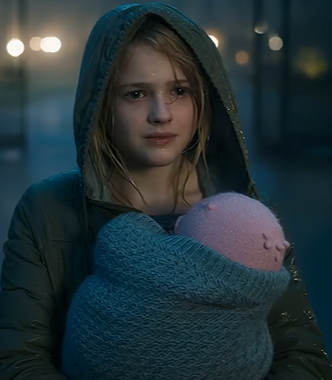
Edward stepped out of the car, his brow furrowed in irritation. He was used to solicitors, but not someone this desperate. Before him stood a girl who looked no older than eighteen. Her dress was a patchwork of rags, her face smeared with the soot of the city. But it was the bundle on her back that made him pause. Wrapped in a faded, thin cloth was a baby, her breaths shallow and fragile in the biting London air.

“This is private property,” Edward began, his voice cold. “If you need assistance, there are charities—”

He stopped mid-sentence. The girl had turned her head to check on the infant, and as the collar of her worn dress shifted, the streetlights caught something on the side of her neck. It was a dark, distinct, crescent-shaped birthmark.

Edward felt the air leave his lungs. It was as if a ghost had reached out and touched him. His late sister, Margaret, had been born with that exact mark. It was a genetic anomaly their father had always called the ‘Hale Moon.’ Margaret had vanished two decades ago after a bitter fallout with their father, choosing a life of rebellion over the family fortune. Edward had spent years looking for her, then years trying to forget her.

“Who are you?” he demanded, his voice cracking with an emotion he hadn’t felt in years.

The girl flinched, pulling the baby closer. “My name is Lena. Lena Carter. Please, sir. We haven’t eaten in two days. I’ll scrub the floors, I’ll clean the stables… just don’t turn us away.”

Edward ignored her plea for work. He stepped closer, his eyes locked on the birthmark. “That mark… where did you get it?”

Lena’s lips trembled. “I was born with it. My mother had one too. She told me it was the only thing our family ever truly owned.”

The world seemed to tilt on its axis. “Your mother… what was her name?”

“Elena,” the girl whispered. “But she said she used to be someone else. She died last winter. The cold… it was too much for her.”

Edward leaned against the cold stone of the gatepost. Elena. Margaret Elena Hale. His sister had changed her name, hidden her tracks, and lived in the shadows of the very city where he reigned as a king. She had died in the cold while he sat in a heated mansion. The guilt hit him like a physical blow.

“She never told you about me?” Edward asked, his voice barely a whisper.

Lena looked at the massive mansion, then back at the man in the bespoke suit. “She said she had a brother. But she said he lived in a tower of gold and had forgotten the color of blood. She told me never to come here… but Amelia was coughing, and I didn’t know where else to go.”

Edward looked at the baby—his niece. He looked at Lena—the daughter of the sister he had failed to protect. The silence stretched, heavy with the weight of twenty lost years.

“Bring them inside,” Edward commanded his driver.

“Sir?” the driver asked, surprised.

“I said bring them inside! Call the family doctor. Now!”

The following weeks were a blur of transformation. The mansion, once a museum of silent wealth, was suddenly filled with the sounds of a crying infant and the hushed, uncertain footsteps of a girl who didn’t know how to sit on silk chairs. Edward watched from the shadows as Lena ate her first full meal, her hands shaking as she realized the food wouldn’t be taken away.

He hired the best tutors, the best doctors, and the best nannies, but Lena refused to let Amelia out of her sight. She still looked at Edward with a mixture of awe and deep-seated resentment.

One evening, Edward found her in the library, staring at a portrait of their father.

“He was a hard man, Lena,” Edward said softly. “Your mother was right to leave him. But I was wrong to let her go.”

Lena didn’t turn around. “She died thinking you didn’t care. She worked three jobs until her heart just… stopped. Why didn’t you look harder?”

“I thought she wanted to stay hidden,” Edward admitted, the truth tasting like ash in his mouth. “I prioritized the business. I prioritized the ‘tower of gold.’ I thought money was the only way to honor the family name. I was a fool.”

He walked over and handed her a legal document. Lena looked at it, confused.

“It’s a trust,” Edward explained. “And a deed. You and Amelia are now the legal heirs to the Hale estate. You aren’t maids, Lena. You are Hales. This house, this fortune—it belongs to you as much as it does to me.”

Lena looked at the paper, then at the billionaire who stood before her with tears in his eyes. For the first time, the hardness in her expression softened. She realized that while she had spent her life fighting for survival, Edward had spent his life in a different kind of poverty—one of the soul.

“I don’t want the money,” Lena said, her voice finally steady. “I just want Amelia to know she has a family.”

Edward stepped forward and, for the first time, tentatively reached out to touch the girl’s shoulder. “She does. And so do you.”

The mansion was no longer a fortress of solitude. It was a home. Edward Hale had spent forty-five years building a kingdom, but it took a beggar girl with a crescent birthmark to teach him that the only inheritance worth keeping is the one that beats inside your heart.

Uber Driver Picks Up A Stranger And Discovers His Missing Father


I picked up a stranger for a midnight Uber ride, but when he saw my eyes, he started weeping. Then he showed me a photo on his phone that changed my entire identity.

FULL STORY:


I drove Uber for three years just to survive. No dreams attached. No big plans. Just rent, groceries, and keeping my head above water after life had stripped everything else away. I grew up in the system—foster homes, group homes, and a distinct lack of anyone who actually gave a damn about me. My history was a black hole.

Most nights blurred together—airports, bars, quiet neighborhoods, tired conversations that ended when the door closed. That night felt no different, initially.

It was raining hard when I picked up the request. A pickup from a high-end nursing facility on the outskirts of the city. I pulled up, and an elderly man came out. He walked slowly, dressed neatly in a coat that looked like it cost more than my car, hands folded in his lap as soon as he sat behind me.

The ride was long—almost an hour into the downtown district. At first, he said nothing. Just the rhythmic thrum of the tires on wet pavement and the windshield wipers fighting the storm.

But I could feel his eyes on me in the rearview mirror.
Not in a creepy way. In a searching way. Every time a streetlamp washed light over the interior, I caught his gaze fixed on my reflection.

Finally, he spoke. His voice was gravelly, worn down by time.
“You have your mother’s eyes,” he said softly.

I smiled politely, eyes on the road. “I get that a lot. Well, I used to.”
He hesitated, shifting in the leather seat. Then he asked something that made my hands tighten on the steering wheel.
“What’s your mother’s name?”

I almost didn’t answer. It felt too personal for a stranger. But something in his voice—fragile, careful, desperate—made me reply.
“Her name was Elena. She died when I was a baby.”

The car went silent. The air pressure in the cabin seemed to drop.
I glanced in the mirror and saw his face crumple. It wasn’t a subtle emotion; it was total devastation. Tears spilled down his cheeks, unchecked, like a dam had finally broken after holding back a flood for decades.

“Oh my God,” he whispered. “It’s you.”

I pulled over instinctively into an empty gas station lot. “Sir… are you okay? Do you need a doctor?”

He covered his face with his hands, shoulders shaking violently.
“I’ve been searching for you for twenty-eight years,” he said through sobs. “Twenty-eight years of dead ends. Twenty-eight years of praying.”

My heart began to race, thumping against my ribs. “Searching for me? Look, mister, I don’t know who you think I am, but I’m nobody. You must be mistaken.”

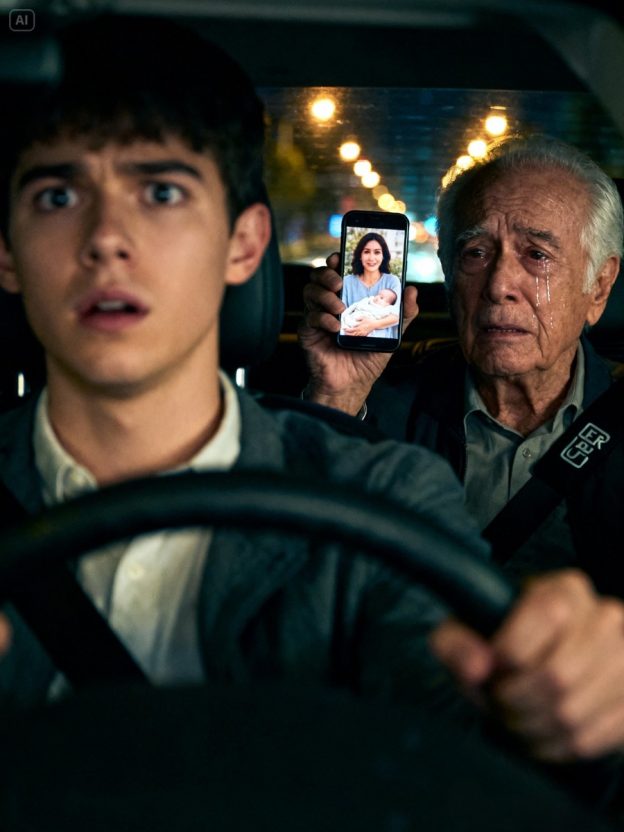
He shook his head fiercely, wiping his eyes with a trembling hand, and pulled out his phone.
“I knew this day would come,” he said. “I just didn’t know it would be like this. I didn’t know if you were even alive.”

He swiped through his gallery and turned the screen toward me.
“Look.”

I leaned back over the center console. When I saw what was on the screen, my breath caught painfully in my chest. The world stopped spinning.

Staring back at me was a digital scan of an old, slightly faded Polaroid.
It was a woman sitting on a porch swing, laughing, holding a newborn baby wrapped in a yellow blanket.
I knew that photo. I knew it because I had the exact physical copy of it tucked into the sun visor of my car—the only possession I had left of my mother.

“That’s… that’s my mom,” I choked out. “And that’s me.”

“And the man taking the picture,” the passenger said, his voice cracking, “was me.”

He reached out, his hand hovering near my shoulder, afraid to touch me. “Elena ran. My father… he didn’t approve of us. He was a powerful man, and he threatened her. She thought she was protecting you by disappearing. By the time I found out where she went, she was gone, and you were lost to the system. They told me you had died with her.”

He looked at me, really looked at me, with a love I had never seen directed at me in my entire life.
“I never stopped looking, son. I drove around this city for years, looking at faces, hoping to see hers again. And tonight… I found her eyes.”

I sat there in the front seat of my beat-up sedan, the rain still pounding outside, and for the first time in twenty-eight years, I wasn’t just a driver surviving. I was found.

She Thought She Was Alone In The House… Until She Read These Letters


She returned to her childhood home to settle her father’s estate… But a frozen letter found beneath the floorboards revealed he never actually left.

FULL STORY:


The wind howled through the skeletal branches of the ancient oaks surrounding the Miller estate, a sound like a choir of the grieving. Elara stood on the porch, her breath hitching in the frigid mountain air. The house was a monument to silence, its gray siding peeling like dead skin under a muted winter sky. It had been twenty years since she last stepped foot inside—twenty years since her father, Elias, had supposedly walked out into a blizzard and vanished, leaving her and her mother, Martha, to rot in the isolation of the peaks.

The interior smelled of cedar, damp wool, and the peculiar, sharp scent of ancient dust. Elara moved through the rooms with a handheld flashlight, the beam cutting through the gloom. The furniture was draped in white sheets, looking like a gathering of ghosts in the shallow depth of field. Her mother was upstairs, or so the hospice nurse had said—lost in the fog of dementia, waiting for an end that felt decades overdue.

As Elara began the grim task of sorting through her father’s study, the floorboards groaned under her weight. A loose plank caught the edge of her boot. Prying it up, she expected to find nothing but insulation and mouse droppings. Instead, she found a tin box, rusted shut by the humidity of a thousand storms.

Inside was a stack of letters, all addressed to her, but never sent. The ink was faded, the handwriting frantic.

“Elara,” the first letter began, dated three days after his disappearance. “I am not in the woods. I am in the cellar. She has locked the heavy door from the outside. If you are reading this, she has finally let the winter take me. Do not trust the garden. Do not trust the silence.”

The temperature in the room seemed to drop ten degrees. Elara’s heart hammered against her ribs like a trapped bird. She looked toward the hallway, where the door to the cellar stood—a heavy, oak monstrosity she had been told was “broken” for two decades.

She descended the stairs, her flashlight flickering. The air grew heavier, tasting of earth and copper. At the bottom, the beam landed on a wall that didn’t match the rest of the foundation. It was newer stone, crudely laid. Behind it, a rhythmic scratching sound began—soft, persistent, like fingernails on rock.

“Dad?” she whispered, her voice cracking.

From the shadows behind her, a floorboard creaked. Elara spun around. Her mother stood at the top of the stairs, her frame skeletal, her eyes unnervingly clear in the dramatic light of the hallway. Martha wasn’t wearing her hospice gown; she was wearing the heavy wool coat she had worn the night Elias “disappeared.”

“He always was a loud sleeper, Elara,” Martha said, her voice a terrifyingly calm melodic trill. “I thought the stone would drown him out. But some secrets, like the winter, just won’t stay buried.”

Martha began to descend, a heavy iron key glinting in her hand. Elara backed away, her heel hitting the new stone wall. The scratching from inside the wall grew louder, more frantic. The realization shattered her: her father hadn’t died twenty years ago. He had been kept, a prisoner of her mother’s madness, fed through a gap in the stone, living in a tomb of silence while Elara grew up thinking she was abandoned.

“You’re late for dinner, dear,” Martha whispered, reaching the bottom step.

Elara realized then that the “muted” colors of her childhood weren’t just the weather—they were the shadows of a house built on a living grave. As Martha lunged with surprising strength, Elara had to choose: run into the blizzard outside, or tear down the wall to face the monster her father had become in the dark.

The “Secret Meeting” That Shattered A Mother’s Heart Forever


She surprised her daughter with a homemade pie… But the sound of her husband’s voice inside the house revealed a betrayal she never saw coming.


The pie tin was still warm against my palms, the scent of cinnamon and baked apples a cruel irony against the freezing morning air. I had spent all morning in the kitchen, carefully crimping the edges of the crust just the way Clare liked it. I wanted to be the “good mother,” the one who heals rifts with dessert and a smile.

But as I stood in the shadow of my daughter’s pristine white-picket-fence home, my world began to tilt. Frank’s SUV was parked crookedly in the driveway. My husband, who claimed he was at a back-to-back board meeting across town, was here. Without a word to me.

I moved like a ghost toward the side window. I told myself there was a logical explanation. Maybe Clare was sick. Maybe they were planning a surprise for me. But the laughter that drifted through the glass wasn’t the sound of a family planning a celebration. It was the sound of a shared life that I wasn’t part of.

“You’re late,” Clare’s voice teased. It was light, airy, and lacked the usual tension she had when I was in the room. “I thought maybe your wife was keeping you busy.”

My heart hammered against my ribs. Your wife. Not “Mom.” Not “my mother.” She spoke of me like I was a hurdle they had successfully cleared.

Then came Frank’s voice—the man I had shared a bed with for twenty-five years. “Don’t start,” he murmured, and I could practically hear the smirk in his voice. “You know how careful we have to be. If she suspects anything, the whole plan falls apart.”

“She’s too busy playing house to suspect a thing,” Clare replied. I heard the clink of a glass—a toast. “To the new beginning. Once the papers are signed and the money is moved, she won’t even know what hit her.”

I looked down at the pie in my hands. The “sweet surprise” suddenly looked like a pathetic peace offering to two predators. They weren’t just keeping a secret; they were dismantling my life while I was in the next room baking.

I didn’t scream. I didn’t throw the pie through the window. Instead, I carefully set the tin down on the porch mat, right on top of the word “Welcome.” I pulled out my phone and took a photo of Frank’s car in the driveway, then a video of their muffled voices laughing about my “ignorance.”

As I walked back to my car, the cold air finally felt clean. They thought they were being careful. They thought I was “playing house.” But as I put the car in reverse, I realized that if they wanted to play a game of secrets, I was about to show them who the real master was. I wasn’t going home to cry; I was going to my lawyer.

New Student Bullies The “Shrimp” And Instantly Regrets It


The new transfer student shoved the “”shrimp”” to the ground, laughing at him… But he didn’t realize that “”shrimp”” was the only person the entire football team would die for.

FULL STORY:


The cafeteria at Jackson High isn’t just a place to eat; it’s a kingdom with invisible borders, and everyone knows where the landmines are buried. Everyone, apparently, except for the new guy.

It was Taco Tuesday. The air was thick with cumin and teenage anxiety. I was sitting at the center table—the one reserved for the Varsity defense. I’m Jackson, middle linebacker and captain. To my right was Miller, our nose tackle. We move as a unit. We breathe as a unit. In this town, football is gravity. But with the jersey comes a code: You don’t punch down. You protect the herd.

That’s when I saw him. Brock.

He’d transferred in two weeks ago. He was big—gym-sculpted, not field-tested. He walked like he was doing the hallway a favor by stepping on it, headphones blasting, bypassing the long lunch line. He cut straight through the gap, stepping in front of a group of terrified sophomores.

“He’s cutting,” Miller grunted, taco halfway to his mouth.
“Watch,” I said quietly.

We don’t intervene immediately. You have to let people show you who they are. But then I saw where he was heading. He wasn’t just cutting to the front. He was cutting in front of Leo.

Let me tell you about Leo. He’s five-foot-four, asthmatic, and stutters. To the average observer, he’s the bottom of the food chain. But to us? Leo is the Lion. Literally. He’s the guy inside the mascot suit. When we’re down by two touchdowns, sweating and bleeding, Leo is the one inside a 120-degree suit doing backflips to keep the crowd alive. We treat him like the little brother we’d die for.

Brock didn’t know the law.

He stepped up behind Leo, extended a massive arm, and shoved. It wasn’t playful. Leo stumbled, tripped over his own feet, and hit the metal railing. His tray hit the floor. CLANG-CLATTER-BANG.

The cafeteria went silent.

“Move it, shrimp,” Brock sneered. “You’re blocking the fuel.” He stepped into Leo’s spot, grinning at the lunch lady. “Heavy on the beef, sweetheart.”

He looked around, expecting applause. Instead, he got the sound of my chair screeching against the linoleum.

Then, the sound multiplied.

To my right, Miller stood up. To my left, the safeties rose. Behind us, the JV linebackers and the freshman squad. Eighty chairs pushed back at once. Eighty bodies rose in unison.

Brock froze. The taco scoop hovered over his plate. He turned slowly, his arrogant smirk faltering as he saw the wall of navy blue and gold standing silent, staring right at him.

I stepped out. “Not hungry anymore, boys?”
“Nope,” Miller cracked his knuckles. “Lost my appetite.”

I walked toward the line. The eighty guys fell into step behind me—a slow, rhythmic tide of aggression. Brock swallowed hard. I walked right past him without making eye contact and went straight to Leo.

I put a hand on Leo’s shoulder. “You okay?”
“I… I’m fine, Jackson,” Leo stammered.
“No,” I said, my voice carrying through the silent room. I turned to face Brock. “It’s not.”

Brock tried to laugh, but it came out as a dry choke. “Relax, man. It was a joke. I didn’t know he was… your boyfriend or something.”

Wrong thing to say.

I took a step closer. I didn’t have to look up to meet his eyes, but I looked through him. “Pick it up.”

Brock blinked. “What?”

“The tray,” I said calmly. “The food you made him drop. Pick. It. Up.”

Brock looked at the eighty guys behind me. He looked at Mrs. Higgins, who was crossing her arms. He looked at the exit, which was currently blocked by our offensive line.

“I’m not picking up garbage,” Brock whispered, though his voice shook.

“Then you’re not eating,” Miller said, stepping up beside me. He’s 280 pounds of bad attitude. “In fact, I don’t think you’re eating here at all. This table? It’s for the team. And the family.”

I pointed at Leo. “That ‘shrimp’ is the reason we win on Fridays. He works harder in that suit than you do on your biceps curls. You touched him. That means you touched all of us.”

The silence stretched, heavy and suffocating. Brock’s face turned a deep shade of crimson. His gym muscles couldn’t help him against an army.

Slowly, painfully slowly, Brock bent his knees. He reached down. He picked up the plastic fork. Then the napkin. Then the spilled tacos. He put them on the tray.

“Apologize,” I said.

Brock stood up, holding the trash. He wouldn’t look at me. He looked at Leo’s shoes. “Sorry.”

“I didn’t hear you,” I said.

“I said I’m sorry!” Brock snapped, humiliated.

“Good,” I said, stepping aside and pointing to the back of the cafeteria, near the trash cans. “Now, go sit over there. By yourself. And if I ever see you cut a line, shove a kid, or breathe in Leo’s direction again… we won’t just stand up. We’ll walk over.”

Brock took the tray of trash and did the longest walk of his life across the cafeteria. He sat at the furthest table, alone.

I turned back to Mrs. Higgins. “Double beef for Leo, please. On me.”

The cafeteria erupted. Not in cheers, but in the low, approving rumble of order being restored. We sat back down. Leo sat right between me and Miller.

Brock transferred out three weeks later. Said he didn’t like the “culture.” He was right. He wasn’t built for the ecosystem.

Billionaire Dad Fired 37 Nannies — Until The Maid Did This


He fired 37 nannies in two weeks because his six daughters were “monsters”… But the housekeeper found one note in the fridge that changed everything.

FULL STORY:


In fourteen days, thirty-seven nannies had walked out of the Hernández mansion on a cliff above the ocean in Tijuana. Some left crying. Some left screaming. The most recent one ran out with green paint smeared through her hair, shouting at the gate guard, “Tell Mr. Hernández to hire an EXORCIST, not a nanny!”

From his third-floor office, Javier Hernández watched the taxi vanish. At 36, the billionaire tech founder looked twenty years older. Exhaustion clung to him like dust. He looked at the photo on his wall: Lucía, his late wife, smiling with their six daughters.

“Thirty-seven,” he muttered. “I can’t keep up.”

His assistant, Santiago, broke the news gently. “Sir, every agency has blacklisted the house. No more nannies. But… there is a cleaning worker available. Just to manage the debris until we figure this out.”

“Send her,” Javier said, looking at the yard littered with broken toys. “Anyone willing to walk through that door.”

Natalia Delgado, 25, was studying child psychology by night and scrubbing floors by day. When she arrived at the mansion, the gate guard looked at her like she was stepping into a war zone. “God be with you, miss.”

Inside, it was chaos. Graffiti on the antique wallpaper. Dishes piled high. Javier met her, looking defeated. “Just cleaning,” he told her. “I’ll pay triple. My daughters are… difficult.”

As he spoke, a crash echoed from upstairs. Six girls appeared on the landing like an army.
Camila (12), the ringleader. Renata (10), Isabela (9), Julia (8), and the twins, Paula and Mia (6). And little Lola (3), clutching a broken doll.

“Thirty-seven,” Camila announced, her voice cold. “You’re number thirty-eight.”

Natalia didn’t flinch. She saw the rage in Camila’s eyes, but her psychology training saw something else: a desperate need for control in a world that had fallen apart.

“I’m Natalia,” she said calmly. “I’m not a nanny. I’m just here to clean the kitchen.”

She turned her back on them—the first mistake the other nannies made was trying to engage—and walked into the disaster zone of a kitchen.

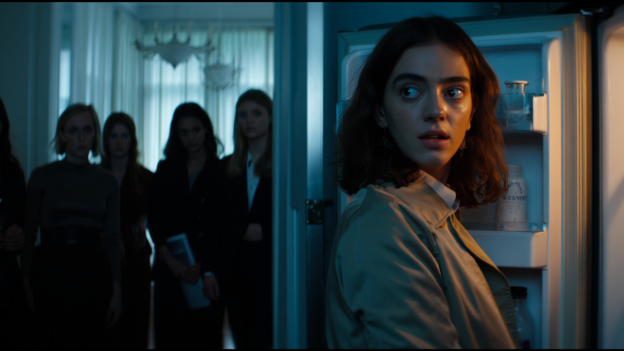
It was overwhelming. Rotting fruit, cereal on the floor. But when she opened the massive stainless-steel fridge to find cleaning supplies, she froze.

Taped to the inside of the door, protected by a layer of plastic wrap, was a handwritten list in elegant, looping cursive.

“Las Favoritas de mis Niñas (My Girls’ Favorites):
Camila: Albóndigas with extra mint.
Renata: Fideo soup, but only with the star noodles.
Isabela: Rice pudding with cinnamon sticks, not powder…

The list went on for every child. At the bottom, in shaky handwriting, was a final note: “Please feed them with love, so they taste me in the food.”

Natalia’s throat tightened. It wasn’t a menu; it was a goodbye letter.

Suddenly, she understood. The nannies had come in trying to instill discipline, trying to be new authority figures. They tried to change the routine. But these girls didn’t want a new mother. They were terrified that if a new woman came in, the memory of the old one would fade.

Natalia rolled up her sleeves. She didn’t reach for the bleach. She reached for the ground beef and the mint.

An hour later, the smell of sizzling onions, garlic, and mint drifted up the stairs. It was a specific scent—the scent of the list.

Slowly, footsteps creaked on the stairs.

Camila appeared in the doorway, holding a bottle of red paint, ready to ruin the “new nanny’s” clothes. But she stopped. Her nose twitched.

“What are you doing?” Camila asked, her voice trembling slightly.

“Cleaning out the fridge,” Natalia lied, not looking up as she rolled meatballs. “But I found this meat about to spoil, so I thought I’d make soup. I made too much, though. You all might as well eat it so I don’t have to throw it out.”

She placed the pot on the table. Albóndigas. Exactly how the note described.

The twins, Paula and Mia, crept in first. Then Lola. They climbed onto the chairs, swinging their legs. Natalia put bowls in front of them and retreated to the sink to wash dishes, making herself invisible.

She heard the first spoon clink. Then silence.

“It tastes like…” little Lola whispered. “It tastes like Mommy.”

Camila dropped the paint bottle. It didn’t break, but the thud echoed in the room. She walked to the table, looked at the soup, and then at Natalia.

“Who told you?” Camila demanded, tears welling in her eyes. “Who told you about the mint?”

Natalia dried her hands and leaned against the counter. “Your mother did. She left the note in the fridge. I’m just following instructions.”

Camila sat down, her shoulders shaking. The armor cracked. For the first time in six months, she wasn’t the General of the resistance; she was a twelve-year-old girl who missed her mom.

When Javier came home that evening, bracing himself for the screaming, he stopped dead in the hallway.

Silence.

He rushed to the kitchen, fearing the worst.

He found his six daughters sitting around the island. They weren’t fighting. They weren’t screaming. They were eating, scraping the bottom of their bowls. Natalia was in the corner, quietly scrubbing the stove.

Javier looked at Camila. She looked up, her eyes red but soft.

“It’s the soup, Papa,” she said quietly. “The one Mom made.”

Javier looked at Natalia, bewildered. “I thought you were just cleaning.”

Natalia smiled, a sad, knowing smile. “I am, Mr. Hernández. Sometimes, to clean a house, you have to clear out the grief first.”

Natalia didn’t quit the next day. Or the day after. She never tried to be their mother. She simply kept the memory of Lucía alive through the routine, becoming the bridge they needed to heal.

The mansion on the cliff was still loud, and sometimes messy, but it was no longer hell. It was a home again.

Mother-In-Law Banned Me From Her Party


After 32 years of marriage, my mother-in-law banned me from her 75th birthday party… But 11 days later, when she begged for help, my 3-word reply destroyed them.


I was folding the fresh kitchen towels—the new ones with a tiny daisy print—when my phone buzzed. It was Kate, a friend from the office. I almost ignored it, but she called four times in a row.

“Emily, why aren’t you picking up?” Kate was breathless. “Did you hear about Margaret’s birthday this Saturday?”

I froze, the towel clutched in my hand. “What birthday?”

“She’s turning seventy-five. Sarah told me. Margaret sent out invites two weeks ago. Everyone is going.”

The towel slipped from my fingers. Thirty-two years married to James, and I had never missed a family gig. I was the one who bought the gifts, cooked the roasts, and remembered the anniversaries. Yet here was Margaret’s milestone, and I wasn’t on the list.

“Maybe they just forgot?” I whispered, my stomach churning.

“Forgot? Sarah says the guest list is twenty people. James’s brothers, their wives, the grandkids… even the neighbour from flat five.”

I sat down heavily on a stool. Memories flooded back: Me sleeping in a hospital chair after Margaret’s gallbladder operation because her own sons “couldn’t handle hospitals.” Me using my vacation days to drive her to get her dentures fitted. Me babysitting the nieces and nephews so the “real family” could go on outings.

When James came home, shaking the rain from his hair, I didn’t even say hello.

“James, is your mum having a birthday party this Saturday?”

He froze by the fridge. He didn’t turn around. “Yeah. Something small.”

“Why didn’t you tell me?”

“Mom doesn’t want a big do,” he said, finally looking at me, his eyes shifting away. “Just the closest family.”

“Closest family,” I repeated. “And I’m not part of that? Even the neighbour from flat five is invited, James!”

“Emily, don’t start. You know Mum. She’s got her quirks. She thinks you bought the wrong cake last New Year’s and she’s still being petty. Just let it go. It’s one night.”

“I have served this family for thirty-two years,” I said, my voice trembling. “I cleaned her house. I washed her laundry. I fed her. And I am excluded because of a cake?”

“You’re making a scene over nothing,” James snapped, grabbing a beer. “It’s her party. She chooses the guests. Just stay home and relax for once.”

So, I did.

Saturday came. James put on his best suit, spritzed on cologne, and left. He didn’t look me in the eye. I sat in the living room with a glass of wine, scrolling through social media. I saw the photos. The toasts. The laughter. The neighbour from flat five eating a slice of cake. I wasn’t sad anymore. I was cold. Something in me had snapped shut.

Life went on for exactly eleven days.

On the eleventh day, my phone rang while I was at work. It was James.

“Emily, you need to leave work. Now.”

“What’s wrong?”

“It’s Mum. She fell down the front steps. Shattered her ankle and fractured her hip. She’s being discharged, but she can’t walk. She needs 24/7 care for at least six weeks.”

“Oh, that’s terrible,” I said, my voice flat.

“Yeah, it’s a nightmare. Sarah can’t do it because of the kids. Dave and Steve are working. So, I told the doctors you’d handle the home care. I’m coming to pick you up; we need to set up the guest room for her.”

Silence stretched over the line.

“Emily? Did you hear me?”

“I heard you, James.”

“Good. Get your stuff ready. She’s really in a bad way, she’s crying, asking for you. She knows you’re the best at this stuff.”

I took a deep breath. “No.”

“What?”

“No. I won’t be doing that.”

“Emily, are you crazy? She’s family! She’s my mother!”

“James,” I said, projecting my voice so my office mates could hear. “Eleven days ago, on her birthday, you and your mother made it very clear that I am not ‘closest family.’ I am an outsider. I am a guest. Actually, less than a guest, since the neighbour made the cut and I didn’t.”

“That was a party! This is a medical emergency! Stop being vindictive!”

“I’m not being vindictive. I’m respecting her wishes. She clearly doesn’t view me as close family. Caregiving is a very intimate act, James. It should be done by those closest to her. Like you. Or Sarah. Or the neighbour from flat five.”

“Emily, please! I can’t take six weeks off work!”

“Neither can I. And I certainly won’t use my vacation days for a woman who erased 32 years of love over a sponge cake.”

“If you don’t come home and help, don’t bother coming home at all,” James threatened.

“Okay,” I said. “I’ll go stay with Kate. She invited me over, unlike your mother.”

I hung up.

It’s been three days. James has been blowing up my phone. Apparently, the private nurse they had to hire costs a fortune, and Margaret is miserable because the nurse won’t tolerate her ‘quirks.’ They are begging me to come back.

I just booked a solo trip to Italy. I hear the cake there is delicious.

Stepmother Forced Boy To Eat Like A Dog, But The Family K9 Had Other Plans


She forced her billionaire stepson to eat scraps off the floor… But she forgot the family’s retired K9 was trained to hunt monsters.

FULL STORY:

CHAPTER 1: THE GILDED CAGE
The Vance estate in Greenwich was a masterpiece of glass, marble, and lies. To the neighbors, Julian Vance was the titan of industry who had suffered the ultimate tragedy—the loss of his wife, Sarah—only to be “saved” by the elegant Vanessa. Vanessa was the picture of grace, a woman who had stepped into the vacuum of a broken home and supposedly filled it with light.

But inside those walls, the air was heavy with a different kind of silence. It was the silence of a seven-year-old boy named Leo, who had once been full of laughter but had gradually become a ghost in his own home.

Vanessa’s cruelty wasn’t loud. It was surgical. She didn’t leave marks where the public could see them. She used isolation, food deprivation, and the terrifying “crawl space”—a small, dark utility closet beneath the grand staircase. She told Julian that Leo was “troubled,” that he was “acting out” due to trauma, and that she was doing her best to provide “firm boundaries.”

Julian, blinded by grief and the crushing weight of a global empire, believed her. He saw the organic meals Vanessa “prepared” for the family and didn’t see the cold scraps she forced Leo to eat in the kitchen hours later. He saw the expensive private school uniforms and didn’t see the bruises hidden beneath the starch.

CHAPTER 2: THE PROTECTOR
The only one who saw the truth was Shadow.

Shadow was a retired Belgian Malinois-German Shepherd mix, a veteran of a high-stakes K9 unit. Julian had adopted him at Sarah’s request months before she passed. Shadow was supposed to be a protector, but in Vanessa’s eyes, he was an obstacle. She had tried to have him “rehomed” multiple times, claiming he was aggressive toward Leo.

The irony was that Shadow was the only thing keeping Leo sane. In the dead of night, the dog would nudge the crawl space door open with his snout, curling his massive, warm body around the shivering boy. Shadow knew the scent of fear, and Vanessa reeked of it—hidden beneath layers of Chanel No. 5.

CHAPTER 3: THE CRACK IN THE PORCELAIN
The morning of the incident began like any other. Julian left at 5:00 AM for what was supposed to be a grueling day of board meetings and a flight to London. Vanessa waited until the taillights of his Audi disappeared down the long, cobblestone driveway before she turned on Leo.

“The sound of the ceramic bowl hitting the marble floor sounded like a gunshot in the silent kitchen,” Julian would later recall.

“Eat it,” Vanessa hissed. Her voice was a jagged blade. On the floor was a mess of gristle, soggy bread, and cold pasta—trash from the night before. “Go on, Leo. Since you want to act like a stray, you can eat like one. Get on your knees.”

Leo didn’t move. He stood there, his small frame shaking, his eyes fixed on the floor. He was wearing a shirt that was two sizes too small, a subtle sign of neglect Julian had missed.

“If you don’t eat it before I count to three, I’m locking you in the crawl space again,” she whispered. “And this time, I’ll tell your father you ran away. He’ll believe me. He always does.”

CHAPTER 4: THE RETURN
In Manhattan, Julian sat in his office, staring at a mahogany folder he had forgotten. But it wasn’t the folder that bothered him. It was a feeling—a cold, visceral dread that had been growing for months. He remembered the way Leo flinched when Vanessa reached out to “stroke” his hair. He remembered the dog’s low, constant growl whenever Vanessa entered a room.

Julian stood up, canceled the meeting, and drove back to Greenwich. He didn’t call. He didn’t text.

When he stepped through the front door, the house was silent, but the air felt charged with electricity. He walked toward the kitchen, his boots silent on the plush rugs. He stopped just outside the arched doorway.

He saw his wife—the woman he had trusted with his son’s soul—towering over Leo. He saw Leo sinking to his knees, reaching for the garbage on the floor with a hand that shook with pure terror.

And then, Shadow intervened.

The dog didn’t bark. A trained K9 doesn’t waste energy on noise. He moved like a dark blur, planting his hundred-pound frame between the boy and the woman. His upper lip curled back, revealing rows of white, lethal teeth. The growl was a physical force, a warning that the predator had finally met a bigger hunter.

“Move, you stupid dog!” Vanessa yelled, her face contorting into something demonic. She raised her hand to strike the dog.

CHAPTER 5: THE COMMAND
“Julian!” Vanessa’s voice transformed instantly as she saw him. The screech became a sob. “Oh, thank God you’re home! This beast—he tried to attack me!”

Julian didn’t look at her. He walked past her, his heart hammering against his ribs like a trapped bird. He knelt in the mess on the floor. He looked at the “scraps.” He looked at the yellowish-purple bruise on Leo’s arm.

“Leo,” Julian said, his voice cracking. “Look at me, buddy.”

The boy wouldn’t. He kept looking at the floor. “I’m sorry, Daddy,” he whispered. “I’ll be faster. I’ll eat it. Just don’t put me in the dark.”

The words hit Julian like a physical blow. The dark.

“The dark?” Julian asked, his voice dangerously quiet.

“He’s… he’s imagining things, Julian,” Vanessa stammered, backing toward the hallway. “I’ve been so patient with him, but the trauma—”

“GET OUT!” Julian roared.

Vanessa turned to flee toward the stairs, likely to pack her things or hide the evidence of her “discipline.” But Shadow was faster. He blocked the hallway, his body a rigid barrier of muscle. He looked at Julian, his intelligent eyes waiting for the one thing he had been trained for.

Julian looked at the woman who had tortured his son. He looked at the dog who had saved him.

“Shadow,” Julian whispered, the rage finally boiling over into a cold, hard command. “Hold.”

The dog sat. He didn’t bite, but he stayed inches from Vanessa’s throat, his eyes locked on hers. She froze, a scream dying in her throat.

CHAPTER 6: THE TRUTH UNVEILED
While Shadow held Vanessa captive in the hallway, Julian picked up his son. He carried him to the living room, wrapping him in a blanket that smelled of home, not of fear.

“I’m so sorry, Leo,” Julian sobbed into the boy’s hair. “I was so blind.”

Julian called his head of security—not the police, not yet. He wanted the house swept. Within thirty minutes, a team was in the estate. They found the “crawl space.” They found the small, scratch marks on the inside of the door where Leo had tried to get out. They found the hidden nanny cam Vanessa had installed to watch Leo, not realizing it had recorded her own sessions of psychological torture.

When the police finally arrived, they didn’t just take a statement. They took Vanessa in handcuffs. As she was led down the driveway, Shadow stood on the porch, a silent sentinel. He didn’t bark as the sirens faded. He simply turned and walked back to Leo’s side.

EPILOGUE: HEALING
Months later, the Vance estate felt different. The lilies were gone, replaced by the scent of fresh air and the sound of a young boy’s laughter.

Julian had stepped down as CEO to spend every moment with his son. They spent their days in the gardens, Leo running through the grass with Shadow at his heels. The “dark” was gone, replaced by a father’s promise.

Shadow was no longer just a dog. He was the bridge between a broken past and a hopeful future. And as Julian watched his son finally start to grow into the shirt he was wearing, he knew that some protectors don’t wear capes—sometimes, they just have a notched ear and a heart of gold.