They locked me in the trunk of a Rolls-Royce to hide my Tourette’s from their high-society guests. But my desperate thumping caught the attention of a K-9 unit that thought I was a ticking bomb.
The Sterling-Vane household didn’t have “problems”—we had “design flaws.” In a world built on French silk, mid-century modern minimalism, and the crushing weight of old money, everything had to be curated. My mother, Eleanor, viewed life as a series of still-life paintings. My brother, Julian, was the masterpiece: a Harvard-bound athlete with a jawline that could cut glass. And then there was me, Leo. I was the smudge on the canvas. The crack in the porcelain.
I have Tourette’s Syndrome. It isn’t the kind you see in movies where I shout profanities; it’s a rhythmic, violent series of motor tics—my head snapping to the right, my shoulder jerking toward my ear, and a sharp, repetitive clicking sound I make with my tongue. To my parents, these weren’t neurological symptoms; they were “aesthetic disruptions.”
The night of the Solstice Gala was supposed to be Julian’s debut into the inner circle of the city’s elite. It was an event held at the historic Heritage Hall, guarded by more security than a federal mint because the guest list included senators and tech billionaires.
“You’re staying home, Leo,” my father had said over breakfast, his eyes never leaving the financial section of the paper. “The sensory input of the gala will only… trigger you. It’s for your own comfort.”
But “comfort” was a lie. The truth was that the governor would be there, and my father was gunning for an appointment. He couldn’t have a son who “glitched” in the background of a campaign photo.
However, Eleanor had a different plan. She wanted the “complete family portrait” for the arrival photos—the four of us stepping out of the vintage silver Rolls-Royce. But she didn’t want the “glitching” during the forty-minute drive or the subsequent dinner.
“We have a compromise,” she whispered, her hand smelling of expensive lilies as she stroked my hair. “You’ll come for the photo. But for the commute… we don’t want you to strain yourself. We’ve put a plush duvet in the trunk. It’s a very large trunk, Leo. Very safe. You can tic all you want in there, and when we arrive, you’ll be calm for the cameras.”
I was seventeen. I was terrified of their disappointment. I let them lead me to the garage. Julian didn’t look at me; he just adjusted his tuxedo cuffs, sipping a glass of pre-gala vintage champagne. My father held the trunk open like he was offering me a seat at a royal banquet.
“It’s for the best, son. Think of the aesthetic.”
The trunk slammed shut. Darkness swallowed me. The engine purred to life, a low vibration that immediately sent my nervous system into overdrive. The “plush duvet” felt like a shroud.
As we hit the highway, the anxiety hit a fever pitch. My tics exploded. My head began to hammer against the padded interior of the trunk—thump-click, thump-click. My boots kicked against the metal frame of the car. I couldn’t stop. The more I tried to breathe, the more my body rebelled. Above me, I could hear the faint muffled sounds of laughter and the clink of crystal. They were sipping champagne just inches away, separated by a layer of leather and steel, while I convulsed in the dark.
By the time we reached the security checkpoint at Heritage Hall, I was in a full-blown crisis. My tics had become a rhythmic, heavy pounding. BAM. BAM. CLICK. BAM.
The car slowed. I heard muffled voices—the security detail.
“State your name and invitation, sir,” a voice boomed outside.
“Arthur Sterling-Vane. Here for the Solstice Gala,” my father replied, his voice oozing charm.
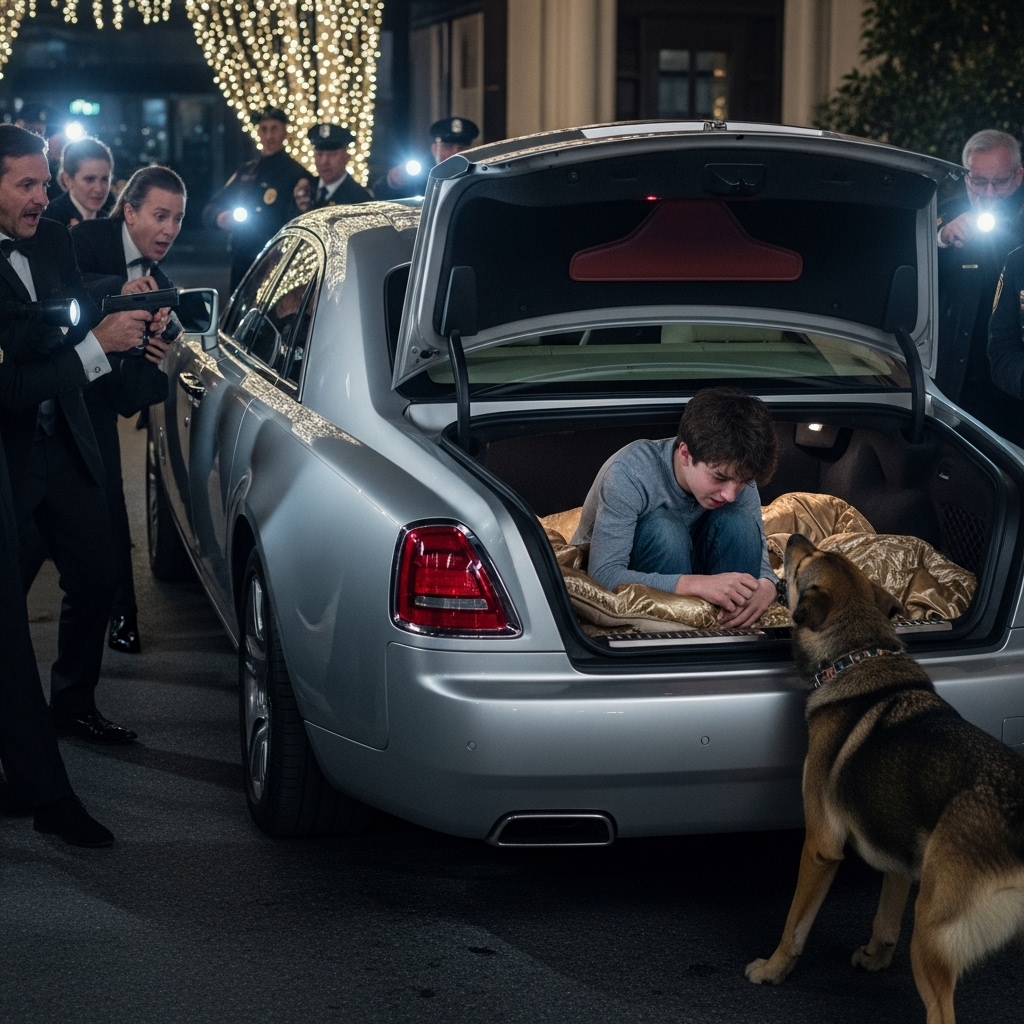
What happened next was a blur of high-stakes misunderstanding. Outside, a K-9 officer named Miller was patrolling the line with Rex, a Belgian Malinois trained in explosives detection. Rex didn’t smell gunpowder, but he heard the rhythm. He heard the metallic, rhythmic thudding coming from the rear of the vehicle—a sound that, to a trained ear in a high-security zone, sounded exactly like a mechanical trigger or a person trapped.
Rex alerted. He sat and barked, his eyes fixed on the silver trunk.
“Sir, step out of the vehicle immediately!” the officer shouted.
“Excuse me?” my mother’s voice trilled. “We are guests of the—”
“HANDS WHERE I CAN SEE THEM! EXIT THE VEHICLE!”
The car rocked as my family was hauled out. I heard my father protesting, his voice high and shrill, stripped of its usual dignity. “There’s nothing in there! It’s just… it’s personal luggage!”
“Open the trunk, sir,” the officer commanded.
“I… I don’t have the key on me, the valet—”
“OPEN IT OR WE BREACH IT!”
I heard the sound of a heavy tool hitting the lock. My heart was a bird trapped in a cage. I let out a loud, piercing vocal tic—a sharp YELP—just as the lid flew open.
The blinding light of the security floodlights hit me. I was curled in a fetal position, my tuxedo jacket torn, my face flushed and sweating, my neck snapping uncontrollably to the right.
I looked up into the barrels of three tactical rifles.
“Don’t shoot!” I screamed, my tongue clicking frantically. “I’m not a bomb! I’m just a ‘design flaw’!”
The silence that followed was deafening. Officer Miller looked at me, then at my parents, who stood there in their couture finery, champagne glasses abandoned on the asphalt. The governor and half the city’s elite were watching from the red carpet just fifty feet away.
“Did you… did you have a child locked in the trunk?” Officer Miller asked, his voice low and dangerous.
“He has a condition!” my mother cried, clutching her pearls. “We were protecting him! The aesthetic of the event—”
“You’re under arrest for child endangerment and false imprisonment,” Miller snapped, reaching for his handcuffs.
The cameras that my mother so desperately wanted to capture our “perfect” arrival were indeed clicking. But they weren’t taking society portraits. They were capturing the image of Arthur and Eleanor Sterling-Vane being pushed against their silver Rolls-Royce in handcuffs.
Julian stood by, his ‘perfect’ jaw dropping in horror as he realized his Harvard recommendation was evaporating in real-time.
As the police helped me out, Officer Miller wrapped a jacket around my shaking shoulders. “You okay, kid?”
I looked at my parents—at the ruined “aesthetic” of their lives—and for the first time in three hours, my body went perfectly still.
“I’ve never been better,” I said. And I didn’t tic once.