My baby screamed at the same wall every night… Until my dog tore it open and I found a hidden room with photos of my wife holding another baby—one she never told me about.
I’m Mark. Six months ago, I thought I had everything figured out. A successful tech career, a beautiful wife named Sarah, and our newborn daughter Lily. We’d just moved from our cramped Jersey City apartment into a sprawling colonial house in The Maples, an exclusive Connecticut suburb where perfection wasn’t just expected—it was mandatory.
But from the moment we carried Lily across the threshold, something was wrong.
She would scream. Not the normal newborn crying that keeps you up at night—this was different. This was primal terror. And she only did it in one specific place: the upstairs hallway, staring at the wall at the end of the corridor.
At 2 A.M. on what felt like the hundredth sleepless night, I stood in that hallway holding my purple-faced daughter. The moonlight cut blue rectangles across the hardwood floor. Lily’s tiny body was rigid, arched backward, her eyes locked on that empty stretch of cream-colored wallpaper.
“Shh, baby. Daddy’s here,” I whispered, my voice raw.
Buster, our normally docile Golden Retriever, sat at my feet. His hackles were raised, and a low growl rumbled in his chest—a sound I’d never heard from him. He was staring at the exact same spot as Lily.
“Sarah?” I called out.
I found my wife sitting bolt upright in bed, hands clutching the duvet so hard her knuckles were white. She was staring at the bedroom door with hollow, sunken eyes.
“She’s doing it again,” I said. “The wall. Something’s wrong with that wall.”
“It’s just old plumbing,” Sarah said flatly. “The water runs through there.”
“Buster hears water? He’s growling like there’s an intruder behind the paint.”
Sarah finally looked at me, and for a split second, I saw something I’d never seen before in her eyes. Not exhaustion. Fear.
“You’re tired,” she said, her voice unnervingly calm. “Give her to me. Go sleep in the guest room. You have that meeting tomorrow.”
I handed Lily over and went downstairs instead, pouring myself a bourbon I didn’t need. As I sat in the dark kitchen, I remembered something our neighbor, Mrs. Gable, had said on moving day.
“Beautiful house,” the elderly woman had rasped, her eyes fixed on the upstairs windows. “Good to see a family back in there. It’s been empty for a long time. Just… keep the windows locked, dear. This house has a way of holding onto things people try to leave behind.”
The next morning, Sarah was performing her Pinterest-perfect wife routine—organic smoothies, packed lunch, bright smile. But she wouldn’t meet my eyes.
“I’m calling a contractor,” I announced, pulling on my blazer. “Something is wrong with that wall. Maybe it’s mold, maybe there’s a dead animal. I’m having someone open it up.”
“No.”
She said it too fast. Too sharp.
“Mark, I don’t want people tearing up the walls. I’ll call someone. Just give me a few days.”
“You’ve been saying that for weeks.”
I left for work but couldn’t focus. Why was Sarah so protective of a piece of drywall? I decided to leave early, to catch the house without her “everything is fine” performance.
When I pulled into the driveway at 3 P.M., Sarah’s car was gone. I let myself in. The house was silent.
Buster didn’t come to greet me. That was the first red flag.
“Buster?”
I heard frantic, muffled thudding from upstairs. I ran up the steps, my heart hammering.
Buster was in the hallway, but he wasn’t himself. He was possessed. He’d somehow pushed the heavy mahogany bookshelf—the one Sarah had insisted we place against that specific section of wall—six inches to the left.
His paws were bleeding. He was tearing at the wallpaper with his teeth, ripping away long strips of the cream-colored floral pattern.
“Buster! Stop!”
I grabbed his collar. He snarled and snapped at me—my gentle dog who’d never shown aggression in his life.
Then I smelled it. Not mold. Not decay. It was the smell of old, stale air that hadn’t moved in years. And beneath it, unmistakably, the scent of baby powder.
I looked at the wall where Buster had torn away the paper. There was a seam. A tiny vertical crack in the plaster that didn’t match the rest of the construction.
I didn’t wait for permission. I went to the garage, grabbed my crowbar, and jammed it into the seam.
The drywall didn’t just break—it swung inward on hidden, rusted hinges. A four-foot section of wall opened like a door.
It wasn’t a crawl space. It was a room.
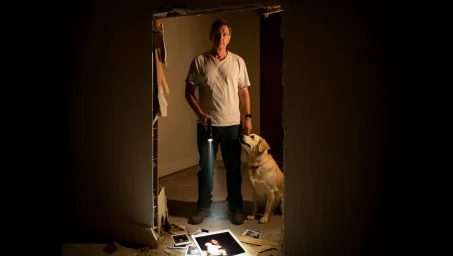
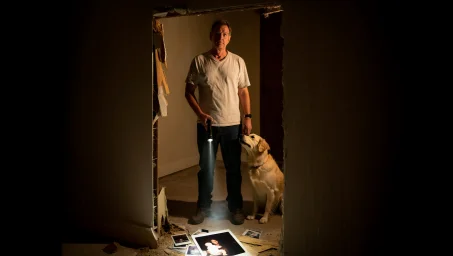
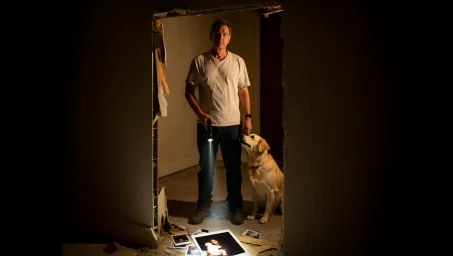
I turned on my phone’s flashlight. The beam cut through dancing dust motes, illuminating what shouldn’t exist.
A small wooden crib sat in the center of the windowless space. A mobile of faded felt stars hung motionless above it. On a nightstand sat a half-empty bottle, the milk inside now a dried yellow crust.
The walls were covered in photographs. Hundreds of them.
My hands trembled as I stepped inside. The photos were all of a woman who looked remarkably like Sarah—younger, with darker hair and terrified eyes. In every photo, she was holding a baby.
But it wasn’t Lily. These photos were old. Very old.
On the crib’s mattress lay a framed document. I picked it up, my breath catching.
It was a birth certificate.
Child’s Name: Emma Rose Thorne. Mother’s Name: Sarah Thorne. Date: June 12, 2012.
My heart stopped. My wife’s name was Sarah Miller. We’d met four years ago. She told me she’d never been married, never had children. She told me her parents had died in a car accident and she had no family left.
I turned the certificate over. Hand-written in red ink were the words: DON’T LET HIM FIND HER.
“Mark?” Sarah’s voice called from downstairs, bright and cheerful. “You’re home early! I got those steaks you like!”
I stood frozen in the darkness of the hidden room, staring at evidence of a daughter I never knew existed, in a space that had been sealed for over a decade.
“Mark?”
Her footsteps began climbing the stairs. Heavy. Deliberate.
I quickly pocketed the birth certificate and stepped back into the hallway just as Sarah reached the top of the stairs. She stopped when she saw the open wall, the destroyed wallpaper, Buster panting beside me.
Her face went chalk white. The grocery bag in her hands dropped, steaks tumbling across the floor.
“Mark,” she whispered, her voice no longer bright. It was hollow. Cold. “You shouldn’t have moved the bookshelf.”
“Who is Emma?” I demanded, my voice shaking. “Who the hell is Emma Rose Thorne?”
Sarah’s eyes filled with tears, but they weren’t tears of shame or guilt. They were tears of absolute terror.
“She was mine,” Sarah whispered. “My baby. Before I was your Sarah. Before I was anyone’s Sarah.”
“You told me you never had children. You told me—”
“I told you what I had to tell you to survive!” she screamed, and I’d never heard that voice come from her before. “You don’t understand, Mark. You can’t understand. I sealed that room to protect her. To protect me. To forget.”
“Forget what? Where is she? Where is Emma?”
Sarah’s face crumpled. “I don’t know. That’s the truth. I don’t know if she’s alive or dead. I don’t know if he took her or if she’s safe somewhere. I don’t know anything except that I woke up one morning thirteen years ago and my three-month-old daughter was gone, and there was blood on my hands that wasn’t mine, and I couldn’t remember anything that happened.”
My entire body went cold. “What do you mean you couldn’t remember?”
“The doctors said it was postpartum psychosis. Dissociative episode. They questioned me for weeks. Her father—” she choked on the word, “—he told the police I’d hurt her. That I’d done something unforgivable. But I would never. Mark, I would never.”
“Then why did you seal the room? Why hide all of this?”
“Because I was afraid!” Sarah sobbed. “I was afraid that if I remembered, I’d remember something worse than not knowing. I was afraid that if anyone found out, they’d take Lily too. I changed my name. I moved states. I buried Sarah Thorne and became Sarah Miller. I tried to start over.”
I looked at the open wall, at the shrine to a missing child, at the cryptic warning scrawled in red ink.
“Who wrote that message?” I asked quietly. “Don’t let him find her. Who is ‘him’?”
Sarah’s eyes went distant. “I don’t know. But I think… Mark, I think Emma is why Lily cries at this wall. I think she can hear something we can’t. I think my baby girl is trying to tell us something.”
“That’s impossible.”
“Is it?” Sarah gestured to the hidden room. “You just found a sealed nursery that shouldn’t exist in a house I swore I’d never been to before. But I recognized this hallway the moment we toured it. I felt something pull me here. And now our daughter screams at the same wall where I hid evidence of a child I lost.”
I wanted to call her crazy. I wanted to call the police. I wanted to grab Lily and run.
But then Buster walked past us into the hidden room. He sat down in front of the crib and looked up, his tail wagging slowly. Like he saw something. Like he was greeting someone.
And from downstairs, through the baby monitor on my belt, I heard Lily.
She wasn’t crying anymore. She was cooing. Laughing.
Sarah and I looked at each other, then ran downstairs.
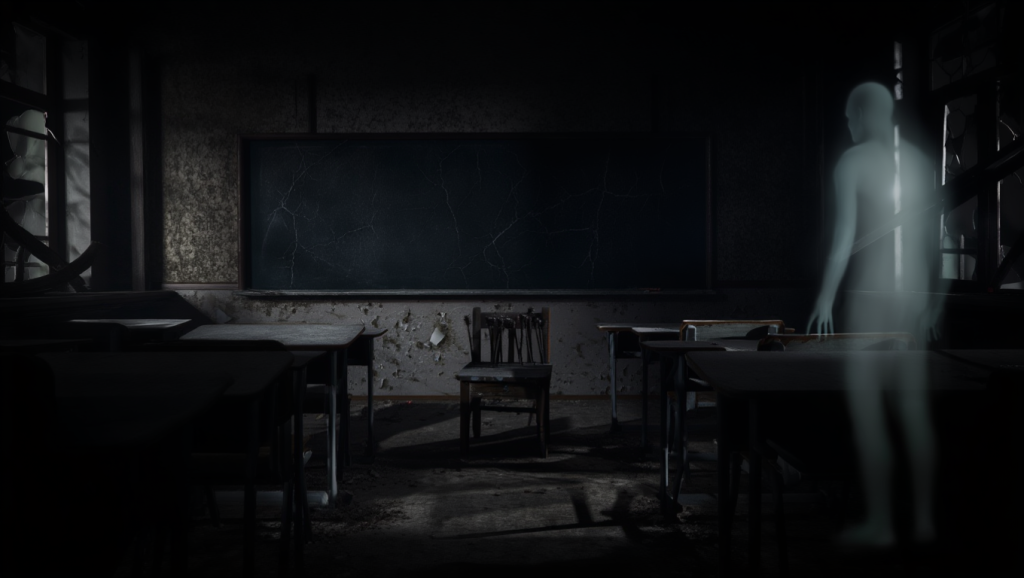
Lily was in her bassinet in the living room, but she wasn’t alone. Standing over her, visible only in the reflection of the window glass, was the translucent figure of a teenage girl.
She looked exactly like the baby in the photographs. Emma. She was older now, maybe sixteen or seventeen. And she was smiling down at Lily, her hand hovering protectively over the infant.
When she noticed us in the doorway, Emma’s ghost turned. She mouthed three words.
I’m still here.
Then she pointed to the fireplace. To a loose brick in the hearth that I’d never noticed before.
And she vanished.
Sarah fell to her knees, sobbing. I walked to the fireplace and pulled the brick free. Behind it was a rolled-up envelope, yellowed with age.
Inside was a letter in teenage handwriting, dated three months ago.
“Mom, I know you can’t remember me. They made you forget. But I’m safe. I’m alive. I was taken, but I escaped. I’m sixteen now, and I’ve been watching you. I’ve been waiting for you to come back to this house. I sealed my nursery to leave you clues. I wrote the warning to protect my baby sister. He’s looking for our family. He knows about Lily. You have to remember what happened. You have to remember HIM. Please, Mom. Before he comes back. I’ll find you when it’s safe. I love you. —Emma”
I looked at Sarah, who was reading over my shoulder, her whole body shaking.
“Who is ‘he’?” I asked.
Sarah closed her eyes. And when she opened them, there was a flicker of something dark and ancient swimming beneath the surface.
“I’m starting to remember,” she whispered. “And Mark… we need to leave this house. Right now.”
But before we could move, all the doors in the house slammed shut at once.
And from the hidden room upstairs, we heard the sound of a music box beginning to play.
A first-grader refused to sit down for three weeks straight… Then the teacher discovered why and uncovered a nightmare that would expose an entire town’s darkest secret.
They say twenty years in a classroom gives you eyes in the back of your head. That’s a lie. What it actually gives you is a second heart, one that beats in sync with the twenty-odd souls entrusted to your care between the hours of eight and three. It gives you a terrifying intuition—a frequency attuned to the silent screams of children who haven’t yet learned the words for their pain.
As the morning sunlight filtered through the dust motes dancing in Room 7 of Willow Creek Elementary, I moved between the desks, listening to the familiar cadence of first-grade chatter. The smell of sharpened pencils and floor wax usually calmed me, but today, a discordant note vibrated in the air.
It was the new girl. Lily Harper.
It was her third day in my class, and she was standing. Again.
While the other children scrambled for their seats, eager to begin our morning story, Lily stood rigid beside her desk. Her fingers, pale and trembling, gripped the hem of a faded blue dress that seemed a size too large. Her chestnut hair fell in uneven waves, hiding a face that carried a stillness no six-year-old should possess.
“Lily, sweetheart,” I said, pitching my voice to that soft, non-threatening register I’d perfected over two decades. “Would you like to sit down for our morning story?”
The child didn’t look up. Her eyes remained fixed on the scuffed linoleum floor. “No, thank you, Miss Thompson. I just… I prefer standing.”
Her voice was barely a whisper, brittle as dried leaves. But it was her posture that made my stomach turn. She wasn’t just standing; she was hovering, shifting her weight from foot to foot with a minute, agonizing rhythm. It wasn’t defiance. It was endurance.
“Did something happen to your chair?” I asked, keeping my tone light, feigning ignorance.
“No, ma’am.” The response was practiced. Automatic.
I let it go for the moment, but the unease settled in my marrow. Throughout the day, I watched her. I watched how she leaned against the cool cinderblock walls during art, how she flinched when the bell rang, how she refused to sit even during lunch, claiming she wasn’t hungry. She was a ghost haunting her own life.
That afternoon, after the buses had rumbled away and the silence of the empty school settled around me, I heard a rustle from the reading corner.
Lily was there, crouched behind a bookshelf, clutching her backpack like a shield.
“Lily?” I knelt, keeping my distance. “Everyone has gone home, dear.”
Her head snapped up, eyes wide with a terror that stopped my breath. “Is it that late? I didn’t mean to… I’m sorry!”
“It’s alright,” I soothed, though my heart hammered. “Are your aunt and uncle coming?”
At the mention of her guardians, the blood drained from her face. “Uncle Greg… he doesn’t like waiting.”
“Lily, is everything okay at home?”
Before she could answer, a sharp, aggressive honk blasted from the parking lot. Lily’s body convulsed. It wasn’t a jump; it was a full-body flinch of anticipation.
“I have to go,” she gasped, scrambling to her feet and bolting for the door.
I watched her run toward a sleek, black SUV idling at the curb. I saw the window roll down, not to greet her, but to gesture impatiently. As she climbed in, I grabbed my notebook from my desk—a small, black ledger I kept for observations.
I opened it to a fresh page and wrote: Lily Harper. Day 3. Still standing. Terror evident.
The next week brought the rain, and with it, a darkening of the situation that I couldn’t ignore. Day 12. Lily arrived without a lunchbox again. She wore long sleeves despite the humid heat of the classroom. And still, she stood.
We were in the gymnasium when the dam finally broke. Coach Bryant had the children running drills, dodging between orange cones. Lily stood at the periphery, arms wrapped around herself, a small island of misery.
“Not feeling well, Harper?” the Coach boomed.
Lily flinched, stepping back so quickly she tripped over her own feet. She hit the floor hard.
“Lily!” I was there in a second, scooping her up.
She began to weep, not from the fall, but from a panic so raw it felt contagious. “I’m sorry, I’m sorry, don’t tell, please don’t tell!”
“It’s okay, you just tripped,” I whispered, walking her toward the girls’ locker room away from the staring eyes. “Let’s get you cleaned up.”
In the safety of the restroom, I grabbed some paper towels. “Did you hurt your arm?”
“My back,” she sobbed. “My shirt… it pulled up.”
“Let me help you fix it.”
I gently lifted the hem of her shirt to tuck it in. The breath left my body in a sharp hiss.
The skin of her lower back was a tapestry of violence. Deep, purple bruises overlapped with yellowing older ones. But it was the pattern that froze my blood—distinct, circular indentations. Punctures.
“Lily,” I choked out, fighting to keep my voice steady, fighting the urge to scream. “How did you get these marks?”
She froze. The silence stretched, heavy and suffocating, broken only by the distant thunder outside.
Finally, she whispered, “The punishment chair has nails.”
I closed my eyes, the horror washing over me. “The punishment chair?”
“At home,” she said, her voice trembling. “For bad children who don’t listen. Uncle Greg says sitting on it teaches us to behave. He says we have to earn the soft chairs.”
I gently pulled her shirt down, my hands shaking. “I believe you, Lily. And I am going to make sure you never have to sit in that chair again.”
“Uncle Greg says no one will believe me,” she whimpered. “He says I tell stories. He says the judges are his friends.”
“He’s wrong,” I said, pulling out my phone.
I didn’t call the principal. I didn’t call the parents. I dialed 911.
I thought I was saving her. I didn’t realize I was starting a war.
The fluorescent lights of the Willow Creek Police Department hummed with an indifference that grated on my nerves. I had been sitting on a hard plastic chair for three hours.
“Ms. Thompson,” Officer Drake sighed, sliding a lukewarm coffee across the metal table. “We appreciate your concern. Truly. But we have procedures.”
“Procedures?” I slammed my hand on the table, rattling the cup. “I saw the bruises, Officer. Puncture wounds. She told me about a chair with nails. A six-year-old doesn’t invent a torture device like that!”
“The child was examined by the school nurse,” Drake said, his eyes avoiding mine. “The bruises appear to be… older. Possibly from before she was placed with the Harpers. You know she came from a traumatic background? Car accident. Dead parents.”
“She has been with the Harpers for six months!” I snapped. “Those bruises were fresh.”
The door opened, and a woman in a sharp grey pantsuit entered. Marsha Winters, Child Protective Services. I felt a flicker of hope, which was extinguished the moment she spoke.
“Ms. Thompson, I’ve just come from the Harper residence,” she said, her voice smooth as oil. “The Harpers were fully cooperative. We toured the entire home. It was immaculate. Lily has a beautiful bedroom. There is no… punishment chair.”
“Of course there isn’t!” I stood up, incredulous. “They knew you were coming! Do you think they keep the torture devices out on the coffee table for guests?”
“Ms. Thompson,” Winters said, her eyes hardening. “False allegations are a serious matter. Greg Harper’s brother sits on the school board. This is a respected family. A pillar of the community.”
“What does his brother’s job have to do with the bruises on a child’s back?” I demanded.
“Lily recanted,” Drake interjected softly. “When we asked her about the chair, she said she made it up. She said she fell out of a tree.”
I felt the blood drain from my face. “Because she is terrified. She told me he threatened her!”
“Go home, Ms. Thompson,” Winters said, opening the door. “Let us do our jobs.”
I walked out into the rain, my car keys digging into my palm. I felt a sensation I hadn’t experienced since I was a child—total helplessness. But beneath it, a cold, hard rage began to crystallize.
They sent her back. They sent her back to the house with the nails.
The retaliation was swift. The next morning, Principal Warren called me into his office. He wouldn’t look at me.
“The board is concerned, Eleanor,” he mumbled, shuffling papers. “Richard Harper—Greg’s brother—is furious. He’s calling this harassment. Defamation.”
“I did my duty as a mandated reporter,” I said stiffly.
“You’re on thin ice. Just… teach your class. Leave the investigating to the professionals.”
But I couldn’t look away. Not when Lily returned two days later, a shadow of herself. She was moved to Ms. Wilson’s class—”to avoid conflict of interest,” they said. I saw her in the hallway, thinner, paler. When our eyes met, she looked away, terrified.
It was a week later when I found the note.
It was tucked into the attendance folder Ms. Wilson had inadvertently left in the staff lounge. A drawing. It was crude, done in hurried crayon strokes.
It depicted a house. Upstairs, stick figures smiled. But underneath, a black scribbled box labeled “BASEMENT.” Inside the box were tiny figures. Lots of them. Trapped.
And in the corner, in wobbly handwriting: Help them too.
I stared at the paper, my hands trembling. Them. Plural.
That night, a knock on my apartment door nearly made me jump out of my skin. It was late—past eleven. I looked through the peephole to see a disheveled man in a raincoat.
“Who is it?” I called, keeping the chain on.
“Detective Marcus Bennett,” the voice was gravelly. “I’m with Willow Creek PD. I’m here about Lily Harper.”
I opened the door. He looked nothing like Officer Drake. He looked tired, haunted, and angry.
“Can I come in?” he asked, glancing down the hallway. “Off the record.”
Inside, he saw my kitchen table. It was covered in notes, timelines, and photocopies of public records I’d spent the last week gathering.
He picked up a photo of Greg Harper receiving a “Citizen of the Year” award. “I see you’ve been busy.”
“Are you here to arrest me for harassment?” I asked, crossing my arms.
“No,” Bennett said, pulling a chair out. “I’m here because three years ago, I handled a case involving a foster child placed with a friend of the Harpers. That child died. Ruled an accident. The coroner was Judge Blackwell’s cousin. The investigation was buried.”
He looked at me, his eyes intense. “When I saw your report—the punishment chair—I knew. It’s the same pattern. But the Captain shut me down. Said the case is closed.”
“So why are you here?”
“Because you found something they missed,” he said. “I saw the drawing you took from the lounge.”
My heart skipped a beat. “You were watching me?”
“I’m watching them,” he corrected. “And they are watching you. Eleanor, this isn’t just about one bad father. This is a network. Foster payments. State subsidies. Children go in, the checks clear, and the children… disappear or get recycled into the system.”
I showed him the drawing of the basement. “She wrote ‘Help them too.’ How many children, Bennett?”
“The Harpers are licensed for two,” he said grimly. “But looking at the water usage for that property? The food delivery receipts I pulled from their trash? It’s enough for an army.”
“We have to go in,” I said.
“We can’t. Judge Blackwell denied the warrant this afternoon. If we go in, it’s breaking and entering. It’s a felony. We lose our jobs, maybe our freedom.”
I looked at the drawing. I thought of the nails. I thought of the way Lily stood, enduring pain because she believed she didn’t deserve to sit.
“I don’t care about my job,” I whispered. “Friday.”
“What?”
“Lily told me once,” I recalled, the memory surfacing. “Uncle Greg says Friday nights are for the visitors. That’s when we have to be extra good.”
Bennett’s face darkened. “Friday visitors. Trafficking. Or exploitation rings.” He checked his watch. “Friday is tomorrow.”
“We go tomorrow night,” I said. “Authorized or not.”
Bennett looked at me for a long moment, then nodded. “Pack dark clothes. And pray we’re wrong.”
The Harper estate sat on the edge of town, surrounded by a dense thicket of oaks that screamed “old money.” The rain had returned, turning the ground into a slurry of mud that sucked at our boots as we crept through the treeline.
Bennett moved with a tactical grace I couldn’t mimic. I was just a teacher in a raincoat, clutching a flashlight like a weapon.
“Security cameras on the perimeter,” Bennett whispered, pointing to the red blinking lights. “We have a blind spot near the cellar doors. That’s our entry.”
My heart hammered against my ribs like a trapped bird. We reached the heavy cellar doors. Bennett pulled out a lockpick kit. His hands were steady. Mine were slick with sweat.
Click.
The door groaned open. The smell hit us first. Damp earth, mold, and something else—the sharp, unmistakable tang of ammonia and unwashed bodies.
“Oh god,” I breathed, pulling my scarf over my nose.
We descended into the darkness. Bennett clicked on his flashlight, keeping the beam low. We were in a finished basement, but it wasn’t a rec room. It was a prison.
The space was divided by makeshift plywood walls into cubicles. No doors, just curtains.
Bennett swept the light across the room.
Eyes reflecting the beam. Dozens of them.
They weren’t beds. They were mattresses on the floor, stained and thin. Huddled on them were children. Not two. Nine.
They ranged in age from toddlers to pre-teens. They didn’t scream when they saw us. That was the worst part. They were silent, conditioned to silence.
I rushed to the nearest mattress. A little boy, maybe four, looked up at me with dull, glassy eyes. He was shivering.
“It’s okay,” I whispered, tears blurring my vision. “We’re here to help.”
“Are you the Friday people?” a voice asked from the shadows.
I turned to see a girl, older, maybe ten. She was rocking back and forth. “Are you here for the pictures?”
“No,” Bennett choked out, his professional veneer cracking. “We’re the police. We’re getting you out.”
“Uncle Greg is upstairs,” the girl whispered. “With the camera men. And the Judge.”
Bennett stiffened. “The Judge is here?”
“He likes to watch,” she said simply.
Bennett grabbed his radio. “Dispatch, this is Bennett. I have a Code Zero at the Harper residence. Officer in distress. Multiple minors in immediate danger. Send the state troopers. Do not—repeat, do not—inform the local precinct.”
“We have to move them,” I said, reaching for the shivering boy. “Now.”
Suddenly, the door at the top of the stairs flung open. Light flooded the basement.
“What the hell is going on down here?”
Greg Harper stood at the top of the stairs, silhouetted by the warm light of the hallway. He wasn’t holding a camera. He was holding a shotgun.
Behind him, I saw the faces of “respected” men. I recognized the Mayor. I recognized Judge Blackwell.
“Ms. Thompson,” Greg sneered, raising the weapon. “You really don’t know when to sit down, do you?”
“Drop the weapon!” Bennett shouted, stepping in front of me and the children, his service pistol drawn. “State Police are three minutes out, Greg! It’s over!”
“You’re trespassing,” Greg spat, though the barrel of the gun wavered slightly. “These are my foster children. This is private property!”
“Nine children?” Bennett yelled back. “Locked in a basement? Look at them, Greg! You’re done.”
“Shoot them!” Judge Blackwell’s voice hissed from the hallway. “Get rid of them before the troopers get here!”
For a second, time suspended. I looked at the children—huddled, terrified, waiting for the violence they knew was inevitable.
Then, a siren wailed. Not local police. The distinct, high-pitched yelp of State Trooper cruisers.
The sound broke Greg’s resolve. He glanced back at his conspirators, and in that split second of distraction, Bennett lunged.
The shotgun discharged into the ceiling with a deafening boom. Plaster rained down. Bennett tackled Greg to the concrete floor, the two men grappling in the dust.
“Run!” I screamed to the children. “Up the stairs, now! Go!”
I grabbed the four-year-old and ushered the others toward the exit. The older girl, the one who had spoken, hesitated.
“Go!” I urged her.
“Lily is upstairs,” she whispered. “In the special room.”
My blood ran cold. I handed the boy to the girl. “Get outside. Run to the lights.”
I didn’t follow them out. I ran up the stairs, past Bennett who had Greg pinned and cuffed. I ran past the Judge, who was trying to flee through the kitchen, only to be met by a wall of uniformed troopers bursting through the front door.
I ran to the second floor.
“Lily!” I screamed. “Lily!”
I kicked open the doors. Guest room. Bathroom. Master bedroom.
At the end of the hall, a door was locked. I threw my shoulder against it. It didn’t budge.
“Lily, move away from the door!”
I backed up and kicked the lock with everything I had. The wood splintered.
The room was set up like a studio. Heavy curtains, bright lights. And in the center, a chair. The chair. It was wooden, high-backed. And even from here, I could see the glint of metal protruding from the seat.
Lily was standing in the corner, pressing herself into the wallpaper as if trying to merge with it.
“Ms. Thompson?” she whimpered.
I crossed the room in two strides and fell to my knees, wrapping my arms around her. She was shaking so hard her teeth rattled.
“I didn’t sit,” she cried into my shoulder. “I promised I wouldn’t sit!”
“I know, baby. I know.” I held her tight, shielding her eyes from the equipment, from the chair, from the truth of what this room was. “You never have to sit there again.”
The weeks that followed were a blur of media vans and depositions. The “Basement of Willow Creek” became national news. The sheer scale of the corruption was staggering.
They found the videos. Hundreds of them. They implicated not just the Harpers, but the Judge, the Mayor, and two members of the school board. It was a ring of power that fed on the powerless.
I was suspended, of course. Richard Harper, desperate and cornered, filed lawsuits. He went on TV, calling me a vigilante, a liar, a woman obsessed. The local paper, owned by his cousin, ran headlines: ROGUE TEACHER ENDANGERS CHILDREN.
I sat in my apartment, blinds drawn, watching my career turn to ash.
But then, the tide turned.
The Special Prosecutor, a woman named Vanessa Chen from the Attorney General’s office, arrived. She bypassed the local courts entirely. She took the case federal.
The trial of United States v. Gregory Harper et al. began three months later.
I testified. I sat in the witness box and endured the defense attorney’s sneers. They tried to paint me as hysterical. They tried to say I broke the law.
“I did break the law,” I told the jury, looking Richard Harper in the eye. “And I would do it again. Because the law was protecting the monsters, not the children.”
But the nail in the coffin wasn’t my testimony. It was Lily’s.
She testified via closed-circuit video. She was small on the giant screen, but her voice was clear.
“Tell us about the chair, Lily,” Prosecutor Chen asked gently.
“It has sharp parts,” Lily said. “Uncle Greg said if we sat on it and didn’t cry, the men would give us candy. If we cried, we had to stay in the basement.”
A collective gasp sucked the air out of the courtroom.
“Who were the men, Lily?”
“The Judge,” she said. “And the man who gave me the award at school.”
The jury was out for less than four hours.
Guilty. On all counts. Trafficking. Child Abuse. Conspiracy.
Greg and Victoria Harper were sentenced to life without parole. Judge Blackwell received forty years. Richard Harper was disbarred and faced charges of witness intimidation.
As the verdicts were read, I looked across the aisle at Bennett. He looked tired, but for the first time since I met him, the ghosts in his eyes seemed to be resting.
One year later.
The morning sun filtered through the windows of Room 7. It looked much the same as it always had—dust motes dancing, the smell of crayons and potential.
But there were changes. A new principal. A new school board. And a new policy on reporting that I had helped write.
“Ms. Thompson?”
I looked up from my desk. Standing in the doorway was a woman I recognized—Lily’s new adoptive mother, a fierce social worker from the city. And beside her…
“Lily,” I breathed.
She looked different. Taller. Her hair was shiny and pulled back in a bright yellow bow. She wore jeans and a t-shirt that fit perfectly.
“Hi, Ms. Thompson,” she beamed.
“We were in the neighborhood,” her mother smiled. “Someone wanted to show you something.”
Lily walked into the classroom. The other children looked up. They didn’t know who she was, only that she was a visitor.
Lily walked to the center of the rug, where we had our morning meetings. She looked at me, a mischievous glint in her eye.
“Can I?” she asked.
“Anything you want,” I said, my throat tight.
Lily walked over to the teacher’s chair—my chair. The big, comfortable, spinning chair behind the desk.
She hopped up, spinning it around once, and then sat down. She leaned back, crossing her legs, looking comfortable, safe, and utterly at home.
“It’s soft,” she declared.
“It is,” I laughed, wiping a tear from my cheek.
She hopped down and ran to me, wrapping her arms around my waist. “I have a new chair at home,” she whispered. “It’s purple. And I sit in it to do my homework, and to eat dinner, and sometimes just because I can.”
“I’m so glad, Lily.”
She pulled back and handed me a piece of paper. It was a drawing.
It showed a classroom. Bright colors. Sunshine. And every single stick figure was sitting in a chair.
At the bottom, in neat, practiced handwriting, it read: In Ms. Thompson’s room, everyone gets to sit.
I pinned it to the board behind my desk, right next to the Teacher of the Year award they had tried to give me, which meant far less than this scrap of paper.
“Ready to go, Lily?” her mom called.
“Coming!” Lily yelled. She ran to the door, then stopped and looked back. “Ms. Thompson?”
“Yes, Lily?”
“Thank you for standing up for me,” she said. “So I could sit down.”
She waved and skipped down the hallway, her footsteps echoing—not fleeing, not hiding, just the sound of a child moving freely through a world that was finally, finally safe.
A TSA agent humiliated a “homeless” veteran and threw him out of the terminal… But she didn’t realize he was the genius who designed the airport’s entire security system.
The fluorescent lights of Terminal 4 hummed with a sterile, rhythmic energy, but for Arthur Vance, the noise felt like a dull headache. Clad in a faded, grease-stained M-65 field jacket and carrying a rucksack that had seen better decades, Arthur looked less like a tech mogul and more like a man who had spent the last week sleeping in a park. His hair was a wild thicket of salt-and-pepper, and his boots were caked with the red clay of his rural retreat.
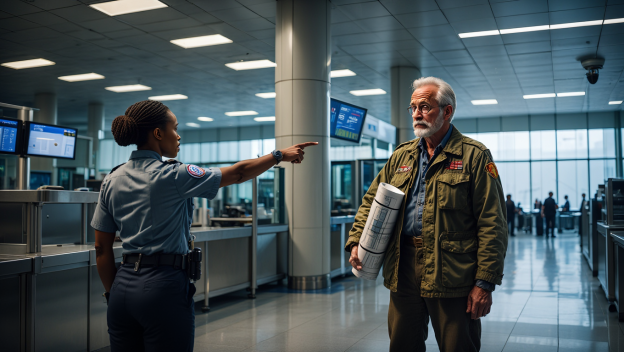
As he approached the premium security bypass, Agent Sarah Miller stepped into his path, her arms crossed tightly over her crisp uniform. She didn’t see the piercing, analytical blue eyes of a man who had spent twenty years in Special Operations and another fifteen as a lead systems architect. She only saw a “vagrancy risk.”
“Move along, sir. This area is for ticketed passengers and authorized personnel only,” Miller said, her voice dripping with practiced condescension.
Arthur stopped, offering a tired smile. “I’m here for the Level 5 systems audit. My name is Arthur Vance. I was told my credentials would be at the kiosk.”
Miller let out a sharp, mocking laugh that drew the attention of the surrounding travelers. “Level 5? You? Look, Grandpa, the soup kitchen is three blocks from the downtown station. You’re in the wrong place. If you don’t turn around right now, I’m calling airport police to escort you out for loitering.”
“I suggest you check the manifest for ‘Project Aegis,'” Arthur said quietly, his voice losing its warmth.
Miller leaned in, her badge glinting under the lights. “I don’t need to check anything. I know exactly what a threat looks like, and right now, you’re an eyesore. Security! We have a non-compliant individual at Gate Alpha!”
Two burly officers arrived within seconds. Despite Arthur’s calm explanations, Miller ordered them to “get this trash out of my sight.” They grabbed Arthur by the arms, dragging him toward the exit. He didn’t fight; he simply looked at the security cameras—cameras he had helped calibrate—and whispered, “System Override: Alpha-Niner-Zero.”
Ten minutes later, Arthur sat on a concrete bench outside in the humidity, watching the airport’s main doors. Inside, chaos was erupting.
Suddenly, every digital screen in the airport flickered and turned red. The automated gates locked. The baggage carousels groaned to a halt. The “Aegis” security grid, the most sophisticated in the world, had just entered “Blackout Mode.”
A frantic group of men in expensive suits, led by the Airport Director, burst through the doors. Among them was the Regional Director of the TSA. They scanned the sidewalk frantically until their eyes landed on the man in the dirty field jacket.
“Arthur!” the Airport Director screamed, sprinting toward him. “The system is down! Everything is locked! We can’t even open the emergency exits!”
Arthur stood up slowly, dusting off his rucksack. At that moment, Agent Miller stepped outside, looking pale. “Sir! We found him, but I was just doing my job—he looked suspicious—”
The Regional Director turned on her with a fury that made her flinch. “You idiot! This is Arthur Vance. He didn’t just ‘design’ the system; he owns the patents to every sensor and algorithm in this building. He’s here for a mandatory inspection, and you just assaulted the man who holds the keys to our entire infrastructure!”
Arthur looked at Miller, who looked like she wanted the earth to swallow her whole. “The system didn’t fail,” Arthur said calmly. “It reacted to a flaw. The flaw wasn’t in the code, Agent Miller. It was in the person operating it. You judged a man by his jacket while he was holding the blueprint to your security. If I were an actual threat, I would have been inside your mainframe before you finished your first insult.”
Arthur walked back inside, the doors sliding open automatically as he approached. Miller was stripped of her badge on the spot. As Arthur restored the system with a few taps on his ruggedized tablet, he reminded the staff that true security starts with respect—especially for those who sacrificed their youth to build the peace others take for granted.
The judges rolled their eyes when the janitor asked for the microphone… But the moment he hit the first note of “Only You,” the entire theater went dead silent.
The “Golden Mic” talent showcase was a place for glitter, sequins, and polished rehearsals. It was not a place for Elias.
Elias was sixty-two, wore a faded grey jumpsuit that smelled faintly of lemon cleaner and floor wax, and had spent the last twenty years mopping the very stage where dreams were made and broken. He was invisible—a ghost in the machine of the entertainment industry. He knew the squeak of every floorboard and the hum of every spotlight, yet no one knew his name.
On this particular Tuesday, the atmosphere was toxic. The lead judge, a sleek producer named Marcus Vance, had just shredded a young pop singer to tears. “Next!” Vance barked, checking his watch. “And make it quick. I have a dinner reservation.”
There was a mix-up in the wings. The next act—a fire breather—hadn’t arrived. The stage manager, panicked, looked around. Elias was there, broom in hand, sweeping up glitter from the previous act.
“Hey, you!” the stage manager hissed. “Just… stand there. Hold the mic. Let me check the audio levels while we wait.”
Elias hesitated. He leaned his broom against the velvet curtain and limped toward center stage. The audience, bored and restless, began to titter. Someone in the back whistled mockingly. Marcus Vance looked up, lowered his sunglasses, and sneered. “What is this? The cleaning crew act? We really are scraping the bottom of the barrel.”
Laughter rippled through the auditorium. Elias felt the heat rise in his cheeks. He looked at his scarred hands, then at the pianist, a kind man named Jerry who knew Elias often hummed while he worked.
“Just a sound check, Elias,” Jerry whispered, giving him a wink. “Play whatever you want.”
Elias closed his eyes. He didn’t think about the mocking crowd or the arrogant judge. He thought about 1955. He thought about a dusty record player in his childhood living room. He thought about Tony Williams and The Platters. He thought about the song that had defined the golden age of R&B—an anthem of unwavering love that transcended trends.
He nodded to Jerry. Jerry struck the opening chord. Bum-bum-bum-bum…
The iconic, triplet-driven piano intro of “Only You (And You Alone)” floated through the air. The crowd giggled. It was such an old, cliché song. What was the janitor going to do? Ruin a classic?
Then, Elias opened his mouth.
“Oh-nly you…”
The sound that came out was not the voice of a tired old janitor. It was a resonant, velvet cannon blast of pure soul. He hit the signature vocal break—that famous “Oh-nly”—with a quiver so precise, so full of heartbreaking vulnerability, that it felt like Tony Williams himself had descended from the rafters.
The laughter died instantly. It was as if the air had been sucked out of the room.
Elias wasn’t singing for the judges. He was singing for his late wife, Martha. He was singing about a love that anchored him in a world that treated him like furniture. The lyrics, penned by Buck Ram decades ago, were simple, but Elias treated them like scripture.
“Can make this world seem right…”
His voice soared, rich and clear, carrying the weight of a thousand heartbreaks and a thousand joys. It possessed that rare, serendipitous magic that happened during The Platters’ original rehearsal—a capture of raw passion. He navigated the melody with a masterclass in emotional restraint, the way the song was intended. It wasn’t just a performance; it was a resurrection of a feeling.
Marcus Vance, the cynical judge, slowly took his sunglasses all the way off. His mouth hung slightly open. The production assistant in the wings stopped chewing her gum.
Elias climbed the scale to the bridge. The piano accompaniment, usually just a backdrop, seemed to weave around his voice, creating that perfect marriage of melody and feeling that had made the song a #1 hit in the UK and a staple in films like American Graffiti. But here, in this room, it wasn’t a movie soundtrack. It was real.
When Elias hit the climax—“You are my destiny”—his voice cracked with such authentic, raw emotion that a woman in the front row audibly sobbed. He wasn’t performing; he was bleeding out his soul, reminding every person in that room of the universality of love. He was the embodiment of the song’s history—a timeless harmony etched into the heart, proving that true talent doesn’t fade with age or hide behind expensive costumes.
He held the final note, a shimmering vibrato that seemed to suspend time itself.
“…and you alone.”
The piano faded. Elias stood there, head bowed, hands trembling slightly at his sides.
For three seconds, there was total silence. The kind of silence that is heavy and holy.
Then, the room exploded.
It wasn’t polite applause. It was a roar. People jumped to their feet. The cynical Marcus Vance stood up, clapping his hands high above his head. The stage manager was crying. The audience, who had mocked his jumpsuit moments ago, was now chanting his name.
Elias looked up, blinking in the spotlight, a shy smile breaking through his weathered face. He reached for his broom, but Jerry the pianist grabbed his hand and raised it high.
In a world full of fleeting trends, Elias had reminded them that some things—like pure talent and the power of a song like “Only You”—are immortal.
A transfer student got drenched in fake blood during Spirit Week… But instead of crying, she asked them to do it again.
October transfers are cursed from the start.
Everyone already knows who sits where, who dates who, who’s worth talking to. The social ecosystem is locked. And when someone new walks in two months late, wearing the wrong shoes and carrying last year’s backpack, the ecosystem doesn’t adapt.
It hunts.
Maya learned this on her third day at Westridge High, during Spirit Week—that beautiful tradition where teenagers pretend school spirit matters more than social survival.
She was walking to third period when she heard footsteps accelerating behind her.
“Yo, watch out—”
A boy in a football jersey “tripped” spectacularly, arms windmilling, and launched a cup of stage blood directly onto her white sweater. The liquid exploded across her chest like a gunshot wound. Thick, red, dripping.
The hallway erupted.
“CARRIE!” someone screamed, and the crowd lost it. Phones materialized instantly, a dozen cameras capturing her humiliation in vertical video. A girl near the lockers was actually crying from laughter.
Maya stood there, red liquid soaking through to her skin, staining her jeans, pooling in her shoes.
Everyone waited for the tears. The run to the bathroom. The transfer student breakdown that would feed the group chats for weeks.
Instead, Maya looked down at her ruined clothes.
Then she looked up at the boy who’d thrown it.
And she smiled.
“Nice,” she said calmly, loud enough for everyone to hear. “Can you do it again? From the other side? The coverage wasn’t even.”
The hallway went silent.
The football player blinked. “What?”
“You heard me. Other side. I want the shot balanced.” She gestured like a film director. “And this time, really commit to the fall. You looked stiff.”
Nobody knew what to do with that.
Because humiliation only works when the victim cooperates. When they cry, run, hide. When they give you the reaction that confirms you have power.
Maya wasn’t playing.
She walked to the bathroom, rinsed the blood off her hands, and returned to class like she’d just washed off rain. She didn’t change. Didn’t explain. Just sat down in her stained sweater and took notes.
At lunch, she posted one photo to Instagram.
Just the sweater. Red-soaked. Ruined.
Tagged with the school’s location.
Caption: “Evidence.”
That was it.
No essay. No callout. No names. Just that word, sitting there like a threat.
By seventh period, three parents had emailed the principal.
By eighth period, Maya’s mother was in the office.
And by 10 PM, the school’s official Instagram had disabled comments after the post got flooded with messages demanding accountability, asking what kind of school allowed this, threatening lawsuits, media coverage, investigations.
The football player’s parents hired a lawyer.
Two students deleted their videos.
The administration sent a schoolwide email about bullying and “recent incidents.”
And at midnight, Maya got a DM from an unknown account:
“Who are you?”
She didn’t answer immediately.
Instead, she opened her laptop, pulled up a folder labeled “Westridge Documentation,” and reviewed the footage one more time.
Because here’s what nobody knew:
Maya wasn’t random.
She’d transferred to Westridge specifically. Deliberately.
Her older sister, Alison, had gone there four years ago. Bright kid. Scholarship student. Didn’t fit the mold. Got targeted during Spirit Week her junior year—different prank, same cruelty—and the humiliation spiraled until she stopped going to school altogether.
She never graduated.
The school never apologized.
They just moved on.
But Maya didn’t.
She spent two years researching Westridge. Learning the culture. Understanding the patterns. She knew Spirit Week was when they struck. Knew they always went for the outsider. Knew they filmed everything because cruelty without an audience doesn’t satisfy.
So when the fake blood hit, she didn’t flinch.
She’d been waiting for it.
And she’d been recording too.
The “Evidence” photo wasn’t just for Instagram.
Before she even posted it, she’d sent the raw footage—every angle, every laugh, every face—to three people:
A family friend who worked for a local news station.
A lawyer who specialized in school harassment cases.
And her sister.
The Instagram post was just bait. A way to make them panic, make them delete, make them accidentally create a cover-up that would look even worse when the real story broke.
She replied to the midnight DM:
“Someone who doesn’t forget.”
The next day, Westridge hired a crisis PR firm.
Within a week, two teachers were on leave pending investigation into “supervision failures.”
Within a month, the school updated its anti-bullying policy, installed hallway cameras, and issued a public apology.
And Maya?
She showed up every day in that stained white sweater—washed, but still visibly marked.
A reminder.
Because sometimes the best revenge isn’t fighting back.
The bullies drenched the transfer student in fake blood to humiliate her… But her chilling three-word response turned their prank into a nightmare.
The transfer student, a girl named Elara with sharp eyes and a backpack that looked too expensive for a public school, showed up in October. In the social ecosystem of Crestwood High, an October arrival meant two things: everyone already had their cliques solidified, and everyone was bored enough to hunt for fresh meat.
They chose her on the Wednesday of Spirit Week. The theme was “Hollywood Horror,” which gave Jason, the football team’s captain and the school’s resident agitator, a convenient excuse.
Elara was walking to third period, wearing a pristine white cashmere sweater. It stood out in the sea of denim and school colors. It was a target.
As she passed the water fountain, Jason jogged past. It was a practiced move, one he’d used a dozen times before. He feigned a trip, stumbling forward. The large oversized cup in his hand—filled not with soda, but with a thick, sticky mixture of corn syrup and red dye—exploded across her chest.
The white cashmere turned crimson instantly.
The hallway went silent for a heartbeat, followed by the roar. Screams of mock terror. Laughter. And then, the synchronized movement of a hundred arms raising smartphones to record.
“Carrie!” someone shouted from the back, acting as if they had just invented comedy. “Go to the prom, Carrie!”
Jason stood up, wiping a fake tear of laughter from his eye. “My bad, new girl. Clumsy feet.”
Elara stood freezing in the middle of the hallway. The red sludge dripped from her hem onto the linoleum. Most girls would have run. Most girls would have covered their faces, burst into tears, and fled to the nurse’s office to call their mothers.
Elara didn’t move. She looked down at the ruined sweater, tracing the stain with a manicured finger. She rubbed the substance between her thumb and forefinger, checking the viscosity.
Then, she looked up.
She wasn’t crying. She wasn’t red-faced with embarrassment. She was smiling. Not a nervous smile, but the cool, detached smile of a director watching a scene unfold.
She looked directly into the nearest iPhone camera, then pivoted to Jason.
“Nice spread,” she said, her voice calm and piercingly clear over the dying laughter. “But the lighting is bad here. Can you do it again? From the other side?”
Jason’s smile faltered. “What?”
“The angle,” Elara said, pulling her own phone out. She didn’t wipe the blood off. She held her phone up, steady as a surgeon. “You blocked the light when you fell. If you’re going to assault me for content, we should at least make sure it trends. Go get another cup. I’ll wait.”
The silence that followed was heavy and confused. The crowd didn’t know how to process a victim who refused to be a victim.
“You’re… you’re a freak,” Jason muttered, stepping back. The adrenaline of the prank had evaporated, replaced by a creeping dread.
“And you’re sloppy,” Elara replied. She snapped a single photo of Jason’s face, then turned and walked calmly toward the girls’ bathroom. She didn’t run. She walked with the rhythm of someone who owned the hallway.
Inside the bathroom, she didn’t wash the sweater. She carefully removed it, folded it plastic-side in, and placed it in a sealed bag she pulled from her locker. She washed her hands and face, fixed her hair, and walked out in her gym shirt like nothing had happened.
Ten minutes later, her Instagram story went live.
It wasn’t a rant. It was a single, high-definition photo of the blood-soaked sweater against the white tile floor. Location: Crestwood High School. Tagged: @CrestwoodOfficial and @Jason_Miller_QB. Caption: Evidence. Item #1.
The ripple effect was instantaneous. By lunch, the post had been shared two thousand times. By fifth period, the “Carrie” joke had turned into a discourse on bullying. But it wasn’t just the students watching.
Elara hadn’t just tagged the school. She had tagged the local police department and the school board superintendent.
By last period, the Principal had called Elara’s mother. But her mother didn’t answer. Instead, a lawyer from the city called the school back.
By dinner, the school’s official Instagram account had turned off comments because they were being flooded with demands for expulsion. Jason was sitting in the administrative office, his head in his hands, as his parents screamed at the Vice Principal.
And by midnight, Elara sat on her bed, scrolling through the chaos she had orchestrated. Her phone buzzed with a DM from a blank profile.
“Who are you?” the message read.
Elara typed back instantly.
“I’m the girl who got kicked out of her last school for breaking a bully’s nose. My therapist suggested I try a non-violent approach this time. Legal action seems to be working, doesn’t it?”
She hit send, then attached a video file to the chat. It was a recording from her perspective in the hallway—clear, steady footage of Jason throwing the liquid, his face perfectly visible, his intent malicious.
“P.S. I sent this to the local news station an hour ago. Morning show starts at 6 AM. Sleep tight.”
They drenched the biker’s daughter in industrial paint to humiliate her… But they didn’t realize her father was a legendary Enforcer who just called in 200 of his brothers for “parent-teacher night.”
Jax Miller had spent the last five years trying to bury the “Iron Jax” persona six feet deep. He’d traded his kutte for a flannel shirt and his chrome-plated brass knuckles for a toolbox. He did it for Sarah, who had begged him with her dying breath to give their daughter, Lily, a life that didn’t involve police sirens or midnight hospital runs.
But as Jax pulled his ’98 Fat Boy into the pristine, manicured parking lot of Crestview Academy, the old ghost was clawing at his throat.
The school looked like a country club, all red brick and ivy, but the scene by the flagpole was pure gutter. A circle of students stood there, their expensive smartphones held aloft like digital daggers. In the center was Lily. She looked like a broken porcelain doll dipped in toxic waste. Azure blue paint—thick, smelly, and permanent—dripped from her hair and soaked into the vintage leather jacket she wore every single day.
Jax’s heart didn’t just break; it detonated. That jacket was the last thing Sarah had touched. She’d hand-painted the eagle on the back while sitting in a chemo chair, her fingers trembling but her spirit fierce. Now, the eagle was drowned in blue sludge.
“LILY!” Jax’s voice carried the weight of a thunderclap.
The circle of kids scattered. Jax didn’t see the principal, and he didn’t see the teachers. He only saw his daughter, shivering in the afternoon sun, trying to wipe the chemicals from her eyes.
“Dad,” she sobbed, her voice a wet rasp. “They said… they said I was ‘white trash’ and needed a makeover. They wouldn’t let me leave.”
Jax pulled her into his chest, the blue paint staining his own shirt, but he didn’t care. His eyes locked onto a tall, blonde kid standing near an empty bucket. Bryce Sterling. The son of the town’s most powerful judge.
“It was just a prank, Mr. Miller,” Bryce said, though his knees were visibly shaking. He looked around for his friends, but they were backing away. “My dad can pay for the jacket. It’s just old leather, anyway.”
“Old leather?” Jax whispered. The silence that followed was more terrifying than any scream. He looked at the school building. Principal Miller—no relation—was watching through the tinted glass of the office, phone in hand, likely waiting for Jax to swing so he could call the SWAT team.
Jax realized then that the law wouldn’t help Lily. Money protected the bullies here. But Jax had a different kind of insurance.
He pulled out his phone and hit a number he’d deleted and re-memorized a thousand times.
“Dave,” Jax said, his voice a low, tectonic rumble. “The ‘Enforcer’ is back for one night. I’m at Crestview Academy. They touched my blood, Dave. And they ruined Sarah’s eagle.”
There was a pause, then the sound of a heavy engine revving on the other end. “How many brothers do you need, Iron?”
“All of them,” Jax said. “I want the ground to shake.”
For the next forty minutes, the school was eerily quiet. The Principal finally came out, trying to usher Lily and Jax into his office to “settle this quietly.” Jax didn’t move. He sat on the curb, holding Lily, letting the sun dry the paint on her skin. Bryce and his friends stayed nearby, emboldened by the Principal’s presence, laughing and filming TikToks about the “stinky biker.”
Then, a low hum started.
It wasn’t a car. It wasn’t the wind. It was a vibration that started in the soles of the feet and moved up the spine. The windows of the academy began to rattle in their frames.
From the north end of the boulevard, a black line appeared. Then another from the south.
Two hundred Hells Angels, riding in a formation that looked like a funeral procession for the devil, turned into the school’s driveway. The roar of 200 V-twin engines was so loud the Principal had to cover his ears. The smell of gasoline and burnt rubber replaced the scent of freshly cut grass.
They didn’t come in hot. They came in slow. Methodical. A wall of chrome, leather, and grim-faced men who had crossed state lines the moment the word went out.
Big Dave, a man the size of a mountain, killed his engine right in front of Bryce Sterling. One by one, the other 199 bikers followed suit. The silence that followed was heavier than the noise.
“Who did it?” Dave asked, his voice like grinding stones.
Jax stood up, Lily still tucked under his arm. He pointed at Bryce. The boy’s face went from pale to ghostly white. He dropped his phone. It shattered on the pavement.
“He says it’s a tradition,” Jax said to the wall of bikers. “He says money makes it okay.”
Dave looked at the Principal, who looked like he was about to have a heart attack. “We aren’t here to break bones,” Dave announced, his voice booming across the campus. “We’re here for a parent-teacher conference. Since the school won’t protect one of our own, we’ll stay here until they do.”
The bikers didn’t move. They didn’t shout. They just stood there—a terrifying, silent sentinel. For three hours, the school was under a peaceful but absolute siege. No one left. No one entered. Parents arriving to pick up their kids saw the 200-man escort and chose to wait down the block.
The “tradition” ended that day. Under the unwavering gaze of 200 outlaws, Judge Sterling was forced to come to the school personally. He didn’t come with a checkbook; he came with an apology. Bryce was expelled, the Principal resigned within the week, and the school board suddenly found the funds to implement a zero-tolerance bullying policy.
But the real victory happened a week later. A package arrived at Jax’s small house. Inside was Lily’s jacket. The club had sent it to an expert in leather restoration. The blue was gone, and the eagle Sarah had painted was brighter and more vibrant than ever, reinforced with a new protective coating.
Jax looked at the jacket, then at the 200 bikers waiting at the end of his driveway to escort Lily to her new school. He realized Sarah was right—he didn’t need to be the Enforcer anymore. But it was good to know that when the world turned blue, his brothers would always bring the black leather.
A poor teacher raised abandoned twins to be pilots… But when their birth mother returned with $10 million to buy them back, their reaction stunned everyone.
The Chicago winter was unforgiving in 1998. The wind didn’t just blow; it bit through the layers of wool and cotton, seeking bone. Eleanor Brooks knew this cold well. At thirty-four, living in a dormitory room with peeling wallpaper and a radiator that hissed more than it heated, Eleanor had accepted her lot in life. She was a schoolteacher in a district the city seemed to have forgotten. She had no husband, no children, and a bank account that hovered dangerously close to zero by the third week of every month.
But Eleanor possessed a wealth that couldn’t be tallied in a ledger: she had a heart that refused to harden.
It was on a Tuesday evening, leaving the public health clinic after treating a persistent cough, that her life fractured and reformed. On the concrete steps, shielded slightly by the overhang, sat a cardboard box. Inside were two infants, huddled together for warmth, their skin blue-tinged and fragile. A note, fluttering under the weight of a stone, read simply: I can’t feed them. Please.
Eleanor didn’t look for a policeman. She didn’t call social services, knowing the foster system was already overflowing. She simply unbuttoned her oversized, threadbare coat, wrapped the twins against her chest, and walked home.
She named them Lucas and Noah.
The first five years were a blur of sleepless nights and financial terror. Eleanor learned to stretch a pot of rice to last four days. She took in laundry on the weekends. She graded papers with a baby on each knee. When the boys grew old enough to understand their poverty, they didn’t complain. Instead, they joined the fight.
By age eight, Lucas and Noah were standing on street corners in the biting wind, selling lottery tickets and handmade crafts to help pay for the heating bill.
“Teacher,” Noah asked one night, shivering under three blankets as Eleanor read to them by the light of a kerosene lamp during a power outage. “Why are we poor?”
Eleanor closed the book—a ragged copy of an aviation encyclopedia she’d rescued from the school trash. “We aren’t poor, Noah. We are just… pre-rich. We have empty pockets, but full heads. And as long as you have this,” she tapped the book, “you can go anywhere.”
The boys became obsessed with flight. It was their escape. They built gliders out of trash. They spent hours watching the distant specks of airliners climbing out of O’Hare, dreaming of a view that wasn’t grey concrete and slush.
Eleanor fueled this obsession with every spare cent she had. She stopped buying meat so she could afford math tutors for Lucas. She patched her shoes with duct tape so Noah could attend a physics camp. She aged rapidly, her hair turning white, her hands rough and calloused from scrubbing floors at a second job she took in secret.
The day the acceptance letters came from the Air Force Academy and a prestigious flight school, Eleanor locked herself in the bathroom. She turned on the shower so the boys wouldn’t hear her sobbing—not from sadness, but from the overwhelming relief that their wings were finally ready.
Fifteen years passed.
The scene at O’Hare International Airport was chaotic, a river of travelers flowing in every direction. But near the international arrivals gate, the crowd seemed to part.
Two men stood there. They were tall, broad-shouldered, and dressed in the crisp, intimidating uniforms of airline captains. Lucas and Noah Brooks. They held their caps under their arms, their eyes scanning the crowd.
When they saw her, their posture softened. Eleanor, now bent with age and wearing a coat that had gone out of style two decades ago, smiled. She looked tiny next to the men she had raised.
“Mom,” Lucas said, his voice thick with emotion, stepping forward to embrace her.
But before they could leave, a sleek black limousine pulled up to the curb, violating airport protocol. A chauffeur opened the door, and a woman stepped out. She was beautiful, preserved by expensive creams and surgeries, draped in a fur coat that cost more than Eleanor had earned in her entire career.
She walked straight to the pilots, ignoring Eleanor entirely.
“Lucas. Noah,” the woman said, her voice shaking slightly. “My sons.”
The brothers froze. Eleanor’s grip on her purse tightened until her knuckles turned white. She knew who this was. She had seen the resemblance in the mirror of their faces for thirty years.
“I am your mother,” the woman continued, tears welling in her eyes—tears that looked practiced. “I was young. I was starving. I had no choice but to leave you. But I married… well. I have been looking for you for years.”
She snapped her fingers. The chauffeur stepped forward and placed a heavy envelope on the metal bench beside them.
“This is ten million dollars,” she said, her voice gaining strength. “Consider it… back pay. A raising fee. I want to make up for lost time. I want you to come with me. I have a private jet waiting. We can be in Paris by morning. You don’t have to worry about…” she glanced dismissively at Eleanor, “…charity anymore.”
The terminal went silent. Passersby stopped, sensing the gravity of the moment. Ten million dollars. A life of instant luxury. A biological connection.
Eleanor looked down at her taped shoes. She felt a familiar shame rising. She had nothing to offer them but soup and old stories. She stepped back, preparing to let them go. It was the natural order, she thought.
Lucas reached out and grabbed the envelope.
The wealthy woman smiled, a victorious glint in her eye. “I knew you were smart boys.”
Lucas weighed the envelope in his hand. He looked at the thick stack of cash inside. Then, he looked at his brother. Noah nodded, a nearly imperceptible tilt of his head.
Lucas gently slid the envelope back across the bench toward the woman.
“You’re mistaken,” Lucas said, his voice calm and commanding, the voice of a man who steered giants through storms.
“Mistaken?” the woman scoffed. “It’s ten million dollars.”
“No,” Noah spoke up, stepping closer to Eleanor and wrapping a protective arm around her frail shoulders. “You’re mistaken about who our mother is.”
“She gave us life,” Lucas said, pointing to the wealthy woman, “in a biological sense. That took nine months.”
He turned to Eleanor, taking her calloused hand in his. “But she? She gave us a life. That took thirty years. She starved so we could eat. She walked so we could fly. She taught us that value isn’t printed on paper.”
“We can’t accept your money,” Noah added, his tone final. “Because everything we need is right here.”
The brothers picked up Eleanor’s battered suitcases. One on each side, they guided the little schoolteacher toward the exit, their golden pilot wings catching the light.
“Let’s go home, Mom,” Lucas said. “I’m cooking tonight.”
Behind them, a woman in a fur coat stood alone with ten million dollars that suddenly seemed worthless, watching the only true wealth in the world walk away.
Billionaire Preston Aldridge returned to a silent mansion, thinking his family was safely asleep… But a single mirror selfie left on a discarded phone revealed a betrayal that money couldn’t bury.
FULL STORY:
The iron gates of the Aldridge estate groaned as they swung open, a sound that usually signaled the beginning of Preston Aldridge’s sanctuary. But tonight, the air felt different. Preston, a man whose name was synonymous with the skyline of New York and the brutal efficiency of real estate empires, stepped out of his black sedan and felt a sudden, inexplicable chill. The mansion, a sprawling monument to excess and architectural perfection, stood unnaturally still. There were no security guards at the perimeter. No head butler waiting with a glass of chilled scotch. Just the oppressive weight of a silence so heavy it felt intentional.
Inside, the usual brilliance of the crystal chandeliers had been replaced by flickering hallway lights. The luxury that Preston had spent thirty years building suddenly felt ominous, like a gold-plated tomb. He called out for Mikaelyn, his wife—a woman whose striking beauty was as famous as his fortune. Mikaelyn was a vision of contrast; her vitiligo gave her skin dramatic, artistic patches of deep onyx and pale alabaster, a look she embraced with an edgy, modern fashion sense that turned heads at every gala. With her long white hair tied in twin high ponytails and her piercing, light-colored eyes, she was the jewel of the Aldridge crown. But as Preston walked through the marble foyer, there was no sign of her.
More unsettling than the absence of the staff was the silence from the upper wings. His children, Mikaelyn and Masonel, were the emotional heartbeat of the house. Their laughter usually cut through the coldness of the stone walls, but now, even the air seemed to have stopped circulating. Preston’s heart hammered against his ribs—a primal alarm that no amount of wealth could silence. He climbed the grand staircase, his footsteps echoing like gunshots in the void.
When he reached the master suite, he found the door ajar. The room was bathed in the harsh, clinical light of a single floor lamp. On the vanity sat Mikaelyn’s phone, propped up against a perfume bottle. Preston picked it up, his hands trembling. The screen was frozen on a mirror selfie she had taken only hours before. In the photo, she looked breathtaking—wearing a minimalist black bikini that highlighted the sharp, beautiful patterns of her skin, her white hair flowing over her shoulders. She looked like a piece of living art in their bright, minimalistic apartment-style suite. But it wasn’t her beauty that stopped Preston’s breath.
It was the reflection in the background.
Behind her, partially obscured by the edge of the walk-in closet, was a figure Preston recognized instantly—his own Chief of Security, clutching a flight manifest and a stack of untraceable bonds.
The social media storm began less than an hour later. Theories exploded across the internet. Some accused Preston of orchestrating a disappearance for insurance purposes, while others pointed to the “hollow” nature of billionaire dynasties. But the truth was far more personal. Psychologists later argued that Preston’s reliance on hierarchy and fear had created a vacuum where loyalty could not survive. He had built a fortress, but he had forgotten to build a home.
Preston sat on the edge of the bed, the “editorial” perfection of his life crumbling around him. The missing staff hadn’t been kidnapped; they had been paid off. The silence wasn’t a tragedy; it was an escape. Mikaelyn, with her striking, unmistakable appearance, had spent her life being looked at, but never truly seen by the man she married. She hadn’t just left; she had used the very spotlight Preston loved to mask her exit. As the sun began to rise over the Aldridge mansion, the real estate mogul realized that while he owned the land, the air, and the stone, he owned nothing of the people who lived within it. The mansion wasn’t frozen in time—it was finally empty.
Billionaire Preston Aldridge thought his wealth could buy ultimate security… But when he opened his front door, the silence was more terrifying than any threat. .
FULL STORY:
The iron gates of the Aldridge estate usually hummed with the silent efficiency of high-end machinery, but tonight, they groaned as they swung open. Preston Aldridge, a man whose name was synonymous with the steel and glass of the city’s skyline, felt a strange prickle of unease as his wheels crunched over the gravel. The mansion, a sprawling neoclassical beast of white marble and gold leaf, didn’t look like a home. It looked like a tomb.
Neighbors would later tell news crews that the house appeared perfectly normal from the street—lights glowing softly through the tall, arched windows. But to Preston, something was fundamentally broken. The “normalcy” felt rehearsed, a staged set where the actors had vanished moments before the curtain rose.
Stepping into the foyer, the opulence felt suffocating. Usually, the air was filled with the scents of expensive wax and gourmet cooking. Tonight, it smelled of nothing but cold stone. The grand chandelier, which usually bathed the entrance in a warm, welcoming brilliance, flickered rhythmically. The light didn’t illuminate; it stuttered, casting long, jerky shadows that seemed to dance just out of his peripheral vision.
“Mikaelyn? Masonel?” Preston’s voice, a tool he used to command boardrooms of hundreds, sounded small and brittle against the marble.
There was no response. No pitter-patter of feet, no high-pitched laughter that his staff often called the “emotional heartbeat” of the house. Even more disturbing was the absence of the staff. He employed a rotating team of twelve: security, chefs, housekeepers, and nannies. They were paid six-figure salaries for their absolute loyalty and constant presence. Yet, the security booth at the gate had been empty. The kitchen was spotless, the ovens cold.
As he moved deeper into the house, the silence became a physical weight. Psychologists would later speculate on the “instinctive parental alarm”—that primal realization that the environment has been sanitized of its most precious elements. Preston felt it now. He rushed to the children’s wing, his heavy footsteps echoing like gunshots in the empty hall.
The door to the nursery was ajar. Inside, everything was in its place. The hand-painted rocking horse stood still. The designer cribs were made with military precision. But Masonel’s favorite teddy bear sat in the middle of the floor, its glass eyes reflecting the flickering hallway light. It looked like a marker. A crime scene without a body.
He checked the nanny’s quarters. The bed was made. No luggage was missing. It was as if ten people had simply dissolved into the air.
Preston collapsed into his leather armchair in the study, the room where he made the deals that shaped the world. He reached for his phone, but his hands shook so violently he dropped it. On his mahogany desk sat a single, silver-framed photograph of his children. Next to it was a small, hand-written note on high-end stationery. It wasn’t a ransom note. It didn’t ask for money.
It simply said: “Is it enough?”
Within hours, the world knew. Social media erupted into a frenzy of speculation. The “Aldridge Void” became a trending topic, with millions dissecting the billionaire’s life. Some commenters turned cold and cynical, arguing that a man who built an empire on ruthless acquisitions had finally faced a consequence that money couldn’t fix. Others defended him, seeing a tragic figure whose success had made him a target for a calculated, psychological strike.
The missing staff became the center of the mystery. Had they been bribed? Or had they, in a moment of collective realization, decided that their loyalty to a man who treated them like furniture had reached its expiration date? The online theories grew darker: cults, government conspiracies, or a staged disappearance meant to manipulate the market.
But for Preston, sitting in the center of his billion-dollar silence, the reality was much simpler and much more haunting. He realized that for years, he had filled his house with people he paid to love him and his children. He had replaced presence with power. And now, as the shadows continued to dance in the flickering light, he was forced to confront the one thing his billions couldn’t buy: the answer to where his family had gone, and why no one—not even the people he paid—had stayed to tell him.
The mansion remained a frozen monument to his ambition. Outside, the world watched and waited, but inside, the billionaire was finally alone. The lights eventually stopped flickering and died out completely, leaving Preston Aldridge in the dark, surrounded by the echoes of a life he realized he never truly owned.